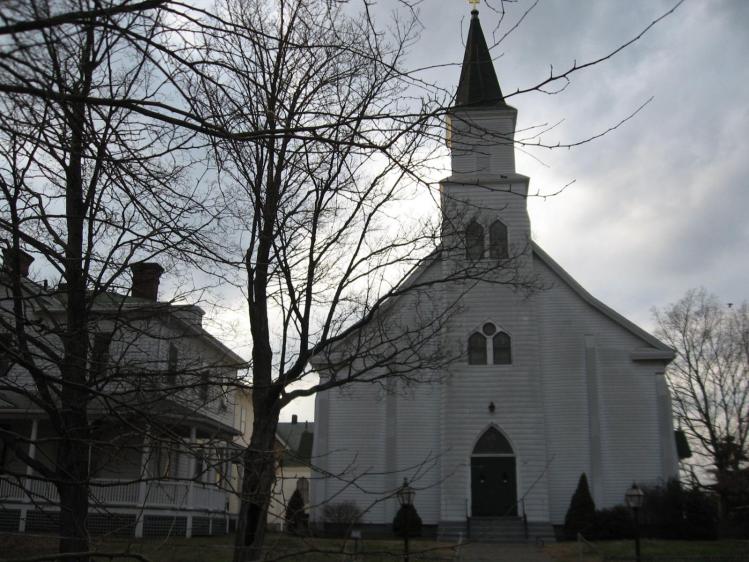
At one time, scores of people regularly came to services at Temple Hadar Israel in New Castle, Pennsylvania, which dates back to 1926 and even earlier if you count the first organized congregation in the area. After it closed for good in 2017, people still came to that building, but for occupational-therapy treatments, administered by the wife of the building’s buyer. Members of a nondenominational Christian church (Whole Truth Ministries) also came there for twice-weekly services. There are now only “fifty-two Jewish people in the community, of which there may be fifteen to twenty active congregants,” said Samuel M. Bernstine, a former president of Temple Hadar Israel. “We struggled to get a minion every week.”
If the temple could not stay open, it was not for lack of trying. Back in 1997, the Orthodox group merged with a Reform temple, “which solved for a while the problem of not enough congregants,” Bernstine said. In 2015, the leaders of the congregation sold the rabbi’s house and the temple itself in order to raise money to keep the congregation going a bit longer, renting out the space that it used to own and bringing in itinerant rabbis for services. “We tried to keep it open to accommodate of lot of the elderly congregants,” but that wasn’t a long-term solution to the real problem, which was that there weren’t enough observant Jews living there anymore. Bernstine was sixty-two years old when the temple closed and said he was “one of the youngest members.”
This is sad, perhaps, but not tragic, nor terribly surprising. “Jews don’t stay put,” said Dr. Ira M. Sheskin, a professor in the department of geography at the University of Miami and director of the university’s Jewish Demography Project. “This country is constantly moving around to where jobs and a better life are available.” When Jewish Americans move, it’s often to larger, urban areas. “Jews tend to be big-city people, because they can do better there economically.”
Still, as people relocate—or, perhaps more accurately, as the children of long-time residents move to cities where their prospects are better—certain things, such as local religious communities, may become unsustainable. The remaining congregants in New Castle would now have to drive forty minutes or more to get to the nearest synagogues, which Bernstine said they weren’t willing to do.
Many declining congregations still have the problem of what to do with their buildings, which are usually used for something besides worship after they’ve been sold. For instance, Ohavi Zedek, a synagogue in Burlington, Vermont, was turned first into a carpet warehouse and later into condominiums. Tifereth B’nai Jacob in North Minneapolis, Minnesota, was converted into an African American house of worship, the First Church of God in Christ. A Jewish Center in Commack, New York, was sold to Christian televangelists, and a synagogue in Manitowoc, Wisconsin, became a private home.
There are many reasons that houses of worship eventually become something else. St. Joseph’s Church in Salem, Massachusetts, was torn down in 2012 not because of a declining congregation—although the number of parishioners had dropped significantly—but because the Boston Archdiocese needed to sell churches in order to pay settlements to survivors of sexual abuse.* Where St. Joseph’s once stood is now a fifty-one-unit affordable-housing apartment complex, developed by the nonprofit Boston-based Planning Office for Urban Affairs, or POUA, which has been turning churches and other buildings into affordable and mixed-income housing units since 1969.
“Many people supported the church being torn down, because they thought it wasn’t beautiful. Some people have called it ugly,” said Stanley M. Smith, a former president of Historic Salem, Inc., a nonprofit historical preservation group and one of the leaders in the fight to readapt the church structure for apartments rather than tear it down. “Ugliness and beauty are not criteria for deciding if an historic building should be preserved,” he said. “It was Salem’s only example of the international style of architecture.”
“Endless Potential!” reads a J. Ray Realty notice for an unused 1,280-square-foot church in Council, North Carolina. The church was built in 1950. The listing agent, Brett Baxley, said that the property is zoned as general use and could become a private residence or a business. “Someone inquired about making it into an Airbnb.” Any conversion of the building, which has no heat or plumbing, would take a lot of work and money, which is one reason the offering price is just $85,000. Perhaps it will be a knock-down, purchased for the full acre it sits on.
A 4,400-square-foot Baptist church in Rumford, Maine, has an asking price of $150,000. This building, constructed in 1902, does have several bathrooms, a full kitchen, a “gigantic pipe organ,” and some nice stained glass, according to Coldwell Banker realtor Bryce Hamilton, who called it “a very distinctive property.” Still, turning the former church into a home or business up to code would probably cost “two or three times the price of the building itself,” Hamilton. It needs new wiring, a new heating system, “and just a lot of fixing.” Such costs have kept the church on the market at least a year. “Maybe, it could be used as an arts center or a dance studio,” Hamilton said, “except most arts centers and dance studios don’t have a lot of money to work with.”
Jess Anaya, who bought Temple Hadar Israel in New Castle, noted that “no structural changes were needed” in order to convert the building into one where his wife could practice occupational therapy, but synagogues do not always lend themselves so easily to other functions. “What do you do with a synagogue building?” Sheskin asked. “There is a limited number of things it could become. You generally have to find a school or church to buy it, and a lot of churches are closing, too.”
Temple B’nai Israel in Revere, Massachusetts, and St. Gerard’s Catholic Church and Rectory in Buffalo, New York, were both purchased by local Muslim communities and turned into mosques. The sale in Buffalo to Ammar Shaibi and two financial backers took some time to complete, as legal challenges from area Catholics prolonged the process. The purchase of the synagogue in Revere went off without a hitch. “We were delighted to sell the building to people who would use it as a house of worship,” said Debby Cherry, the last president of the temple, which now belongs to the Bosniak Society of Boston. “Bosnians have had a similar experience to the Jews, being persecuted and forced to leave their homeland and go somewhere else.”
This phenomenon isn’t unique to the United States. In 2016, a synagogue in Marseille was converted into a mosque, while another in Trnava, Slovakia, was transformed into a coffee shop in 2018. Yet others in Krakow and Warsaw have become nightclubs. Back in the United States, Protestant churches in Pittsburgh, Pennsylvania, and Youngstown, Ohio, have been turned into breweries—the one in Pittsburgh is called the Church Brew Works. Where a sign once announced times of worship there is now the company’s motto: “On the Eighth Day, Man Created Beer.” One can find old churches that have become taverns all across the country.
Churches and synagogues don’t disappear in one day. Their congregations dwindle slowly over the course of years, even decades. This means they have plenty of time to plan. In 2013, the leadership group at Temple B’nai Israel realized that the synagogue was not sustainable. More than thirty years earlier, it had gone from having a full-time rabbi to having only a part-time rabbi. Later, it went from having a rabbi to having a rabbinical student from Hebrew College in Newton. (Some other synagogues forgo the rabbi altogether and just rely on laymen leading worship services.) In August 2017, temple leaders contacted the Georgia-based Jewish Community Legacy Project, which was founded in 2010 and has worked with 335 congregations over the past fifteen years. The Legacy Project does what might be considered estate planning for synagogues, helping them dispose of assets, sell property, and use whatever money remains to maintain a such things as cemeteries. “The idea,” said Noah Levine, the founder of the Legacy Project, “is that a synagogue may close but the legacy of the building and congregation will live on.”
The Legacy Project set up a to-do list for B’nai Israel, which included placing sacred objects in other synagogues. One of the synagogue’s Torahs went to a former B’nai Israel rabbi who worked in Washington D.C., while another went to a synagogue in Kenya. Prayer books, pews, and the mantel and ark were sent to Jewish congregations that didn’t have these things. After the sale of the temple was complete, the money went to an endowment that provides funding for “Jewish organizations, women’s organizations, organizations that help children,” Cherry said. The building may be gone, but community’s legacy lives on.
*In a note to the editors, Terrence C. Donilon, Secretary for Communications & Public Affairs for the Archdiocese of Boston, insists that “settlements and associated costs related to the abuse crisis was largely funded by insurance and the sale of the Brighton campus to Boston College in 2003. The sale of churches closed during the reconfiguration process and subsequent church property sales have been reinvested back into the welcoming parishes that were incorporating the parishioners and assuming the debt of the closed parish.”
We welcome your comments about this article. Please send your response to [email protected].