As visitors step into the high-ceilinged entrance room of Divine Egypt, an expansive exhibition on view through January at the Metropolitan Museum of Art, they observe that it is slightly darkened. Huge letters announce the exhibition’s title in a mixed Papyrus-like typeface against a desert-like background, with colors ranging from a misty grey to bright orange. The mood is mystical and hazy. Side walls display large-scale illustrations of various Egyptian gods in profile. The lone sculpture in this first room represents the god Amun-Re hovering in a protective pose over the young King Tutankhamun—popularly known as King Tut.
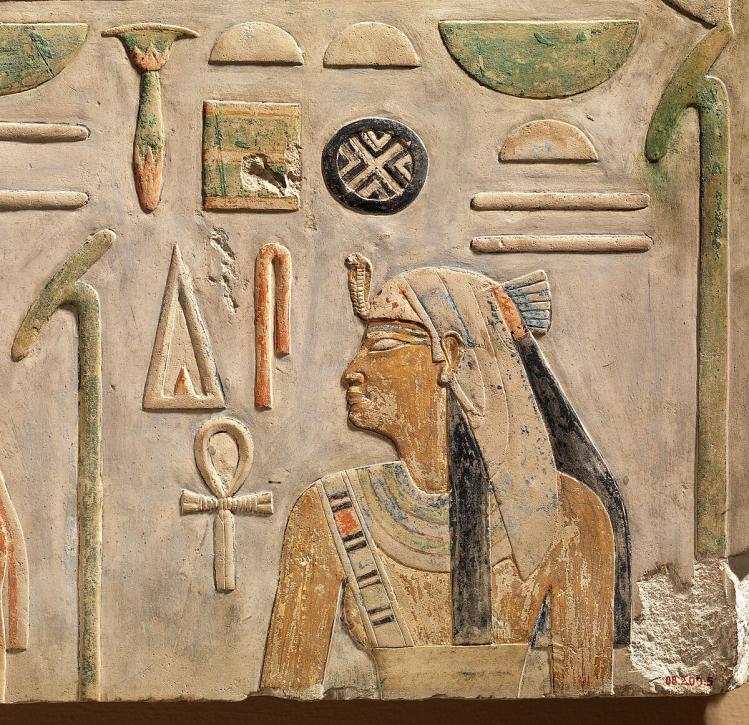
According to the wall text, Divine Egypt is devoted to ancient Egypt’s many deities, of which there were more than 1,500. These gods and goddesses were often invoked to validate Egypt’s human rulers. This is why it is common in ancient Egyptian art to see deities hovering over smaller kings and queens. In some cases, the gods and rulers appear side by side, arm in arm, somewhat poignantly. In one painted linen object, a deified king Mentuhotep II drinks from the udder of the goddess Hathor, who takes the form of a cow. Hathor had many other manifestations; she could sometimes appear as a snake or a lioness. When she appears as a woman, she can be identified by a distinctive headdress consisting of a sun orb rimmed with cow horns.
Hathor’s various representations and their ambiguity point to a general feature of the ancient Egyptian pantheon: no one really has their story straight. Deities could appear in a wide array of likenesses and there were various interpretations of their backstories and personalities. The god Seth is a good example. Maybe he was nefarious; maybe he wasn’t. It seems not to have mattered very much. No single text or tradition calcified these gods’ stories into a settled mythology.
From goddess Hathor and the god Horus, visitors move through Divine Egypt’s adjoining rooms in a large loop. Other gods appear in succession as part of a seemingly endless list of names—Maat, Neit, Thoth, Seth, Anubis, and on and on. Some of these names are laden with obvious significance: the name Meresger, belonging to a goddess often represented as a rearing cobra, means “She Loves Silence.” But many other names lack a clear signification and are therefore more difficult to remember.
Certain images give viewers a sharp glimpse into how ancient Egyptians saw their world. A huge quartz diorite sculpture of a scarab from around the 330s BCE is meant to depict Khepri, a manifestation of the sun god. According to the caption, this scarab spends his days “pushing a red sun disk across the sky in an echo of how the insects roll balls of dung for food. Egyptians connected the species with the sun god’s ability to self-create, as their larvae mature in underground dens and emerge as fully formed adults.” The smooth, stylized surface of the scarab puts one in mind of a Henry Moore sculpture. In the next room, a statue of Horus as a falcon with King Nectanebo II, from the Late Period between 360–343 BCE, has a similarly modern effect.
A huge variety of beautiful objects are showcased in the exhibition, from wall carvings and sculptures to painted linens, amulets, jewelry, and pendants. Particularly arresting are the carefully preserved miniature objects, with their intricate details. Among these are a gorgeous gold hand mirror and a lapis lazuli pendant inlaid with gold and alabaster—both featuring deities’ faces—as well as a tiny blue figurine of the god Thoth with an ibis’s head and, at the end of the exhibit, a striking gold statuette of the gods Osiris, Isis, and Horus. The craftmanship of these statuettes and likenesses is of course impressive, but, notwithstanding the gravitas of the gods they represent, what made them most endearing to me was their, well, cuteness! They reminded me of the small, lively Indigenous figurines by American and Cochiti artist Virgil Ortiz at the Portland Art Museum.
Some of these miniature objects were ornamental; others had specific ritual functions. There is, for example, a stunning miniature glass orb containing a vial at its center and topped with the gold head of Hathor, shown as a beautiful woman with her characteristic sun-disk headdress. Dated to 747–713 BCE in Nubia (now Sudan), this object apparently belonged to a queen, and the vial “may have contained a magical substance or a prayer chased in gold foil.”
The shadow of the afterlife loomed large over ancient Egyptian culture, with its mummification rituals and Great Pyramids, which were after all tombs. One deity in particular was associated with the perilous transition from this life to the next. Maat was both a goddess and “a complex, culturally specific concept that encompasses notions of rightness, truth, justice, and social and political order.” Egyptians believed that, after they died, their hearts would be weighed on scales against Maat’s ostrich feather. Only if the heart was lighter than this feather could a person advance toward the afterlife.
Longtime fans of the Metropolitan Museum of Art may already be familiar with this myth, which figures in the museum’s 1983 film Don’t Eat the Pictures, in which the cast of Sesame Street gets trapped in the museum overnight after Big Bird wanders off from the group. During this after-hours adventure, Big Bird and his friend Snuffy meet a little boy who turns out to be a young Egyptian prince named Sahu. Sahu has been stuck in the Met’s Egyptian wing for more than four thousand years, unable to cross into the afterlife. Prince Sahu’s heart is weighed against a feather—this time supplied by Big Bird himself!—and the love this tiny prince receives from his Sesame Street friends allows his heart to become light enough for the next world.
With around thirty thousand pieces, the Met possesses one of the most expansive Egyptian art collections in the world. During the first three decades of the twentieth century, the museum even conducted its own archeological excavations in Egypt. The museum’s Egyptian wing famously features the Roman-era Temple of Dendur, which was given to the Met during the 1960s after an international UNESCO conservation campaign. For regular Met-goers it feels odd to travel upstairs away from the Egyptian wing’s permanent collection to see this special exhibition.
The heavily stylized depictions of ancient Egyptians—their strikingly posed bodies seen in profile, dressed in white and adorned with jewelry—can almost make one forget that they, unlike their gods, were not mythical. They were real people, and even their religious objects remind us of their ordinary humanity, reflecting their very human preoccupation with mortality.
Christianity eventually overtook ancient Egypt and its gods receded, then disappeared. Now these deities hang from pendants at the Met gift shop, no longer objects of fear or devotion. Visitors to the exhibition may feel overwhelmed at the sheer numbers of gods on display, as I did. It is hard to keep track of who is who, of which god oversees what, especially because these are deities no one believes in anymore. Their elaborate stories have been drained of all existential urgency. The wall texts, featuring thunderous quotes attributed to the gods, don’t pack the same punch they would have for their original audience. But that audience intrigues us most now, and Divine Egypt whets our appetite to learn more about them. Who were these people who wanted to die with hearts lighter than feathers? Divine Egypt renews our curiosity about ancient human Egypt, sending us back downstairs to the Met’s Egyptian wing with a deeper appreciation and some new questions.