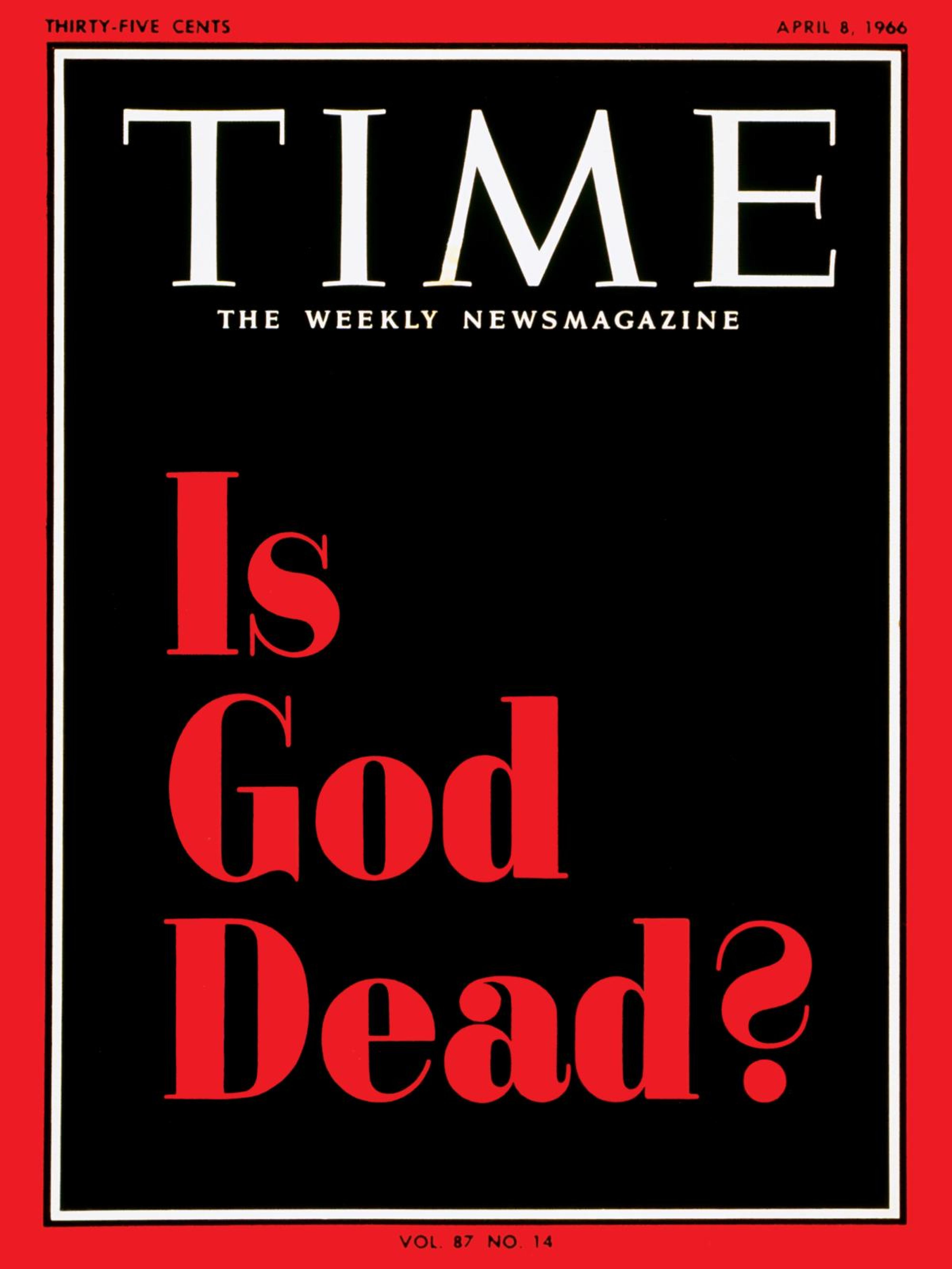
Is God dead? The stark question appeared on the cover of Time magazine on April 8, 1966, in blood-red typescript set against a background of funereal black. An obvious allusion to Friedrich Nietzsche’s famous proclamation about the death of God in The Gay Science (1882), the cover was widely perceived to be giving an affirmative answer to its own question. The furor that ensued sixty years ago was a harbinger of the culture wars to come.
Yet the article corresponding to the cover is better described as abstruse than incendiary. Titled “Toward a Hidden God” and written by John T. Elson (Time’s religion editor), the piece considered the waning of institutional religion, the relationship of faith and science, and the problem of evil. To a contemporary reader, the most shocking thing about the article is its length and level of detail. No popular magazine today would give so much attention to in-house theological debates.
But what about its substance? How do the article’s assessments of the likely trajectory of religious belief stand up in light of the past six decades? To address this question, I have asked authors who in some sense stand in the shoes of figures quoted by Elson to offer their reflections on the cover and the article itself.
The first three essays help us understand the Time cover and Elson’s article in its own context. Veteran religion journalist Kenneth L. Woodward opens the symposium by analyzing the journalistic environment in which Elson was working. Next, since Elson notably interviewed fiction writers as well as theologians, social critic Paul Elie situates the article within the broader relationship of religion and culture in the 1960s. Elson also highlights statistics revealing the state of religious belief in mid-twentieth-century America; sociologist Brandon Vaidyanathan examines the strengths and weaknesses of statistical projections, then and now.
The next three essays bring to bear critical issues, some of which only became clear with the passage of time, and some of which ought to have been apparent even then. Scott Appleby, a student and later collaborator of Martin Marty, looks at the unexpected rebirth of a sclerotic religious fundamentalism. Elson was fascinated by European theology; Michael Welker, a Protestant theologian based at Heidelberg University, invites us to turn “death of God” theology on its head. Only by accepting the death—and resurrection—of Jesus Christ can Christians proclaim a “credible faith and sustainable hope.” Finally, Susannah Heschel, expert in Jewish Studies and the daughter of Abraham Joshua Heschel, looks at missing voices and omitted context. Why were the dominant voices those of white, Christian men? What about the civil-rights movement as a religious movement?
The symposium concludes with an essay by Anthony Amado, a Georgetown undergraduate, on the challenges of faith today. Elson could not have reasonably anticipated Amado’s story. But it testifies, I think, to a living God who is full of creative and merciful surprises.