Time magazine’s dramatic cover question—“Is God Dead?”—was more interesting than the article itself, which cited a variety of mostly Christian male theologians despairing over theological discussions of the moment. Their comments contradicted the polling data presented in the article: that 97 percent of Americans said they believe in God, leaving the reader to conclude that it was the theologians who were leading Americans to disbelief.
The quotation from my father, Abraham Joshua Heschel, the only Jewish thinker cited, is striking for its irrelevance: rather than citing his extraordinary theological affirmations, the article includes him in its claim that lectures on God attract a wide audience. Indeed, I remember my father’s profound dismay over the article, his disgust that anyone would speak of God in such a disparaging way. After all, he opens his major theological books not with proofs of God’s existence but with advice about how we might cultivate our ability to sense God’s presence—with awe, wonder, and radical amazement. God is everywhere; the whole earth is filled with God’s glory, the psalmist writes—“Everywhere we let God in,” my father used to say.
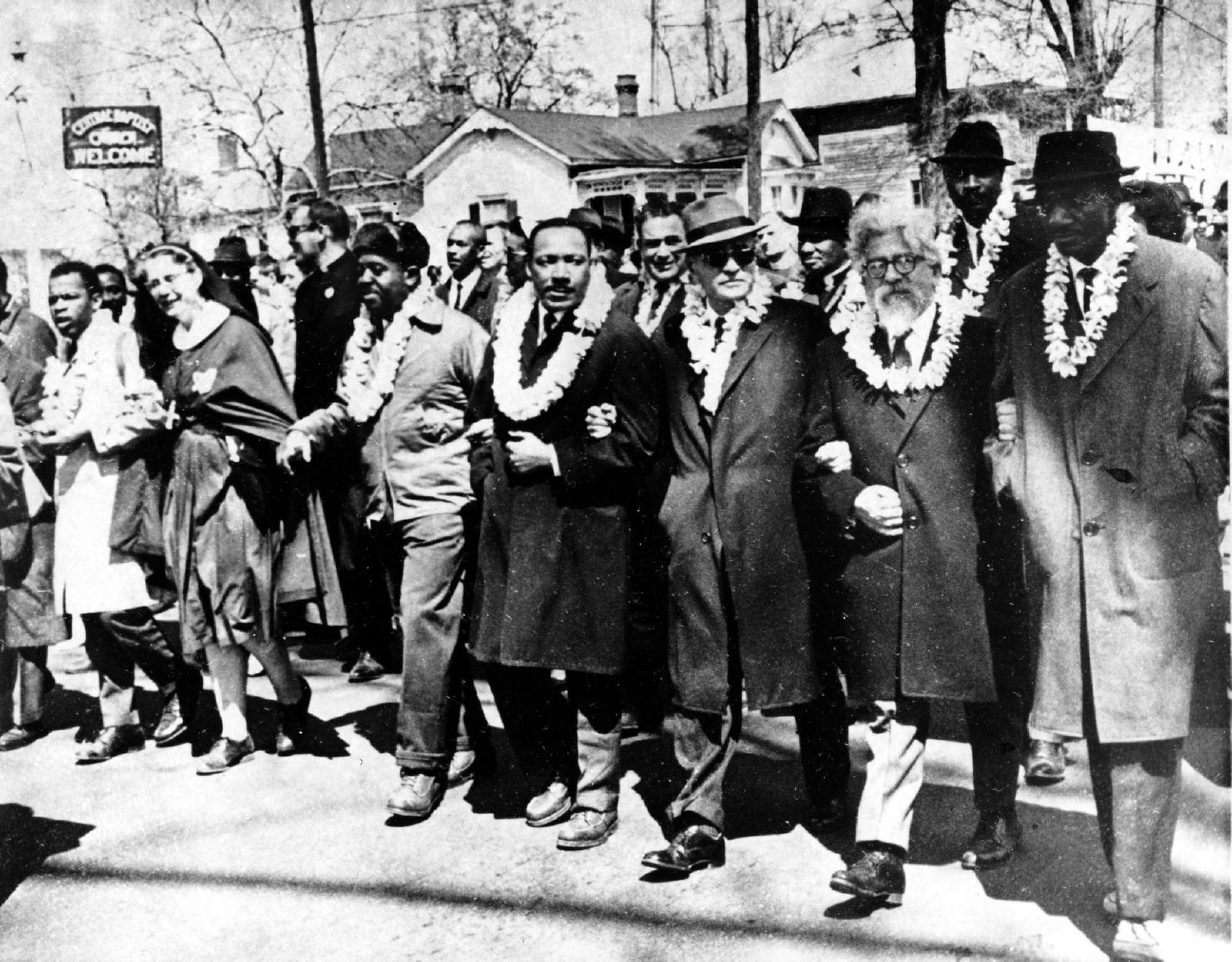
Most troubling is the moment the article appeared: 1966, in the midst of the Civil Rights movement, one of the most extraordinary religious movements of the modern era, led by pastors who brought the Bible to immediacy. Martin Luther King Jr. changed the course of history not with political or legal arguments but with the words of the prophets—it is Amos 5:24 that is inscribed on the civil-rights memorial in Montgomery.
No other country has experienced the Bible in this manner. For my father, Dr. King was a “sign that God has not forsaken the United States of America. God has sent him to us.” As a refugee from Nazi Germany, where some Protestants threw the Old Testament out of the Christian Bible because it was a Jewish book, my father was deeply moved by the Black church’s devotion to the Hebrew Bible.
In the postwar years, rabbis preached that religion strengthened families and made us good Americans during the Cold War. The popular Jewish thinker Mordecai Kaplan taught us that Judaism was a civilization that had created a “God idea” to motivate us ethically. Still, growing up in the shadow of the Holocaust, we hid our Hebrew school books behind brown paper book covers when we went to public school, as the sociologist Charles Silberman described, and when we tried to integrate into white suburbs, we kept Jewish religious observance private and hidden.
Then came Martin Luther King Jr. speaking of Moses and the prophets. Whatever despair and even shame Jews felt about the Holocaust turned into pride in our Bible and its teachings of social justice. So many young Jews and rabbis went south because the Civil Rights Movement felt like a Jewish cause, an enactment of Jewish principles. For American Jews, the 1960s was the decade when American Judaism finally blossomed. We protested on behalf of Jews forbidden by the Soviet Union to learn Hebrew and practice Judaism, we spoke with pride over Zionism as a national and cultural revival, we engaged in ecumenical efforts, especially the Second Vatican Council, and we began establishing Jewish Studies programs at universities. We became more observant, with young Jews turning from secular or Reform homes to Orthodoxy and Hasidism. Opposition to the war in Vietnam was also religious: my father, along with John Bennett, William Sloane Coffin, and Richard John Neuhaus, formed an antiwar organization, Clergy and Laymen Concerned about Vietnam, that led King to speak out against the war in 1967. Note the motto of King’s Southern Christian Leadership Conference: “To save the soul of America.” Where is the Black church in Time’s article?
None of this is mentioned. Rather, we see enormous yearning for religion among Americans yet theologians who were incapable of providing religious meaning and theological formulations. What is the purpose of theological inquiry if it cannot meet the needs of its day? How odd that in the midst of King’s soaring speeches the article claims that “Biblical terminology has ceased to be part of the world’s vocabulary and is in danger of becoming a special jargon as incomprehensible to some as the equations of physicists.”
The article offers contradictory approaches, quoting John Macquarrie that faith “is a total attitude of the self” and Karl Barth that “any search for God that starts with human experience…is a vain quest that will discover only an idol, not the true God at all.” Underlying its discussion is whether belief in God is possible after Auschwitz and Hiroshima. Can we believe in God after what we humans have done—or should we create a society without belief in God? The most articulate Jewish theologian on that question was Richard Rubenstein, a student of my father’s, whose book After Auschwitz appeared in 1966. Its centerpiece was an interview he conducted with Protestant pastor Heinrich Grüber, who was imprisoned by the Nazis in Dachau for assisting baptized Jews. Citing biblical verses about Nebuchadnezzar’s conquest of ancient Israel, Grüber told Rubenstein that the Germans were similarly the instrument of God’s punishment of the Jews, an outrageous disclaimer of German moral responsibility. Thinking of God as an agent controlling human history, Rubenstein concluded, was intolerable, and theology required a new way of thinking about God. By contrast, for my father the question was not theodicy—our belief in God in the face of evil—but anthropodicy: How can God keep faith in us after what we have done?
Despite the pessimistic tone of the article, Time concluded with a hope that theologians might adapt their formulations for the religious faith that still remained. Perhaps Time might have been more in touch with the times had it talked to Black and Jewish theologians and pastors. That’s where the heart of America was beating.
To read all the contributions to the symposium, click here.
We welcome your comments about this article. Please send your response to [email protected].