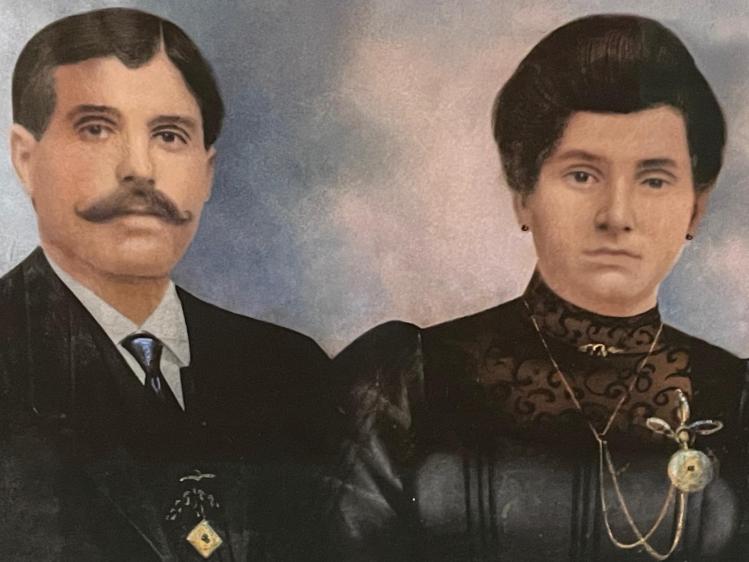
Though she has been dead for well over a hundred years, she has recently been much on my mind. Yet I know relatively little about her. I know her name: Margherita Piro, née Carbone. I’ve seen one photo of her: a stylized early-twentieth-century dual portrait with her husband, Antonio Piro. The portrait shows two young, determined individuals standing shoulder to shoulder, clear-eyed yet hopeful about the journey ahead.
Antonio is my grandfather, whom I knew as a child. So the woman in the photo is my grandmother, Margherita, who died some thirty years before my birth. Indeed, I never even learned of her till I was almost a teenager. The woman I knew as “grandma” was actually Antonio’s second wife, treated by my mother and aunts and uncles with such affection and respect that it had never dawned on me that she was their stepmother.
My mother, Girolama (Americanized as “Julia”), was the last of Margherita’s eight children. Oral tradition has it that my grandparents had already immigrated to the States with their seven children when my grandmother fell ill. The whole family then returned to the little town of Montemurro, in the impoverished Basilicata region of Southern Italy, hoping that the climate and the care of extended family would help her recover.
Margherita died when my mother was less than a year old, leaving Antonio with eight children. I was told that he brusquely reprimanded the old women of the village for praying that God would “take the child and spare the mother for the sake of the other children.” Antonio remarried not long after and the family returned to the United States, living at 105 Thompson Street in the West Village. Years later, in an Italian volume on the Basilicata region, I discovered, under the listing for “Montemurro,” that “Thompson Street in Manhattan” was known as “la strada dei Montemurresi in America.” I have often thought, with some awe, of my second grandmother, Luisa, who in her early twenties took on the care of eight children aged sixteen to one.
I think of all this again when I contemplate my three grandnieces. Their ages are one, six, and nine, and each of them is mastering age-appropriate skills. Every new achievement is a wonder to behold: learning to walk, swim, dance, play softball. Unless a copy of this little reflection finds its way into a family scrapbook or photo album (do they still exist in this digital time?), my grandnieces will probably never know of Margherita Carbone Piro. But even so, each of them is beholden to her and her husband Antonio. As, of course, am I. We are beholden to them for their courage and their suffering, for their aspirations and their faith. Not only are we beholden to them; in our very bodies we bear their imprint.
In my theological writing, I have often used the term “somatic relationality” to suggest how intimately we are bound to one another from generation to generation—so intimately, indeed bodily, that the bond is often visible. I love to watch families come forward to receive Holy Communion and glimpse, if only fleetingly, the resemblance between grandparents and parents, parents and children. History and character mirrored indelibly in their faces, their gait, their speech.
I am no romantic. Even a momentary encounter can reveal real grief amid the joys that connect one generation to another, and Margherita’s short life tragically attests that we have here “no lasting city.” Thompson Street is but a temporary promise, even if the Italian American ghetto has transmogrified into the now fashionable SoHo.
In Canto 14 of Dante’s Paradiso, the wisest of rulers, Solomon, discourses on the resurrected body. Like Aquinas and Bonaventure, Dante knows that the disembodied soul lacks its due perfection. And so Solomon, though conceding that disembodied souls shed a radiance, nonetheless declares, “When we put on again our flesh / glorified and holy, then our persons / will be more pleasing for being all complete” (XIV, 43–45, Robert Hollander translation). But Dante, following Bonaventure, goes beyond Aquinas. He boldly proclaims that the resurrected body will actually enhance the glory of the soul. Solomon continues: “This splendor that enfolds us now / will be surpassed in brightness by the flesh / that earth as yet still covers” (XIV, 55–57).
At this, the chorus of blessed souls intone a rousing “Amen!” thus “showing their ardent desire for their dead bodies”—“che ben mostrar disio d’i corpi morti” (XIV, 63). Commenting on this desire, Dante explains that it is “not for themselves alone perhaps, but for their mothers, / for their fathers, and for the others who were dear to them / before they became everlasting flames” (XIV, 64–66).
“Not for themselves alone!” Dante knows we are all entwined one with another for common weal and woe. His theological-poetic masterpiece celebrates the profoundly corporeal nature of salvation: body, community, cosmos—all implicated in the Divine Comedy of Christian faith. Love enfolds the Margarets and Anthonys, the Julias and Franks, and the myriad others in every generation, and from generation to generation, into a seamless garment of grace incarnate: the Body of Christ.