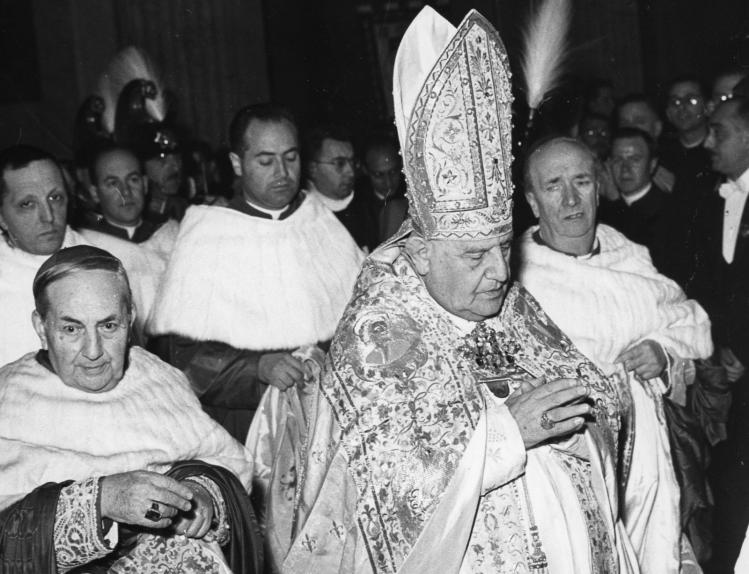
THE HISTORIC words “Habemus Papam” brought joy to the hearts of all who heard them—the hundreds of thousands of the faithful in St. Peter’s Square and the millions throughout the world who were listening on their radios. They knew by these words that the throne of St. Peter was no longer vacant, that the undying Church had entered upon a new pontificate—that of Angelo Roncalli, Pope John XXIII.
Before, during and after the election, the secular press was filled with knowing references to the supposed alternation in the papacy of “political” and “pastoral” Popes. There was much speculation about the “classification” of the Pope who would be elected and, as the conclave wore on, much seemingly knowledgeable talk about a “compromise” Pope, an aged, placid man who would wear the triple crown for a few years only.
Speculation of this nature has not been indulged in by writers in the Catholic press in this country. For one thing, in the United States calculations of this sort are considered unseemly in Catholic publications. But there is also the fact that such categorizing and prediction have little relevance to the true conditions of the papacy. This way of thinking counts the pontificate of Pope Pius XII as “political,” but such a judgment is forced to overlook the extraordinary works of Pope Pius in his “pastoral” concerns—his encouragement of the liturgical movement, permission for evening Mass, easing of the Communion fast, and many like achievements. Such a judgment overlooks also the facts of life in a twentieth century torn by world-wide ideological conflict, beset by war and social dislocation. Whatever is meant by the term “pastoral Pope,” it is clear that the Shepherd of all the faithful could not be unconcerned with the triats and sufferings imposed on his flock by the conditions of the modern world.
The notion that the successor to Pope Pius XII might be a “weak” Pope received fleeting encouragement from the simple fact of Pope John’s advanced age, but the theorizers were discountenanced immediately by his person and identity. There was nothing frail in the figure who came forward on the balcony overlooking St. Peter’s Square. There was nothing to suggest an old man in the strong and purposeful voice which intoned the blessing “Urbi et Orbi.” There was no hint of infirmity in the alacrity with which Pope John took up the burdens of his office. Within a few short hours the new Pontiff had already impressed the world with a lengthy and vigorous papal address (substantial excerpts from which appear elsewhere in these pages), an address which considered all the problems he saw before him and which was delivered to the world over the Vatican Radio.
CONSIDERATION OF the career of the newly elected Pope concludes the demolition of any of those theories mentioned above. It has been an extraordinarily varied—and successful—career, including exceptional scholarship, military service, teaching, highly responsible Church diplomacy and episcopal care as Patriarch of Venice. What more “political” than his work as Apostolic Delegate to Turkey and Greece or as Apostolic Nuncio to France? What more “pastoral” than his efforts to guide and guard the faithful of Venice, where he was known never to lock his door or to be unwilling to see anyone, at any time, because, as he said, “whoever calls on me might also be coming to confess his sins”?
Archbishop Roncalli won the respect and love of the French—no easy task—by his manner of dealing with the most delicate of diplomatic problems in the years immediately following World War II. As Patriarch of Venice he was able to win the affection of his people and, more impressively, even of the Communists and Socialists he opposed so firmly. Now, as Supreme Pontiff, the cares and burdens he has assumed will demand all the strength and skill he has shown in the past—and more.
Pope John has succeeded to the chair of Peter in a world which is the battleground in a desperate conflict between the forces of freedom and the forces of Communist tyranny. Related to this conflict, but not identical, is the struggle of the Church itself against a system which is sworn to the eradication of the Faith and which yet maintains a life and death power over nearly one-tenth of the world’s Catholics—a melancholy total of almost fifty million people.
This is only the first of the innumerable, all desperately urgent, afflictions of our times. There is the constant threat of nuclear holocaust and with it the destruction of our entire civilization; the open war against religion; the pressures of a growing, worldwide materialism; an exploding world population; poverty and want; the seething issues of racism and nationalism, especially among the peoples of the world who are emerging angrily from a colonial bondage.
The enormity of the responsibilities faced by the Holy Father, and the anguish they must bring to the heart of any man who takes them up, were movingly revealed in the final testament of Pope Pius XII. Looking back at the years of his pontificate, Pope Pius in this document asked God for mercy, saying, “Miserere mei Deus, secundum (magnam) misericordiam Tuam.” He went on: “These words, which I, knowing myself to be not worthy of them or equal to them, pronounced when I accepted with trepidation my election to the supreme pontificate, I now repeat with much greater foundation at this time when the realization of the deficiencies, short- comings and faults of so long a pontificate in an epoch so grave, brings my insufficiencies and un-worthiness more clearly to mind. I humbly ask forgiveness of those whom I may have offended, harmed or scandalized by my words and my actions.”
It is understandable that when Cardinal Roncalli said goodbye to the people of Venice on the eve of his trip to Rome and the conclave, he said, “The best thing you can wish for me is that I will return in a fortnight.”
Nevertheless, in the face of all these human fears, we trust in the promises of Christ to His Church. Conscious of the perils and trials in store for the Church and for the Holy Father, our emotion at this time is nonetheless joy. The joy of the Church was symbolized by the words pronounced by Cardinal Canali, and in the voice, breaking with emotion, in which he said them: “Habemus Papam.” With all of Christendom, we rejoice.