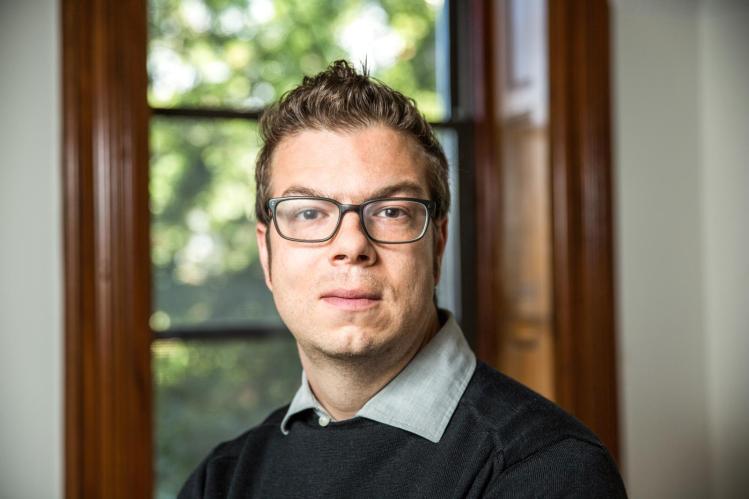
Is there a living writer more interested in flickering than Ben Lerner? It’s not just that his books flicker between fiction and nonfiction. (To take one example: in his novel 10:04, the Lerner-like narrator gets an advance for a book based on a short story published in The New Yorker. The story, which is included in 10:04, happens to be a story that already had been published in The New Yorker under Lerner’s own name.) And it’s not just that his writing flickers between poetry and prose. (Lerner’s five collections of poems are often quite prosey, while his four novels feature discussions of Whitman and Ashbery). And it’s not just that his language flickers between high theory and low comedy. (A typical Lerner character will allude to Walter Benjamin on one page and then humiliate himself at a sperm bank on the next.)
Rather, what most distinguishes Lerner is that he constantly names, and self-consciously examines, these kinds of literary flickering and the effects they aim to achieve. He does this in interviews, where he has said that “the edge of fiction flickers” and that a character’s “presence will flicker in and out of the story.” But he also does it in his novels and poems. In 10:04, the narrator imagines a book, very much like the one we’re reading, that “is neither fiction nor nonfiction, but a flickering between them.” At another point, a gas lamp in Brooklyn Heights seems to be “burning at once in the present and in various pasts, in 2012 but also in 1912 or 1883, as if it were one flame flickering simultaneously in each of those times, connecting them.” At still another point, the narrator declares to his friend Alex, to whom he has donated sperm so that she might have a child, that she’s “asking [him] to be a flickering presence” in her future child’s life. In his 2019 novel, The Topeka School, we encounter another “flickering presence” and another “flickering between” time periods (a character “was all ages at once”), as well as “flickering hieroglyphics” and subway lights “flickering in the shaking, almost-empty car.” In a poem from his 2024 collection The Lights, the speaker declares, “If you see the i as a candle, if i’s are dotted with flame and flicker, then a song has entered circulation.” In another poem from the same book, Lerner describes the “flicker effect in which objects must move in order to persist.”
In all of his writing, Lerner is after this “flicker effect”: the paradoxical achievement of persistence through indeterminacy; a quantum superposition of styles and selves in which multiple states exist simultaneously; the suggestion, which sometimes reads as utopian or even messianic, that our political and temporal lives might be radically different if we could notice the possible worlds that constantly surround us. When a TV flickers, we assume this is a failure of the technology: it’s allowing for interference that it should be screening out. When a poem or novel flickers, Lerner suggests, we should assume that it’s working at its best, giving us access to frequencies we ordinarily ignore. As a character in Lerner’s latest novel, Transcription (Farrar, Straus and Giroux, $25, 144 pp.), puts it, “There is a listening beyond the cochlear, yes? And all of this is true of time, too, not only sound. Vibrations from the past or future may also be received, perhaps also through the teeth.” Or through art.
Transcription is very short—less a novel than a novella in three parts. In the first section, “Hotel Providence,” the unnamed narrator, a poet, has traveled from New York City, where he lives with his wife and daughter, to Providence, where he went to college. He’s there to interview his mentor, Thomas, for a magazine article. (A German writer, translator, and artist, Thomas is a compound ghost of several figures, including Rosemarie Waldrop and Alexander Kluge, both of whom Lerner interviewed for The Paris Review.) Thomas is brilliant and voluble, his talk characterized by “sudden changes of scale, rapid juxtapositions of images and registers.” Ninety years old, he jokes that this is to be his “exit interview.”
“My main concern,” the narrator tells us, “was that I somehow would fail to record us on my phone, or that I’d manage to delete the voice memos when I tried to send them to the magazine.” After brushing his teeth at the hotel before heading over to Thomas’s house, the narrator drops his phone into the sink. His nightmare has been realized: his phone is dead and he has no way to record the conversation. To admit the accident and his unpreparedness to Thomas would be too humiliating—Lerner’s protagonists are nothing if not exquisitely sensitive to all manner of embarrassment—so he comes up with a plan. Tomorrow morning, he’ll buy a new phone. Tonight, he’ll obfuscate:
Here’s what you will do, I instructed myself in a voice that seemed to originate from outside my head, from the chair a few feet to my right. You will go to Thomas’s and say: I was thinking this evening we could just catch up, talk off the record about how we’d like to approach the interview, and then tomorrow I’ll come over late and we can record when we’re prepared and fresh.
And off he goes.
Lerner finds some comedy in his narrator’s trip through the streets of Providence sans phone. After coming up with his plan, he immediately takes out his dead phone to get an Uber. Minutes later, his hand reaches for the phone again: “I would typically start walking directions on the map—even though I knew the way.” But Lerner also treats this phoneless interregnum with great seriousness. “I was experiencing a withdrawal indistinguishable from mild intoxication,” the narrator writes, “the landscape made strange, the stones stonier, by my being suddenly offline.” Here, Lerner channels Viktor Shlovksy, the Russian formalist critic who claimed in “Art as Device” that language defamiliarizes reality, breaking through the encrustations of habitual perception and allowing us to see the world as if for the first time. Now, it’s when our technological devices break down, when their ceaseless mediations finally cease, that we have “an unusual experience of presence.”
As the narrator continues his journey, time folds in on itself, both “because this was a landscape so dense with formative memories and events, and because only in the past would I have been deviceless.” He sees flickers of the past in the people he walks by. A hooded kid is also the narrator’s college friend, Arjun, an amateur actor who would go on to commit suicide. An older woman on the street is, at the same time, his former professor who “kept a cyanide capsule in [an] opal locket for use in case of nuclear war.” As in so much of Lerner’s writing, the tone of this ten-page section is almost impossible to parse, as is its effectiveness. Is it an intelligent exploration of mediation and technology, metabolizing literary and cultural theory into astonishingly clear sentences? Yes. Is it a bit obvious, even clichéd? (Want to see the world anew? Ditch your phone!) Also yes.
The narrator arrives at Thomas’s house. The elderly man is forgetful, his house distressingly unkempt, but the conversation dances along. The two discuss an experimental play that the narrator saw in a black-box theater when he was in college. (In the performance, Arjun repeatedly spilled water on a series of projected transparencies. Was this a mistake or part of the play? Thomas’s very Lernery response: “Or part of the play and a mistake. This is the third option that becomes possible in art.”) Thomas intellectually vamps: “No one ever leaves a theater. A black box theater. Like the black box of an airplane. That is recovered. Like Schrödinger. The superposition of theaters.” The two begin talking about Thomas’s earliest memory of listening to the radio in Augsburg in the 1930s, “Hitler’s voice rising and rising in pitch.” “The air is full of voices,” he says, then and now. It’s all a matter of the devices we use to pick these signals up and transcribe them into new, meaningful forms. In the 1930s, it was the radio. In 2026, it’s our phones.
But then Thomas suggests that they start recording: “Otherwise we repeat ourselves and it grows unnatural. We will sound like bad actors. Even the transcript will show that we have rehearsed.”
I swallowed more wine. “Ok,” I heard myself say.
“You are already recording?” Again I met his eyes. I felt the room had grown darker. Did he think, in his confusion, that I had already set up a device? Or did he somehow know, with his famous powers of observation, that I’d arrived without the necessary tools? Or did he mean something figurative by “recording”?
“Yes,” I said, removing the phone from my pocket and placing it facedown on my side of the lamp. “We are recording.”
Thomas smiled. “A little black box.”
The interview, which isn’t really being recorded (the phone is broken) but is of course being recorded in another sense (we’re reading it), proceeds. The whole episode feels like an anxiety dream or a Kafka parable set in the age of iPhones. The narrator fears he will break his phone and so he breaks it; he hears himself saying and doing things that he can’t quite explain. Thomas begins to address the narrator as if he were his son Max, with whom he has a difficult relationship and with whom the narrator was friends in college, recounting a trip they took to the Hotel Arbez in La Cure. The narrator is confused; Thomas gets agitated.
After the interview ends, the narrator calls his wife, Mia, from Thomas’s landline, hoping to speak to Eva, his daughter. The wobbling of identities and temporalities amplifies in a lovely and moving passage:
“Hello,” a voice said, both alien and familiar. It was Eva—no, it was Mia, her voice rendered tinny, made into soft metal by the landline. I hesitated. “Hello,” the voice repeated; it was Eva’s.
But the voice was also mine—my voice at the age of six, when it resembled hers in pitch, saying hello to my father when he’d call home from D.C. and, for a second, I wasn’t only in Providence but also in the kitchen on Douglas Street, wrapping the white plastic cord around my arm, staring out the window at the black walnut tree, watching its leaves move in the wind.
“Hello,” I said to her, my father said to me, speaking to the boy I was, the comforter pulled back where he’d checked for russet traces of blood, the hotel phone held between ear and shoulder so he could ash his cigarette, muted coverage of the Paris bombings on the TV. I was experiencing the superposition of voices, creating a halo effect around the hand I now pressed, to steady myself, against the wall in Thomas’s kitchen. “How are you, love?”
“Fine. But you said we would FaceTime,” Eva said, but FaceTime hadn’t been invented yet. My daughter and I had only ever communicated, when I was away, by screen.
The section ends with the narrator expressing his belief that, somehow, Thomas has been the maestro of this whole episode, that he “was conducting this electronic opera, orchestrating these interferences, crossing wires, worlds. Impossibly thin glass filaments underground, underwater, in the lungs, in the cochlea, vibrating when the small waves hit them—You call this fiction, but it is more.”
It’s a remarkable ending made all the more remarkable by the novel’s second section, “[Hotel Villa Real].” In it, we learn that the narrator never got to record his interview with Thomas (the elderly man died first), that he ended up publishing their first night’s conversation as if it had been recorded, that the narrator admitted as much in a lecture given in honor of Thomas in Madrid (the suggestion is that the lecture resembles, or is identical to, the novel’s first section), and that this admission (he refuses to call it a confession) angered Max, Thomas’s son.
After that brief ten-page hinge, we move to the novel’s final and longest section, “Hotel Arbez.” There’s no more narration. Instead, we get what appears to be the unedited transcript of a conversation between the narrator and Max. Max is the dominant partner, speaking in long paragraphs about his young daughter’s eating disorder, his father almost dying but ultimately recovering from Covid. (When the doctors thought Thomas’s death was imminent, Max spoke to him on the phone about their strained relationship. Once out of the hospital, Thomas said he didn’t remember the call.) Finally, Max describes a late conversation with Thomas that he secretly recorded, “not because I wanted to preserve his voice for Emmie,” his daughter, “but because I wanted to preserve my connection to reality.” In it, Thomas couldn’t remember, or denied remembering, the trip he took with his son to the Hotel Arbez—the same trip he discussed with the narrator while addressing him as if he were Max. (The Hotel Arbez is “famous because different parts of the hotel are on different sides of the border” between France and Switzerland—yet another example of superposition.)
The links between the novel’s first and final sections are complex and occasionally mystifying. In the first, the narrator claims to be recording a conversation with Thomas, his artistic father, when he’s not and then publishes the conversation as if it had been recorded. In the final section, we learn that Max recorded a conversation with Thomas, his biological father, without telling him. In the first section, the narrator believes, or fears, that Thomas somehow knows he’s not being recorded; in the last, Max believes, or fears, that Thomas somehow knows he is being recorded “and so…was getting his revenge by erasing” him from his memories of the Hotel Arbez. In the first section, Thomas describes his conversation with the narrator as his “exit interview”; in the last, Max uses the same phrase to characterize his hospital-bed call with his father. In “Hotel Providence,” the narrator talks about his daughter Eva’s anxiety and her refusal to go to school; in “Hotel Arbez,” Max talks about his daughter Emmie’s anxiety and her refusal to eat. At one point, Max describes leaving Emmie and his wife, Adelle, to visit his father in Providence. Thomas has recovered from Covid but the pandemic is still at its height. In the emptied-out streets, time acts weirdly, as it did on the narrator’s visit to Providence: “I felt, as I walked, like I was traveling back in time. Adelle and Emmie became a little unreal to me; they belonged to a future world. I was an undergraduate again, an aspiring writer, not a lawyer; I didn’t even check my phone; it hadn’t been invented yet.” “Everything was wobbling for me,” Max says, “like when you press down on an icon on your iPhone screen and all the icons begin to wobble, and you can move them around or delete them; I realize it’s a stupid analogy.” It’s a typical move for Lerner: offering an analogy to think with then immediately apologizing for its stupidity.
Early in the novel, the narrator remembers visiting a glass-flower exhibit at Harvard’s Natural History Museum. (In the last section, Max describes Thomas misattributing this memory to him.) “I kept seeing the flowers as organic one instant and as artificial the next,” the narrator writes, “a kind of duck-rabbit effect, not between things the object might represent, but between nature and culture, the given and the constructed. And I carried this new way of looking, or this new hinge in my looking, outside the museum.” Transcription leaves you caught on the hinge. You register that the first and third sections vibrate across each other. You catch a flicker of what those vibrations might mean. But then, just like that, meaning evanesces, disappearing back into the ether.
To read Transcription is to feel wobbles and flickers all around you. This is a novel. No, it’s a lecture in a novel. No, it’s both. Thomas is a senile old man. No, he’s Prospero, orchestrating everything from behind a scrim of senility. No, he’s both. Lerner suggests that the smartphone flattens time and empties external and internal space. No, he suggests that the smartphone is just the latest device—earlier, it was radio; earlier still, it was language—to register the voices and temporalities that hover around us all the time. No, he suggests both. Transcription is Lerner’s best book, moving and mysterious and strange. Transcription is Lerner’s most insubstantial, least satisfyingly resolved novel. Actually, it’s both.
We welcome your comments about this article. Please send your response to [email protected].