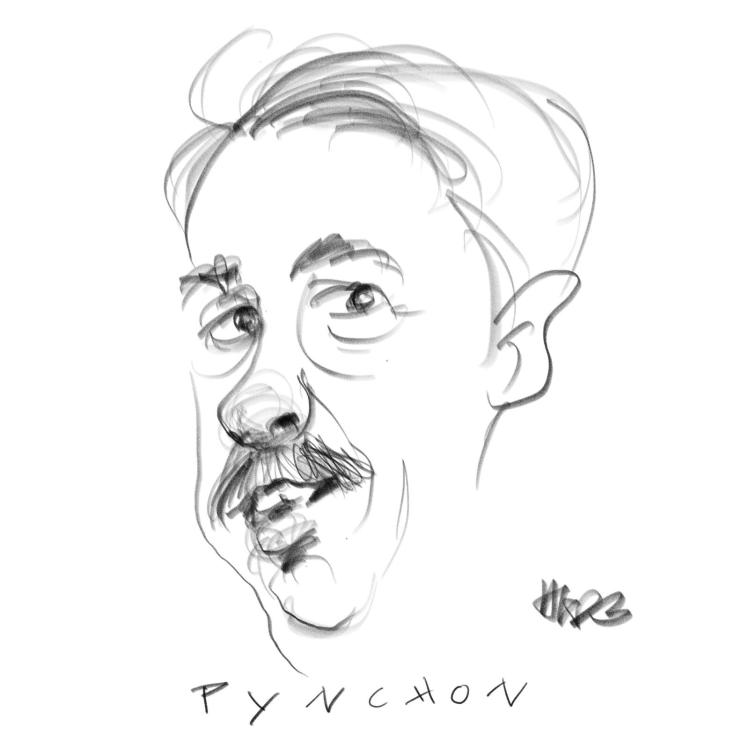
Thomas Pynchon’s fiction is filled with the undead. In Bleeding Edge (2013), there are “ghost vendors” and “ghost payments,” “ghost bears” and “ghost stops on abandoned subway lines.” After September 11 happens midway through the novel, those who died in the Twin Towers linger on as spectral presences in the “deep Web”—the more secretive reaches of the internet that remain, for the moment, untapped by Silicon Valley. (“It’s still unmessed-with country,” a character remarks. “You like to think it goes on forever, but the colonizers are coming.” Yes, they were.) Doc Sportello, the pot-smoking private-eye protagonist of Inherent Vice (2009), “feels his life surrounded by dead people who do and don’t come back, or who never went, and meantime everybody else understands which is which, but there is something so clear and simple that Doc is failing to see, will always manage not to grasp.”
Telling the living from the dead isn’t so easy in Pynchon’s universe, and not just for Doc. In Vineland (1990), we meet the Thanatoids, a California community of those who have died but can’t quite pass into death due to “karmic imbalances.” These “transient souls” hang out, “not living but persisting,” in the appropriately named Shade Creek. Neighbors to the Thanatoids are the Yurok tribe, who dwell alongside “a river of ghosts” and within a countryside filled with woge: spirit-like creatures who “had been living here when the first humans came.” With the arrival of humanity, some woge went “over the mountains.” Some sailed out to sea, “singing unison chants of dispossession and exile.” Others “withdrew instead into the features of the landscape, remaining conscious, remembering better times.” All the way back in 1965’s The Crying of Lot 49, Oedipa Maas discovers—or imagines she discovers—a conspiracy involving a dead man’s will, a secret mail-delivery service, and several centuries of European and American history. “What would come to haunt her most,” Pynchon writes, was “the way it all fitted, logically, together.”
When reading Pynchon, one senses “that saturating the space, invisible as the wavelengths that carry soap operas into the home, dramas of faceted intricacy are teeming all around.” Pynchon’s characters are haunted by plots that are beyond their ken, by the nightmares of a country founded on displacement, by the cruelty of an economy filled with dummy corporations and financial hocus-pocus. Occasionally, this haunting turns utopian, offering the glimmer of an alternative timeline that might, in a kairotic moment, break into and transfigure our own. Early in Inherent Vice, after receiving a plea for help from an ex-lover, Doc returns to his stoner pad:
Back at his place, Doc stood for a while gazing at a velvet painting from one of the Mexican families who set up their weekend pitches along the boulevards through the green flatland where people still rode horses, between Gordita and the freeway. Out of the vans and into the calm early mornings would come sofa-width Crucifixions and Last Suppers, outlaw bikers on elaborately detailed Harleys, superhero badasses in Special Forces gear packing M16s and so forth. This picture of Doc’s showed a Southern California beach that never was—palms, bikini babes, surfboards, the works. He thought of it as a window to look out of when he couldn’t deal with looking out of the traditional glass-type one in the other room. Sometimes in the shadows the view would light up, usually when he was smoking weed, as if the contrast knob of Creation had been messed with just enough to give everything an underglow, a luminous edge, and promise that the night was about to turn epic somehow.
It’s a California that never was but perhaps might be, if only the contrast knob of Creation would stay messed-with for long enough, if only enough people would tune into the right frequency. Far more often in Pynchon, though, haunting feels like hunting. A character in Vineland thinks that something “was on her case forever, the zombie at her back, the enemy no one wanted to see, a mouth wide and dark as the grave.” Larger, unknown forces hold all the cards, dealing out our fates without remorse and in secret, there and not there at the same time.
Of course, the famously private Pynchon has been a kind of ghost, both there and not there, since the publication of his debut novel, V., in 1963. There have been no book tours or photographs or interviews, though he did give voice to a version of himself on a 2004 episode of The Simpsons. (The cartoon Pynchon wore a paper bag over his head.) Every so often, a new Pynchon novel will appear. There will be goofy character names: a lawyer named Sauncho Smilax; a stamp collector named Genghis Cohen; a lieutenant named Tyrone Slothrop. There will be impossible-to-summarize plots with side quests begetting side quests. (I love Inherent Vice. I just read it for the third time a few weeks ago. I couldn’t tell you with any precision what the hell happens in it.) And there will be a character who believes that everything fits together, that, if only they could pierce one last veil, all of existence would be brought “into pulsing stelliferous Meaning.”
On May 7, Pynchon turned eighty-eight. On October 7, Penguin Press published Shadow Ticket, his ninth and, one assumes, final novel. The book opens in Milwaukee in 1932: a beery city in the time of Prohibition. On page two, a bomb blows up the truck of a bootlegger named Stuffy Keegan. He survives and decides to make himself scarce. “Times Stuffy thought he wasn’t here anymore,” a character says, “that they really did get him when they blew up the truck. Kept saying things like ‘Maybe I’m a ghost now and I’m haunting you.’” Stuffy escapes from the Midwest and from whatever forces may wish him harm in “an unsurrendered Austro-Hungarian submarine” from World War I that lurks under Lake Michigan and ferries about “tobacco, dope, guns, hooch, live passengers with their papers not always in order who need to be here or there in a hurry and don’t mind being stashed with the cargo.” A comically named revenant fleeing unknown powers aboard a ghostly bit of military tech: this is Pynchon, almost in his tenth decade, continuing to play the hits.
Stuffy isn’t really a major character in Shadow Ticket, though that submarine will come back, importantly and beautifully, at the novel’s conclusion. And the bombing of his truck will never really be explained, though it will link up with—or appear to link up with—a missing cheese heiress, a Soviet “secret lab specializing in the paranormal,” fascistic vampires (dubbed “Vladboys”) marauding through Central Europe, and Americans who have started playing footsie with Nazism. How all this fits together remains somewhat mysterious. Like all Pynchon novels, Shadow Ticket possesses “an encryption that somehow cannot, must not, be broken.” It offers, tantalizingly but incompletely, “only glimpses behind a cloak of dark intention at something on a scale far beyond trivialities of known politics or history, which one fears if ever correctly deciphered will yield a secret so grave, so countersacramental, that more than one government will go to any lengths to obtain and with luck to suppress it.” World governments can relax. I haven’t cracked the code, either.
Shadow Ticket’s main character is Hicks McTaggart. After high school, Hicks got into the then-booming field of strikebreaking: “At the time in Wisconsin not a week went by there wasn’t a strike at least being voted on someplace, plenty of opportunity to kick asses on behalf of management.” At one point, he went to clock an agitator with a “lead-filled beavertail sap, MPD issue though technically not legal”; the instrument magically vanished from his hand and reappeared in his pocket, saving the striker’s life and Hicks’s soul. (This vanishing and reappearing tends to happen in Shadow Ticket, and it even has a name: “asporting” and “aporting.”) After this near-murder experience, Hicks decided to switch careers, becoming, like Doc from Inherent Vice and Maxine Tarnow from Bleeding Edge, a private investigator. It’s the perfect job for someone with a Pynchonian sensibility, who sees every detail as the clue to a plot and every plot as the clue to an even bigger plot. An older private dick warns Hicks against such a mindset. It’s a good life, he tells him, “just so long as you ain’t another one of these metaphysical detectives, out looking for Revelation. Get to reading too much crime fiction in the magazines, start thinking it’s all bout who done it. What really happened. Hidden history. Oh, yeah. Seeing all the cards at the end of a hand. For some, that kinda thing gets religious mighty quick.” (The advice-dispenser is Lew Basnight, a figure from the Extended Pynchon Universe who appeared previously in Against the Day.)
Lucky for him, Hicks doesn’t have much in the way of a metaphysical bent. He’s a big guy who loves to eat and dance, a simple man in a decidedly complex world. (Despite his background, his politics were never really reactionary; he just liked roughing people up.) At the novel’s beginning, he starts looking into Stuffy’s truck-bombing, though his bosses soon give him a new assignment or “ticket”: find Daphne Airmont, the missing daughter of the “the Al Capone of Cheez.” (If you’re looking for cheese puns and elaborately imagined cheese-political history—an international cheese syndicate! Wildcat cheese strikes!—this is the novel for you. Maybe the funniest sentence in the book: “The year 1930 happened to be the 1776 of the cheese business.”) The search for Daphne, and Hicks’s relationship with a mobster’s fiancée, lead his bosses to send him to Europe, where his path crosses with fascists and Communists, crooked police officers and double-double agents. Each ticket suggests but never quite makes palpable a shadow ticket: the real assignment that drives and determines all the others.
Even by Pynchon’s hyperkinetic standards, things speed up in the novel’s second half. Chapters get shorter and characters proliferate, with Hicks’s quest, such as it is, disappearing for long stretches. We get a microhistory of golem law (“At present, according to a secret rider to the Treaty of Saint-Germain, written in invisible ink, no one in the newly patched-together Czecho-Slovak entity has been allowed to build any golem above a certain size”) and learn about the thriving black market for “tasteless lamps.” One typical sentence reads, “After some mysterious shortwave conversation with Heino Zäpfchen, Zdeněk the golem has located Hop Wingdale en route to a Croatian guerilla training camp near the Hungarian border.” Another: “Glow Tripworth del Vasto is here on assignment for Hep Debutante magazine, sending in a series of articles on how to be a Jazz Age adventuress on a Depression budget.” In a standard Pynchon novel, Hicks would worry over how to relate Hep Debutante to Zdeněk the golem, feverishly trying to figure, like Oedipa from The Crying of Lot 49, how “it all fitted, logically, together.” But Hicks isn’t a religious seeker. He just wants to listen to some good music, Lindy Hop the night away, and end up in bed with a nice woman. (Pynchon loves hard-bitten argot, and so women are “tomatoes” and one guy “sez” something to another.) “Who’s workin for who again here exactly and so forth?” Hicks asks at one point, and the half-assed “so forth” is the point. He’s not looking for meaning or significance and neither, one gets the sense, is Shadow Ticket. The desire to reconcile has given way to the desire to proliferate: more invented histories, more plots, more locations, more more more. There’s an optimism to the novel’s form, a bubbly effervescence that resembles the froth on a cold pint of Milwaukee lager, even while the novel’s content—thugs gaining political power and starting to do thuggish things with it—is pessimistic. “People are keeping company here who, if history had a shred of decency, would never be allowed within miles of each other,” Pynchon writes.
In a famous essay on “late style,” Theodor Adorno described how Beethoven’s final string quartets and sonatas left harmony and synthesis behind for something spikier:
The power of subjectivity in the late works of art is the irascible gesture with which it takes leave of the works themselves. It breaks their bonds, not in order to express itself, but in order, expressionless, to cast off the appearance of art. Of the works themselves it leaves only fragments behind, and communicates itself, like a cipher, only through the blank spaces from which it has disengaged itself. Touched by death, the hand of the master sets free the masses of material that he used to form; its tears and fissures, witnesses to the finite powerlessness of the I confronted with the Being, are its final work.
It’s tempting to read Shadow Ticket as precisely such an expression of late style, a work composed in the shadow of death in which tears and fissures, fragments and disunity, are the irascible gestures with which Pynchon takes leave of his work and his work takes leave of us. Of course, Pynchon has always been interested in ciphers. In every novel his clues have been surrounded by blank spaces that his characters try to fill in and fragments that his readers seek to make cohere. In Shadow Ticket, though, the blank spaces remain just that. Hicks doesn’t need or even want to figure out what it all means. He just wants to stop being pushed around. As he says, “Don’t…much go for folk bein all in my hair’s the thing.” If the dream of meaning haunts Shadow Ticket, it’s a ghost that inhabits Pynchon’s readers, not his novel.
In Shadow Ticket, the presence that is most haunting, if also decidedly comic (this is Pynchon, after all), might be the Vladboys—those motorcycle-riding fascistic vampires wreaking chaos in Hungary. In 1932, they’re an “outward and visible sign” of an inward and invisible rot in the political soul. (Pynchon, whose mother was Catholic, uses the language of sacraments on several occasions in the novel.) In 2025, they’re the political undead, something we wrongly thought we’d buried a long time ago. I suspect that some critics will want to read Shadow Ticket as a commentary on the Age of Trump, but I don’t think that’s right. Pynchon knows that there has never been a time when Americans haven’t been attracted to political ugliness, when they haven’t been seduced by undisguised brute force. In Bleeding Edge, Maxine sleeps with Nicholas Windhust, a right-wing political butcher. In Vineland, Frenesi Gates becomes romantically entangled with Brock Vond, a torture-loving psychopath who is also a federal prosecutor. Beneath all the comic antics, there’s a political death drive in Pynchon’s fiction, the suggestion that we don’t just tolerate but desire brutality.
And yet somehow the final note in Shadow Ticket—and maybe the final note in Pynchon’s career—is a sweet, if melancholy, one. When the mysterious submarine reappears, it’s transporting not illicit goods but a group of exiles who are heading to lands unknown:
All night long, between watches, sleepless, not always sure what they’re dreaming and what they’ve drifted out of dreaming back into however briefly…faces turning from time to time to gaze back down their wake, turning together and drifting upward as if for signs of intention from above, if not quite yet in terror or wonder, at least put on notice—their sight lines briefly converging at the same place in the sky where clouds invisible till dawn are towering toward an altitude still to be reached, a shape as yet untaken, unimagined.
Whatever counter-domain of exile this is they have wandered into, they will be headed not back into any sunrise but west, toward a frontier as yet only suspected, as the days sweep over them—
The novel concludes with a letter sent to Hicks from a young hood who is also making his way out west: “Meantime there’s the Santa Fe Chief whistling all aboard, so I’ll stop here and pick up again when Zin and me get to California. Hope you’ll come out sometime and see us. Right now, we’ve got a couple of sunsets to chase.” The novel ends, as so many Pynchon novels do, with his characters waiting, hoping, gazing at the heavens. Now, though, what they’re seeking is the day’s end.
Shadow Ticket
Thomas Pynchon
Penguin Press
$30 | 304 pp.