As more than two hundred attendees at a People’s Mass for Justice and Peace marched toward the Great Lakes Naval Base outside Chicago—reportedly a hub for National Guard and ICE agents sent by the Trump administration—one verse of the popular protest hymn “We Shall Overcome” had particular resonance.
“We are not afraid,” sang the clergy, parishioners, activists, and family and friends of immigrants. The September 13 bilingual Mass and procession, organized by the Coalition of Spiritual and Public Leadership (CSPL), was billed as a way to pray for peace and justice and demonstrate against the militarization and deportations in Chicago.
“We are here to represent those who did not come to Mass today because they are in fear,” Scalabrini Fr. Leandro Fossá said in his homily, referencing the recent U.S. Supreme Court decision that allows federal agents to use racial profiling in immigration raids and sweeps. “This is not America, and this is not the Gospel, because the Gospel, we heard, speaks of a God who stands with the oppressed.”
Emcee Fr. David Inczauskis, SJ, a doctoral student at Loyola University Chicago, told the crowd that God would be “our rock and fortress as we confront the chaos and oppression of the current regime.”
Since the administration’s mass deportations began in January, many immigrants have been fearful about leaving their homes. In July, Bishop Alberto Rojas of San Bernardino, California, offered a dispensation from the obligation of weekly Mass for Catholics afraid of being caught in immigration raids. The Diocese of Nashville had issued a similar decree in May. Churches in Washington D.C. reported a drop in attendance after Trump deployed National Guard troops there.
Organizers of the People’s Mass—and some participants—admitted they, too, were nervous. Trump has threatened to send National Guard troops to the city and ramped up immigration raids in the frighteningly named “Operation Midway Blitz,” which already resulted in ICE agents fatally shooting an immigrant father in a Chicago suburb. The killing of conservative activist Charlie Kirk just three days earlier and the subsequent threats of retaliation against those on the left only added to the apprehension. Protesters outside an ICE facility in suburban Broadview a week later clashed with ICE agents, who used mace, tear gas, and rubber bullets and tackled demonstrators to the ground. Several protesters were arrested.
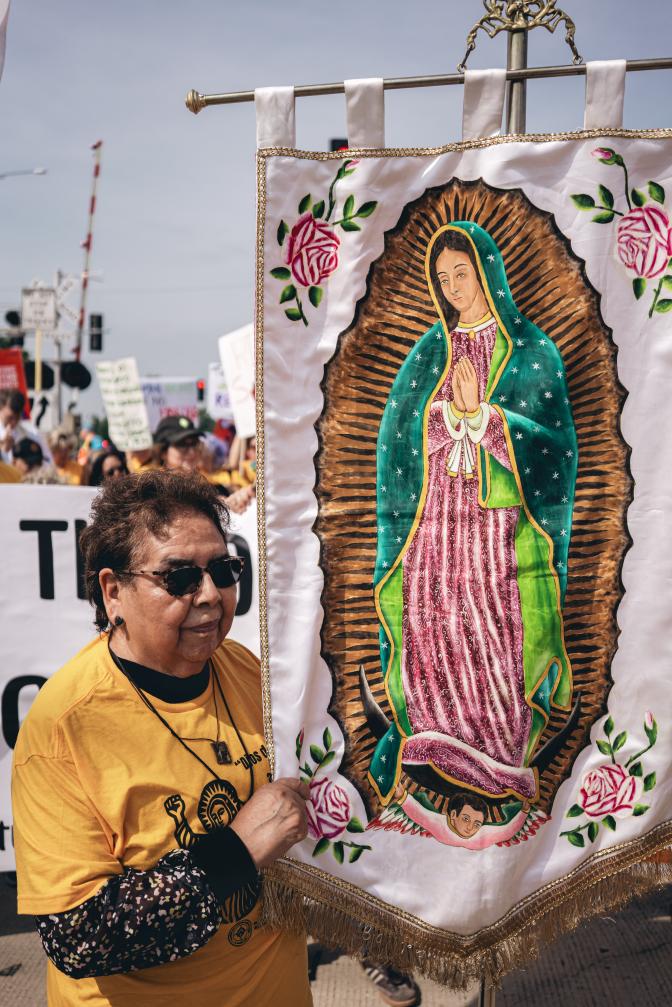
Organizers at the People’s Mass outside the naval base said they worked with the North Chicago mayor’s office and police department and had their own trained marshals as part of security measures. They also cautioned members without legal status to seriously consider the risk of attending.
“We were very worried,” admitted Michael Okinczyc-Cruz, executive director and cofounder of CSPL, a Christian organizing community of forty-five parishes, religious orders, universities, and community organizations in the Chicago area. “It’s a very sad state in our country right now, where violence, for many, is the first choice of how they respond to political adversaries.”
Yet, even as some religious leaders hastened to paint Kirk as a model Christian, and as the president and top members of his administration were threatening political retaliation against those who criticized Kirk, the People’s Mass provided a different kind of nonviolent witness from people of faith. As Okinczyc-Cruz explained:
We felt it was important to proclaim God’s message and the Gospel message that is still profoundly relevant in this moment—that in a moment of deep political and spiritual darkness, God still has something to say and that we as a faith community must do our best to be signs of hope and possibility and courage in our world today.
Still, fear likely kept some from attending, as did the morning’s thunderstorms. But as the skies cleared, cars and buses pulled into the muddy field across from one of the naval base’s entrances. Massgoers chose from a Spanish or English version of matching yellow T-shirts emblazoned with Mary’s Magnificat: “God has cast down the mighty from their thrones, and has lifted up the lowly.”
Religious messages and references to Scripture were ubiquitous. “God stands with the oppressed”—in English and Spanish—was printed on the cloth over the tented altar, where eight priests concelebrated the Mass. “Blessed are the peacemakers, not the deporters,” read one sign. Another quoted Leviticus: “You shall love the foreigner as yourself for you too were once foreigners.”
The liturgy encouraged participation from the people. During the Offertory, sacred items were placed at the altar, including photos of St. Óscar Romero and Blessed Fr. Rutilio Grande García, SJ, both assassinated in El Salvador during that country’s civil war. Such “People’s Masses” were common in El Salvador in the 1970s and ’80s, expressions of nonviolent resistance to the authoritarian government and its violations of human rights. Similarly, the Catholic Church was instrumental to the Solidarity labor movement in Poland in the 1980s.
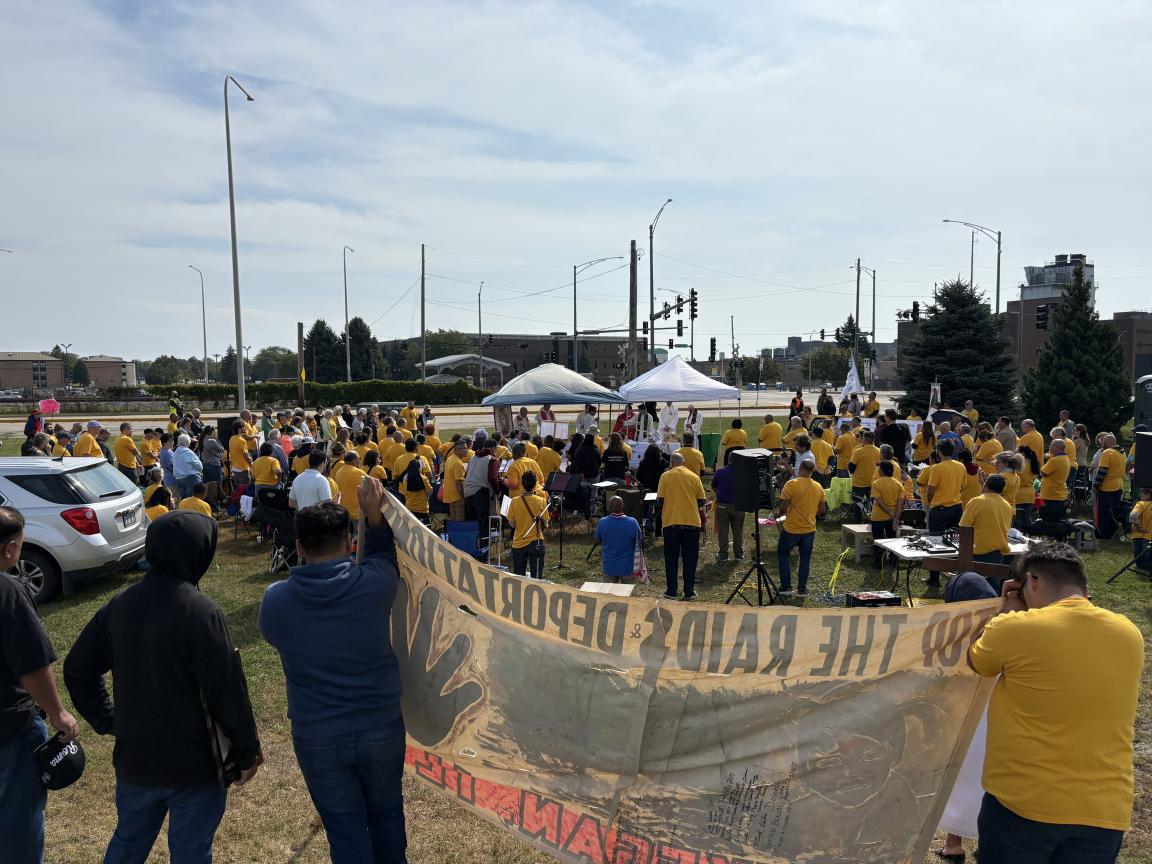
Okinczyc-Cruz said organizers drew on that history of Catholic rituals being brought into the public sphere as prophetic witness. “We wanted to practice that in this moment,” he said. “What other time is more appropriate to do this than now?”
Fossá, pastor of Our Lady of Mount Carmel Parish in the Chicago suburb of Melrose Park, said in his homily that all are called to conversion:
We pray for conversion and healing so our government officials may have the courage to stand with the oppressed, so our military and National Guard have the courage to protect and defend the oppressed, and so [their] eyes may have the courage to see the face of God in every person who is oppressed.
Jeanne Rattenbury, co-chair of the coalition team at St. Gertrude Parish in Chicago, said she attended the Mass in part for her own spiritual edification and to be in community with others who believe in the human dignity of all. It didn’t occur to her to be afraid.
“At a time when many prominent Catholics are supporting the maltreatment of some of the most powerless people in our country, I think it’s important to provide a counterbalance that says ‘this is not who we are,’” she said.
Even as it drew on the history of prophetic witness in the Church’s past, the event seemed to be an indictment of the rarity of such public signs of solidarity with the oppressed and the timidity of too many Church leaders to speak up for justice. The call to conversion could be aimed at a Church that has too often supported the Trump administration even as it moves toward authoritarianism.
Okinczyc-Cruz noted that there are times in the Church’s history when it has sided with authoritarianism and times when it has sided with the people. “These are moments when we have to make difficult choices,” he said. “We feel it’s remarkably important for the Church to be engaged in this struggle at this moment. It’s not just a political struggle, it’s a spiritual struggle.”