My wife, my adult son, and I recently resettled in Wales (though my son may ultimately make his home in Ireland). The rumor online, which I have done nothing to discourage, is that we made the move solely on account of Donald Trump’s reelection and the ascendancy of the murderous gang of psychotic clowns who compose his administration and party. Certainly that would be a sufficient reason for heading to the hills. Because of this rumor, moreover, I have received many messages from friends and readers of mine asking whether, following the resounding electoral repudiation of the Republican Party in the 2026 midterms, we are now planning to return to the States. I did, after all, joke in private and online just before departing those shores that I would find it extremely vexing if, once we had settled in Britain, the socialist utopia were to be established in America. That, of course, is an unlikely prospect; certainly I have no expectations that the Democrats will bring about any enormous revolution in American society and political culture, even if I am greatly encouraged to see how violent a revulsion the MAGA movement has for now provoked in the nation at large. And that revulsion may persist and even grow over the next two years. But the volatility of American politics in recent times, with its extravagant oscillations and bizarre peripeties, makes me hesitant to invest too much of my rapidly diminishing faith in humanity in rosy optimism with regard to what lies ahead. People with a memory so short that, after the terrorist assault on the Capitol in 2021 carried out at the behest of the degenerate moron in the White House, they could restore him to power only four years later are not to be trusted with the keys to the car, much less the keys to the kingdom.
Anyway, the truth of the matter is that there were numerous reasons for our change of residence. It had always been a possibility: my wife is English and has never become a U.S. citizen, my son has dual citizenship, I have as many friends and colleagues in Britain as in the States, and on the whole we live a somewhat transatlantic life. I even have a brother in Norway who is now just a hop, skip, and a jump away (though my other brother is now farther away, out there in Arizona). It is true that the rise of MAGA and its grotesque revival after what briefly seemed like its defeat hastened our departure, simply as a matter of prudence. The U.S. immigrations-and-customs authorities under Trump have shown themselves willing not only to persecute, abuse, abduct, and murder migrants and asylum-seekers from disadvantaged lands, but also to harass green-card holders and visitors with visas from anywhere and everywhere in ways that are truly sadistic, which made the prospect of traveling abroad somewhat daunting for my wife. This is an especially important consideration for us given that—and this is perhaps our chief reason for moving now—her father is ninety years old. He is in excellent health for a man of his years, but we really do think it wise to garner the hours, so to speak. Both my parents are gone, and so no bonds of filial piety remain to tether me to my native land.
Then, too, there is much about America that is spiritually fatiguing even when a masked Gestapo is not dashing around the country killing and kidnapping with impunity under the authority of a soulless ghoul like Stephen Miller. It is, for instance, tiresome to live in a country that seems to love its guns more than its children, or that regards access to health care as a consumer product marketed to the rich, or that finds it so easy to convert putative Christian allegiance into devotion to a national destiny.
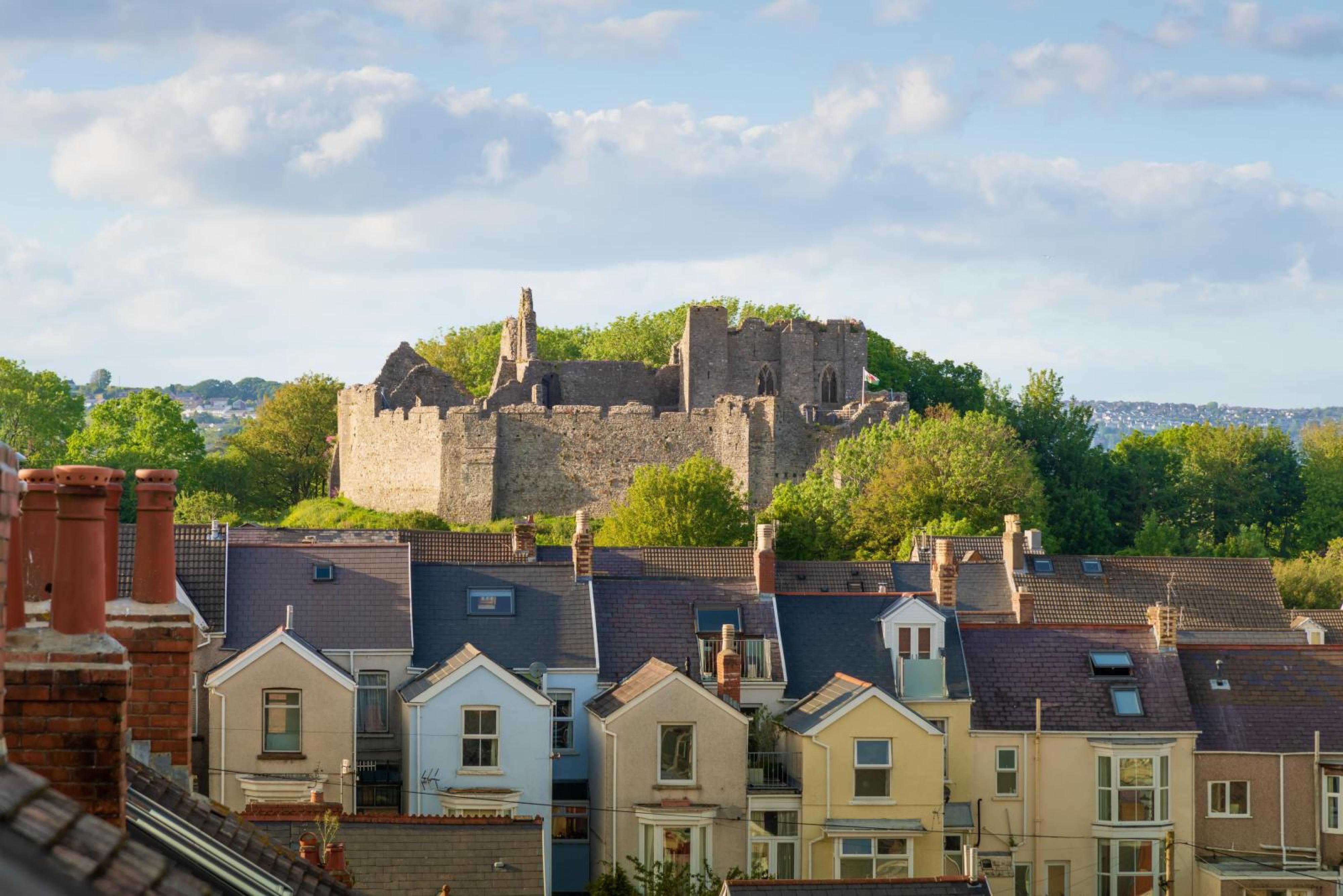
Not that there aren’t any number of features of Britain—and of Wales in particular—that have the power to attract me entirely on their own, without any goad at my heels. For an American, admittedly, it is all remarkably tiny in its physical dimensions, and it lacks certain conveniences and abundances that one takes for granted in the States. Its social services are superior in principle but, in the aftermath of years of cynical Tory governance, often barely functional. But there is something humane even in its parochialism that seems just now especially inviting. We are well situated in a hamlet called Mumbles on the shore of Swansea Bay, beyond which lies the Bristol Channel. Our house also stands just around the corner from the dilapidated ramparts of Oystermouth Castle. And who in his or her right mind would not want to live in a place called Mumbles, in the shadow of a castle called Oystermouth? It is a green and hilly part of the country. The closely clustered houses here are embraced on one side by a low emerald ridge that rises up in a kind of doting way above the garret where I have my office. In the opposite direction lie the open waters that, from the vantage of our home’s moderate elevation, shine through the morning into the afternoon with a silvery and soft blue lustrousness. As the son of a coastal region, I find the constant cries of seagulls intoxicating and bleakly haunting in a way that summons up feelings from deepest childhood.
There is also just enough exotic strangeness about Wales to titillate the cultural tourist in me; I find it has a kind of inverted orientalist appeal. I am actually fairly competent at reading most of the living Brythonic tongues if allowed to pore over the page at my leisure, and in theory I understand the phonetics of written Welsh. But those are the skills of the cloister and cell, not the open roads. When I look at the name of a town or avenue on some passing signboard, or some set of instructions for motorists or pedestrians, and find myself confronted by an almost belligerent slew of seemingly discordant vowels and consonants (including some vowels masquerading as consonants), the effect is a cognitive dissonance that simply refuses to translate into coherent phonemes. My tongue writhes in my mouth, trying to form syllables that my mind cannot define; my eyes jitter in frantic saccades as they search in vain for some kind of orthographic ledge to catch hold of; and, just as something like a pronounceable word is at last taking shape before me, I have to move on and the vision dissolves, leaving me with only my sense of yet another failure. It is not unlike trying to find my way through the streets of Istanbul. But here, as is not quite the case in Turkey, the episode always has an element of charm in it. I know I am not really a stranger in a strange land. This is still part of the Anglophone world and all the indigenes are fluent in English. Not just fluent, in fact, but mellifluent. There is no variety of the native Welsh accent, whether of spoken English or spoken Welsh, that is not like the sweetest music to me: the inverted and absurdly poignant inflections of its rise and fall, those beautiful open vowels, those drawn-out and sonorous terminal syllables—almost like the plagal final notes of an old Anglican or Methodist hymn. To me, a few words exchanged with a local greengrocer can have all the mystical and mesmerizing loveliness of bardic verse. There are few other places in the world where I could feel simultaneously just sufficiently at home and just sufficiently out of place.
Still, I have never been able to adjust my American sense of proportions to this little demi-paradise. There is a certain want of spaciousness to it of which I am sensible at all times, almost as a kind of clairvoyant sensitivity. No disrespect to Britain, but it seems obvious to me that a land that comprises both Manhattan and the Big Sky Country, everglades and tundra, Chesapeake Bay and Puget Sound, the mesas of the Arizona desert and the glaciers of the Yukon, the Blue Ridge and the Pacific Northwest, the Mississippi Delta and the Grand Tetons, Boston and New Orleans, Chicago and Memphis, Tin Pan Alley and the home of the Blues cannot help but be immeasurably more exciting than a nation that, to someone reared in those vast latitudes, seems only marginally larger than a Costco parking lot. There is, I suppose, the fathomless well of Britain’s deep past, which might offer a temporal compensation for the spatial diminution life here forces upon us. But given the almost obsessive hold that the history and lore of Native American civilizations has upon my imagination, that is not as enchanting as one might think. European antiquity is not the only plausible path of retreat from America’s terrifyingly perpetual present.
Some things have improved in Britain since the 1980s, when I was a student here. Good coffee is no longer an incredible legend from distant lands, vegetables are no longer boiled past all recognition, dentistry is no longer chiefly a form of cruel and unusual punishment. There are too many cars on crowded motorways and the trains are not all they used to be, but there is decent public transport and something on the order of a functioning civil infrastructure. The National Health Service has fallen on hard times, but who really wants to live overly long, given the current state of the world? And in many respects this island nation is nowhere near so insular as once it was. Brexit was, of course, a colossal stupidity that might have been averted if the “Remain” faction had ever bothered to make a public case for the European Union (which obviously should not be idealized). And some of the native British are a bit on the saturnine side with respect to the prominence of Islam in much of the country. But, on the whole, the United Kingdom is a pluralist country in a way it was not when I was younger. It was a postcolonial country, of course, with its established share of immigrants from lands the empire once ruled over, but it was also—or so it seemed to an American—depressingly monochrome.
I suppose this is what makes the age of MAGA and its many analogs in the developed and developing worlds especially disheartening to me. Forty years ago, I took a pride, frequently tipping over into arrogance, in the sheer variety of American ethnic and regional culture over against the uniformity of British society. The Scots, the Welsh, and the English may differ from one another in certain broad though fluid ways, but to me in those days their differences seemed about as interesting as the differences between Massachusetts and Rhode Island, or between New York and New Jersey. I became an insufferable braggart about going out to Ethiopian or Korean restaurants, wandering through Little Italies and Chinatowns, moving in a world of Anglo-Latino fusions and Southern Black civility, and so on and so on until I had spoiled all my British friends’ honest pleasure in chips and instant coffee.
For all that is wrong with American society, and all that is horrid and tragic in its history, there was this one truly beautiful idea that was all but unique to its understanding of itself, and that from an early age I found utterly captivating. It was the notion that a functioning cultural and political order could arise from the voluntary association of all the races and confessions and cultural identities of the earth in constant and dynamic congress with one another. I loved the ability of Americans of every class and region to be on the whole quite convinced that the recently naturalized Vietnamese or Nigerian or Punjabi immigrant was every bit as much an American as the descendants of early settlers. Yes, in certain places largely isolated from the better spiritual history of the nation, one occasionally heard talk of “heritage” or “roots” or notions similarly depraved. But the great immigrant mythology of America was something that simply did not exist in any but the vaguest form in other parts of the world. Racists and nativists and nationalists are with us always and everywhere, but this strange and even somewhat apocalyptic ideal was not so long ago almost bizarrely distinctive of the United States. Maybe that was only a passing cultural phase, one that happened to coincide with my youth, but it was the one reality that had the power to kindle a few sparks of patriotism in my breast. So it is a special feeling of defeat that overcomes me when I contemplate how utterly the Republican Party and the evil forces it now serves have betrayed the beauty of that vision, and how easily the politics of ethnonationalist resentment and cruelty has installed itself in American public life. Most appalling of all, of course, is the blasphemous association in the minds of so many Americans of this infernal scale of values with Christian “identity.”
I suppose I always saw that more welcoming, more pluralistic, more ebulliently cosmopolitan image of America as the effect of a Christian moral grammar that had somehow subtly and yet persistently shaped the best impulses of the modern world. I certainly do not believe that America has a sacred destiny or is an especially blessed country, and I loathe any attempt to portray it as a Christian nation. I do, however, believe that this aspect of its understanding of itself has a genuinely sacred dimension to it. It is rather horrifying, therefore, that the forces of reaction and bigotry and resentment in the country are so often the ones most convinced that they are champions of the faith. I do not mean merely the white Evangelical world, with that weird Orphic religion it confuses with Christianity. I mean Catholic integralists, the “postliberal order,” Christian “national conservatives,” those who define the “first things” in life as “faith, family, and flag.” I mean, above all, those who take the gospels not as commanding feeding the hungry, caring for the sick and suffering, loving the stranger in our midst, but solely as delineating a region of ethnic and national identity that must be defended, even if that means using cruelty and violence against those with whom Jesus actually identified himself.
Who can say what the future holds? The forces of anxious reaction have been on the move for several years now throughout the world. Here in Britain, Reform UK—under the leadership of the execrable Nigel Farage—continues to hover on the verge of real political power. The same persons who worked so sedulously to bring Brexit about are now perhaps the chief political beneficiaries of public despair at all the harm that misbegotten project has caused. The UK is in many ways a terrible shambles right now, with public and private services alike in states of accelerating decay, and the far right continues to be an imminent threat to civilization throughout Europe. At the same time, conversely, things might start trending in a more benign direction in the States, if the now irredeemably malevolent Republican Party can be decisively defeated for more than one election cycle, and if the Democrats can be cajoled into becoming something better than the lesser of two evils. Never in my lifetime, not even in the thick of the Cold War, has the future seemed so wholly uncertain. As I say, the general political situation in the United States was not the sole consideration that prompted my family’s departure and relocation, and Britain is not necessarily any kind of safe harbor to which to flee from history’s storms. Everything is up in the air, the die is cast, and this is as good a place as any.
So it goes. I wish there were black bears and groundhogs here, and raccoons and ruby-throated hummingbirds; but hedgehogs are delightful, and British badgers are the finest in the world. And did I mention that I live in a place called Mumbles, near the ancient ravaged walls of Oystermouth Castle?
We welcome your comments about this article. Please send your response to [email protected].