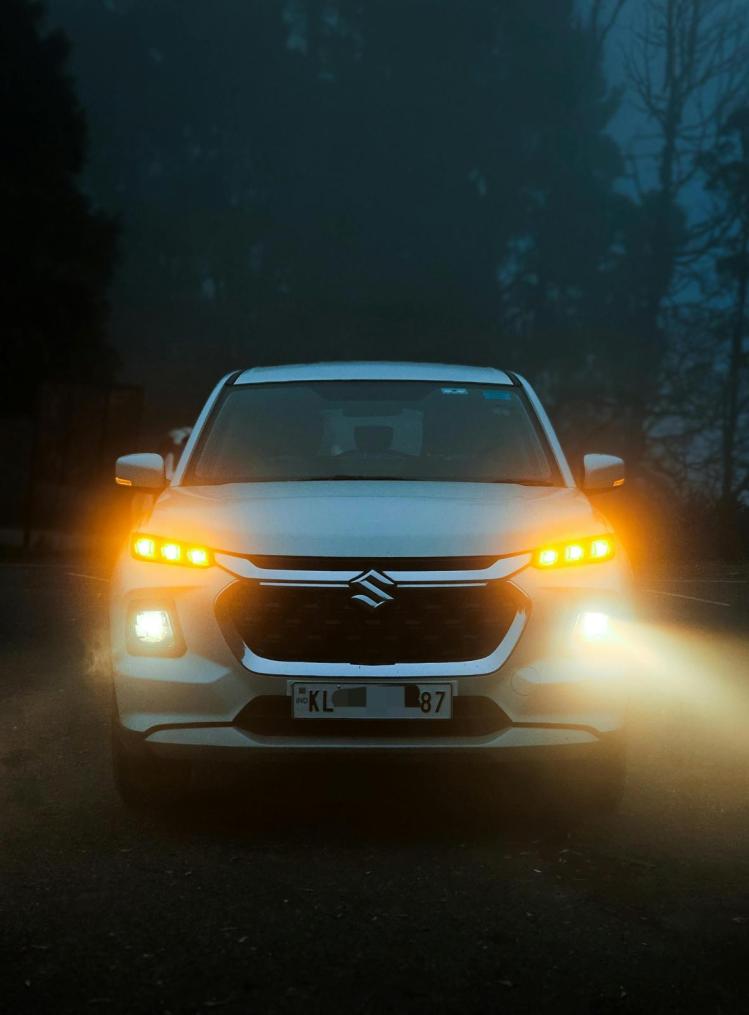
When I recall the moments before the accident, the headlights of my family’s Ford seeming to bring the pavement and roadside trees into existence, I am sometimes reminded of a church-school teacher of mine who liked to read aloud from a book of abridged biblical stories. One Sunday morning, she showed our class an illustration of God with a full white beard. He was pointing a finger as if right at us. He said, “Let there be light.” And the light was good. Yet on the night of the accident—our car heater whirring, the solid comfort of my parents on each side of me in the front, my little sister covered by a blanket and asleep in the back seat—the blinding light weaving toward us was not good. My father braked our car to a stop at a four-way intersection, and a second later my mother said, “It’s gonna hit us.”
I recall the moments immediately before and after, but nothing about the moment of impact: the thunder of metal driven into metal, the hurled ragdoll I briefly became, my chin meeting the dashboard, my mother’s face striking the windshield, the sudden darkness that was itself a sort of illumination. After the collision, a brief stillness, then crying and cursing. The cars were surrounded with broken metal and shards of glass. My mother and I were terrified and hurt. My father had only a minor injury, but he was worried about his family and furious at the other driver. I was crying less because of my cracked chin than because Mom was keening and no longer looked much like herself. Her face was harpooned with windshield glass. I tried to hug her, but she pushed me away. My sister Kim had been thrown to the floor but was unhurt. Still, she was screaming and crying.
This was long before cell phones. The only nearby home was a dark farmhouse, where my father’s knocking went unanswered. He limped into the intersection to wave down help, but the first car to come along passed him by, its driver staring ahead as if he hadn’t seen anything unusual. Perhaps he was late to a date or disliked seeing blood or told himself that the next driver would stop and help. But the next driver didn’t stop, nor the one after that. Their taillights became fading embers in the distance.
Eventually a car did stop. The driver spoke to my father and then parked his car next to ours. He helped me, my mother, and my sister into his station wagon, and then tried to help the driver of the other car. By then I had mostly stopped crying and, with morbid boyhood curiosity, rolled down a window of the station wagon to get a better look at the driver who had hit us. His car doors had flown open during the collision, and yet he was still sitting inside, slumped forward against the steering wheel, his moans sounding like snores, a rivulet of blood flowing over his upper forehead and dripping steadily onto his lap. My father would later tell me that the man “stunk of booze.”
My father set his hand on the shoulder of our helper. “Listen to me,” my father said. “I appreciate what you’re doing for my family, I really do. And I know you want to save his life. But that’s why you can’t put him in your car with me.” The drunk driver was abandoned. I glanced back at the crumpled cars and saw a shattered windshield briefly lit red by the taillights of the car that was taking my family to a hospital.
I was in my early twenties before I thought to ask my mother whether the drunk driver had survived. She said he had. I asked whether his injuries had been serious. She said, “He was hurt pretty bad.” Faintly and briefly, she smiled.
My father and sister were examined and released on the night of the accident, but my mother and I were hospitalized for several days. When our family was together at home again, my mother told us that God had saved us from death to teach us an important lesson we must always remember, which was that we should cherish our lives and each other. I was six years old and accepted her explanation as the truth, in part because I was happy that the swelling of my chin made me look a little like Popeye. I was not happy about my mother’s face, which wore a maze of bandages and stitches. My father made no comment about his wife’s theological interpretation of our fate.
Over the years, I have often thought about my father’s insistence that the drunk driver be left behind. How would my father have felt had the drunk driver died while left alone in the dark intersection? Did he consider that this man, too, might have had a wife and children? I never asked my father these questions. He was dead before I turned twenty, and in the working-class culture of my community, a boy with lots of moral questions was thought to be impractical. I can almost hear his ghost say, “For chrissake—you’re alive. So believe something. Believe your old man was wrong, if you want. Or right. Or believe it’s not for you to judge. But believe something.” Yet instead of believing anything in particular about that night, I continue to wonder about it.