This article was written in response to Sohrab Ahmari’s “Escaping the ‘Torment Nexus.’” You can find the original article and all four responses here.
Sohrab Ahmari has carved out an important space in our public discourse by helping develop a strand of proworker conservatism. His contribution is all the more important, in my view, because it differs in significant ways from that of another prominent conservative Catholic intellectual, Patrick Deneen, whose Why Liberalism Failed has lately been so influential in shaping a “postliberal” politics. In his 2023 book, Tyranny, Inc.: How Private Power Crushed American Liberty—And What to Do About It, Ahmari trained his sights not on liberalism writ large, like Deneen, but on its stepchild: neoliberalism. Castigating neoliberals for their role in exacerbating inequality, disempowering workers, and hollowing out democracy, Ahmari called for a “new consensus” inspired by the New Deal that might repair the damage neoliberalism has caused. While Deneen’s contention that “liberalism has failed because liberalism has succeeded” seeks no common ground with self-identified liberals, Ahmari’s work, including this essay, does something far more constructive. It opens up a space to imagine conservatives of his persuasion and progressives of mine working together on a politics responsive to the vast power imbalances, inequalities, and environmental degradations that both Leo XIII and Leo XIV have warned us about.
In this essay, Ahmari creates that fruitful collaborative space in several ways. His elucidation of the central elements of Catholic social teaching expressed in Rerum novarum lays out broadly appealing principles. His trenchant critique of neoliberalism’s “demolition job” identifies a common foe. His bracing warning about the urgent dangers posed by AI provides a rousing call to action. And his belief that Catholic social teaching may “lift us out of the Torment Nexus yet” is a welcome statement of hope in this dangerous time.
Nonetheless, there are some elisions and oversights in his essay that invite further dialogue in the interest of creating what he has elsewhere called a “new consensus.”
Consider Ahmari’s call for a restoration of the “primacy of politics.” What does this mean in practical terms? My question is prompted by how he handles the relationship between social democracy and Christian democracy in this piece. “Why not both?” he asks. I admire his both/and approach. And I agree with him that, while Leo XIII saw “nothing in common between social and Christian Democracy,” over time—especially as social democracy became more “ameliorist” in approach—“the two models converged” around “the core questions of political economy,” to the point that their complementarity was even mutually beneficial.
But this oversimplifies the history, for while Christian democracy and social democracy might have converged, they never merged. What’s more, at crucial points the tensions between them were mutually destructive, as in Christian democrats’ reluctance to join with social democrats against the rise of fascism. To take one timely example: as Mussolini’s movement rose in Italy after World War I, the Italian Popular Party, which had been founded on the principles of Leo XIII’s Rerum novarum, failed to ally with Italy’s Socialist Party, thus undermining the only bloc that could have stopped Mussolini’s juggernaut.
As was true in that case, the question almost always comes down to: With whom are you willing to compromise, and what are you willing to compromise over? These questions can’t be avoided if we are to restore the “primacy of politics.”
It is therefore refreshing to find so many instances of the word “compromise” in Ahmari’s essay. I believe he’s right that what Pope Leo XIII sought was, in substance, “class compromise.” But the fact is that Leo never used the word “compromise.” That word appears nowhere in the English translation of Rerum novarum. Nor, for that matter, can it be found in such other foundational works of Catholic social teaching as Quadregesimo anno or Laborem exercens. This shouldn’t surprise us, for Catholic doctrine has never looked kindly upon that word. “Compromise” appears only four times in the Catechism, and each time with a negative connotation: as in Satan’s tempting Jesus to “compromise his filial attitude toward God” (§538).
Unfortunately, one reason why Catholic social teaching is often described as the Church’s “best kept secret” has to do with Catholic leaders’ longstanding aversion to compromise. In recent times, U.S. bishops have often been too quick to equate prudent political compromise with “cooperation with evil.” By doing so, they helped marginalize their own teachings about economic justice. But if we seek to reassert the “primacy of politics,” as Ahmari calls us to do, then the questions “With whom should we compromise?” and “Over what?” cannot be avoided. Indeed, these questions have never been more urgent in our lifetimes than they are now. How we answer them will make all the difference in determining whether the “new consensus” Ahmari seeks is possible, or whether our failure to reach prudent compromises opens the door to a deepening catastrophe.
The elision I note in Ahmari’s text concerns what he says about neoliberalism’s “demolition job.” He’s a vivid writer, at his best when eviscerating the false god of the “free market,” under which institutions increasingly “adjust their own functions according to market metrics and logics.” Yet he doesn’t mention one set of institutions of particular interest to his audience that have been warped by such metrics and logics: Catholic institutions of higher education.
Sadly, as the neoliberal revolution was remaking the for-profit economy over the past half century, it was also changing academia, including Catholic higher ed. As Gerald J. Beyer demonstrates in his book Just Universities: Catholic Social Teaching Confronts Corporatized Higher Education (2021), these institutions have “adjusted their functions” to the market by resisting unionization, relying on poorly compensated adjuncts and other forms of temp labor, and contracting out work.
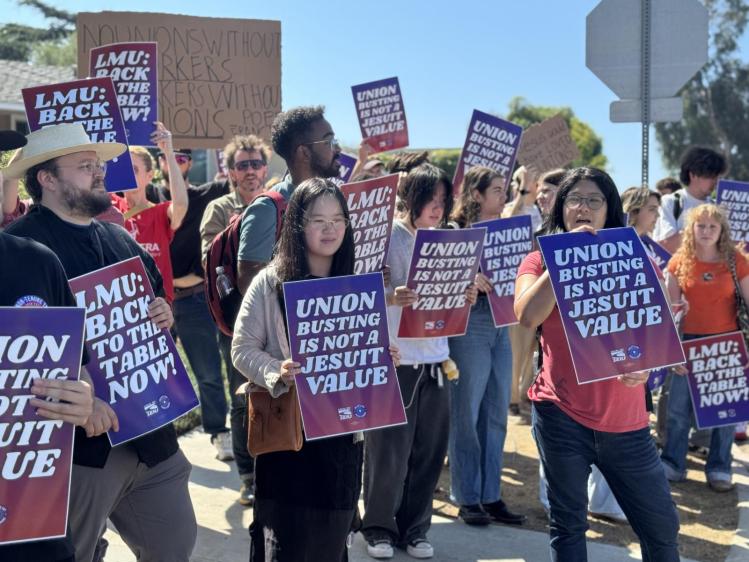
One example is Loyola Marymount University (LMU) in Los Angeles. More than a year ago, the non-tenure-line professors voted 227–29 to form a union, joining the Service Employees International Union (SEIU). Suddenly, on September 12, 2025, after eight months of negotiations with that union, the chairman of the university’s board of trustees abruptly declared that the university was done negotiating and was invoking its “constitutionally protected religious exemption” from the jurisdiction of the National Labor Relations Board, which governs collective bargaining for private employers. LMU now simply refuses to recognize the union its employees chose to represent them.
This has become an increasingly common pattern in recent years. Yet the invocation of religious freedom in this case and others like it rings hollow. LMU’s leaders could have worked with SEIU to bring in a nongovernmental entity to mediate negotiation with their workers’ union, as Georgetown did several years ago when it enlisted the American Arbitration Association to oversee a graduate assistants’ union election. Indeed, Catholic universities could create a Catholic labor board to oversee such cases if they wanted to. But they choose not to. Is it really interference by the government they object to, or is it having to bargain collectively with their employees? The answer seems obvious to me.
I raise this issue here to push Ahmari to broaden his understanding of where and how the principles of Catholic social teaching are currently threatened and in need of application. When Ahmari has written elsewhere about higher education, the kind of problems he addressed in Tyranny, Inc. don’t seem to interest him. Rather, he has preferred to tilt at the “woke university,” as in an essay he wrote in The American Conservative titled “The Right Should Cheer the End of ‘Academic Freedom.’” There he wrote: “Tenure is on life support, and so are academic freedom of speech and inquiry as we have known them since at least the mid-twentieth century. This turn of events is a…dream-come-true of generations of right-wing would-be campus reformers.”
If Ahmari seeks to reassert Catholic social teaching, he can’t afford to ignore how it is being undermined in practice by the very institutions entrusted with cultivating and passing it on to the next generation. He would do well to worry less about the overblown bogeyman of the “woke university” and more about whether our institutions practice what they preach. He should ask why they ignore this statement by the U.S. Catholic bishops in their 1986 pastoral letter on the economy: “All church institutions must also fully recognize the rights of employees to organize and bargain collectively with the institution through whatever association or organization they freely choose.” The truth is we must confront neoliberalism’s presence within as well as outside our walls.
An even more conspicuous silence that I note in Ahmari’s paper concerns what is happening all around us at this very moment in the United States. His focus on the dangers of AI in this piece allows him to look past a more urgent set of problems that are right before our eyes. To be sure, the threats that AI poses are every bit as real and dangerous as he suggests, and I think he’s right that those driving the AI revolution have shown little concern for the common good as they steer us toward a “Torment Nexus.” His impulse to focus on the threat of AI is also understandable in political terms as he seeks a “new consensus”: it is easier to imagine rallying a broad left-right coalition against the techno-fascist promoters of the Torment Nexus than it is to rally such a coalition against a long list of other equally obscene injustices about which Americans are seriously divided at this moment. But we cannot ignore those pressing injustices if we hope to build an effective resistance against the Torment Nexus.
It is hard to read an essay like this without noting what a disastrous year this has been for Catholic social teaching in the United States. We have seen immigrants detained and deported without due process. We have seen ICE agents landing like storm troopers on the roofs of apartment buildings and zip-tying men and women without regard to their immigration status as their young children wail in distress. We have seen refugees denied safe haven, foreign aid and SNAP food-assistance cuts, the unhoused swept from our cities—not to be properly housed, but just to be removed from sight. We have seen hundreds of thousands of federal workers summarily stripped of their union rights in the largest act of union-busting in U.S. history, and federal agencies that serve the poor gutted by indiscriminate firings. All of this suggests to me that we are already in a Torment Nexus. If we can’t come together around Catholic social teaching to address this nexus, then the notion that we might mobilize around that teaching to confront the potential threats posed by AI seems dubious.
This essay and other things Ahmari has written in recent years make me think that he and I could be allies in the fight to ensure that the coming AI revolution benefits workers and the common good. I am less certain, though, that we can find a conservative-progressive common ground on the more immediate issues we face. Yet that, in my view, is where we must begin. This moment demands that all of us inspired by Catholic social teaching be clear with each other about which compromises we are prepared to make and which people we are willing to compromise with. It requires that we reform our own house even as we attempt to reform society. And it demands that we not pass by our suffering neighbor along the Jericho Road on which we’re now traveling. Whether, despite our different political orientations, Ahmari and I can find common ground as we face these issues, I don’t know. But, after reading this openhearted and thought-provoking essay and pondering the scale of the challenges we face, I’m looking forward to finding out.