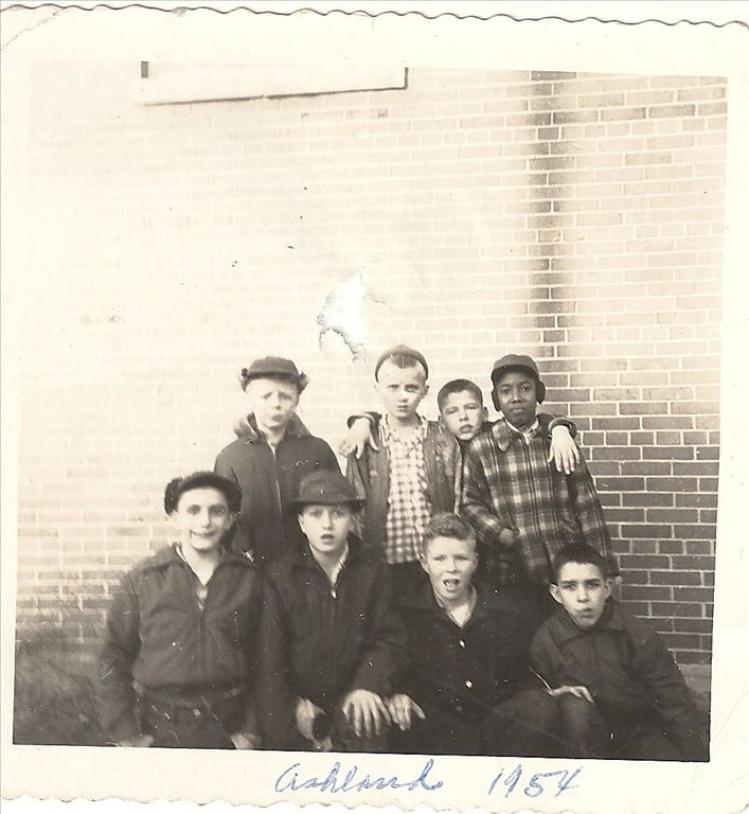
In August 1954, when I was seven years old, my family uprooted from our ancestral home in Dayton, Texas, and moved to Ashland, Kentucky, where my father, a Black World War II veteran, had been hired as an instructor in the education program at the Federal Correctional Institution. Ashland, though still Southern and largely segregated, was for us what Chicago, New York, Los Angeles, and other such destinations were for millions of other Black migrants at that time: a chance for the safety and economic advancement so elusive in the Deep South. We traveled by car—three adults and five children sardined into a Chevy sedan—following a truck owned by Herman Payne, a white family friend. That truck carried all our household belongings. Our route took us through the most notoriously dangerous parts of the South, and we went virtually nonstop, since hotels, motels, restaurants, and other places of public accommodation were all segregated.
We got to Ashland early on Saturday, August 28, and found our way to the house at the south end of town that Daddy had rented for us. I don’t remember much about the house except that it was on a hill and the front yard sloped steeply down to a sidewalk and the street. I recall being amazed that we were going to be living on a paved street with sidewalks instead of a dirt road or a highway with drainage ditches.
Daddy and the three other men promptly began unloading the truck and placing things in the house. Mother recalled that they were almost finished when, abruptly, everything came to a stop. A strange white man showed up at the front door and began talking with Daddy. Mother said she couldn’t hear what was being said at first, but saw that Daddy began to look “downhearted.” She walked to the front door where Daddy and the man were standing. “What’s the matter?” she asked. Daddy explained that the man was the landlord, and he was saying that some of the neighbors had called him and complained when they saw a “colored” family moving in. As far as he was concerned, the landlord said, we could stay in the house, but he couldn’t know what the neighbors might do.
That was no consolation to Daddy, who replied, “How do you think I would feel going off to work every day knowing my family may be in danger?” Under these circumstances, Mother and Daddy both realized we couldn’t remain in the house; they would have to find another. But we would have to stay in that house at least until they could find a new one. The landlord suggested that Daddy go to the police and ask them to keep a special eye on the place as long as we were there.
At this point, Herman spoke up. It is important to appreciate who Herman Payne was. If you had been a Hollywood casting director looking for someone to play the quintessential redneck, you couldn’t have picked anyone better than Herman. Big, redheaded, not particularly well educated, he was a workingman, scuffling to make a living however he could. He and Muriel had a passel of children, and I still remember going to their house for a visit one night before we moved away from Dayton. They had an old piano and someone played it while everybody sang, “Hail, Hail, the Gang’s All Here.” (I remember it so well because a word tripped me up. I thought everybody was singing “Hell, Hell, the Gang’s All Here,” and it gave me a thrill to hear everybody singing so lustily this word we children were forbidden to speak.)
Anyway, pointing to Mother, who was five months pregnant with the baby who would be my sister Joy, Herman addressed the landlord. “This woman has been on the road for three days,” he said, “and she’s in no condition to be moving anywhere tonight. Now I’m gonna spend the night in my truck out back with my shotgun, and if anybody comes around here trying to mess with these people, they’re gonna have to deal with me.” And he did.
Daddy went to the police and told them about the situation. The police said there had been no racial incidents in that part of town, but they agreed to keep a special watch on the house that night. The next day, a Sunday, Daddy went out to look for another house. He had already noticed a vacant house on Central Avenue, also in south Ashland, but had been unable to find anyone who could show him the place or tell him how much the rent might be. On this Sunday, however, luck was with him. He knocked on the door of the neighboring house and found the residents home. It turned out that the lady of the house, Christine Kinney, was handling the showing and renting of the place for the owner, who lived in Cincinnati.
Mrs. Kinney—“Miss Chris” we children later learned to call her—showed him the place. Daddy rented it on the spot, and we moved in that same day. There was no need to spend another night at the house on the hill, no need for Herman Payne to sleep in his truck, cradling his shotgun.
That house on Central Avenue was our home for the next four years. Like every other house we lived in, it was too small—living room, kitchen, two bedrooms, one bath. But that was par for the course in those days of big families and little affluence. Our parents had one bedroom, the girls had another. Francois and I shared a foldout couch in the living room. The living room had a mantle, something I had never seen before, and a fireplace that we never used. There was a porch that wrapped around both the front and the south side of the house. The yard—a big one, with a tall apple tree in the center—was on the north side. Most importantly, the house was safe. The neighbors to the south and east were Black; those to the north and west were white. There was no friction in the neighborhood. There would be no racial danger here.
Safely housed at last, we children still needed to be schooled. And so on Monday morning, not yet twenty-four hours in the new house, Mother took Francois, Karen, and me to enroll for the first time in Catholic school. It was also the first time that Francois and I would attend school with white children.
I had finished first grade and Francois had finished fifth in June at Colbert Elementary School in Dayton. In Ashland, as in Dayton, the public schools were segregated. Had we gone to public school, we would have enrolled at Booker T. Washington, the colored school in Ashland. This, even though the Supreme Court had ruled four months earlier, on May 17, 1954, that separate-but-equal had no place in public education in the United States. It would be half a dozen years before public schools in Ashland were integrated. But Daddy, impatient with Jim Crow and all its inequities and indignities, didn’t want to wait.
It was his boss at the prison, Walter Graybeal, who suggested that he look into sending us to Catholic school. “You’re Catholic, aren’t you, Wyc?” he asked. “Well, why don’t you send your kids to Catholic school just like anybody else would?” Daddy knew it wasn’t as simple as doing “just like anybody else would.” But he liked the idea and decided to go and see if his Black Catholic children really could attend Holy Family School. It was early August when he went and knocked on the door of the parish rectory on Winchester Avenue in north Ashland. The housekeeper answered the door, and Daddy asked to speak to the pastor. Within a few minutes, he was talking with Msgr. Declan Carroll.
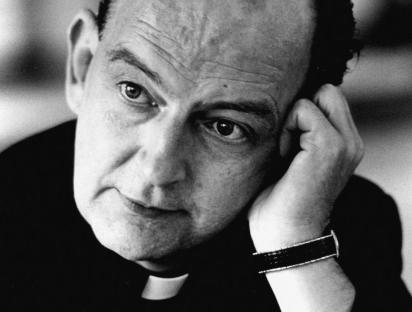
With his florid face, snow-white hair, and unmistakably Irish brogue, Fr. Carroll was another of those characters who could have been sent from central casting. He was, in fact, an Irish immigrant, born in 1886 in the village of Clashmore in County Waterford on the southern coast of Ireland. He and his family moved to the United States around 1897. They settled in Covington in northern Kentucky, just across the Ohio River from Cincinnati. Young Declan attended St. Xavier High School and then St. Xavier College in Cincinnati. He went on to St. Thomas College at the Catholic University of America from 1906 to 1910. In 1911, he attended St. Mary’s Seminary in Baltimore as a student for the Diocese of Covington. He was ordained on June 21, 1911, by Cardinal James Gibbons of Baltimore and returned to Covington.
Daddy told him that he was new to Ashland, that he was employed at the Federal Correctional Institution, that he was Catholic, and that he wanted to enroll his children in the parish school. Without hesitation, Msgr. Carroll replied, “I don’t see why your children can’t attend our school.” But just to be sure, he said, let him confer with the bishop in Covington. He promised to call Daddy at work the following Wednesday.
On Tuesday, Daddy said, he was summoned to his departmental office to take a phone call. It was Fr. Carroll. “Mr. Wycliff, the bishop says that the Catholic schools are for all Catholic children,” the priest said. “Your children will be welcome in our school.”
At that point, the old priest could have congratulated himself and gone back to business as usual. But he didn’t. A few weeks later—on that very Sunday when Daddy was scrambling to find us a new place to live—Fr. Carroll took to the pulpit at Mass and made an announcement. According to one of Daddy’s colleagues at the prison, Carroll told his parishioners that there were going to be “colored children” attending the parish school that fall and that he wanted them treated with decency and respect. And if anyone did not do so, he said, that person would be denied the sacraments of the Church. Many years later, when I was a member of The New York Times editorial board, I would write a commentary in which I cited Fr. Carroll’s behavior in this situation as an example of courageous leadership by a churchman.
Mother was aware of none of that, however, as she stood with Francois, Karen, and me at the school that Monday morning. What she was aware of, she said, were news reports about Black children in another Kentucky town, Sturgis, being “stoned” as they tried to integrate their local public school. “I thought,” she said, “that they might try to stone me.”
The registration site was the convent where the Sisters of Divine Providence, who staffed Holy Family School, lived. The convent had a large, screened front porch where mothers and their children congregated to wait to register. Mother nervously approached the building, opened the door, and took a position near it, with her back against a wall and her three children drawn in close—in case, she said, she needed to make a quick escape.
For several minutes, no one said anything either hostile or welcoming. And then, a lady standing with a little girl on the opposite side of the porch approached.
The woman smiled and asked, “What is your little girl’s name?”
“Karen,” Mother replied nervously. “Karen Wycliff.”
“Why, that’s my daughter’s name, too!” the lady exclaimed. Then, turning to her daughter, she said, “Karen Horgan, meet Karen Wycliff.”
The woman’s name was Virginia Horgan, and her gesture of friendship broke the ice for Mother and dispelled her fears of being stoned or spurned. “You’ll never know what a smile can mean to a person,” Mother used to say when she recalled that day.
Her anxiety was relieved, but she wasn’t the only one with concerns. I was full of anxiety, and I’m sure Francois must have been also. My fears came to the fore on the first day of classes, when Sr. Helen Joseph marched our second-grade class over to the church for Mass. Half the class filed into pews on one side of the center aisle, and the other half went to the other side. Whether because my last name began with a “W” or because I was tall or for some other reason entirely, I was at the back of the formation on the left side.
After Mass, we were supposed to file out of our seats into the middle aisle, genuflect, and then walk out with a partner who would be coming from a pew on the opposite side of the aisle. As the children in the rows ahead of me filed out, my anxiety grew. Would I have a partner, or would I be all alone? What if none of these new people—these white people—wanted to walk with me?
Suddenly, it was my row that was moving out into the aisle. And then it was my turn. I stepped out of my pew, genuflected, and looked to my right, where my partner should be. And there was a boy, about my height, with dark, crew-cut hair, waiting to walk out with me. His name was Johnny Thompson, and it turned out that he and his big family lived just a few doors north of us on Central Avenue. He liked to play army and he liked “Ike,” President Dwight Eisenhower. I didn’t care about Ike, but I liked Johnny, that day and always, because he was my partner and I was not left to walk alone.