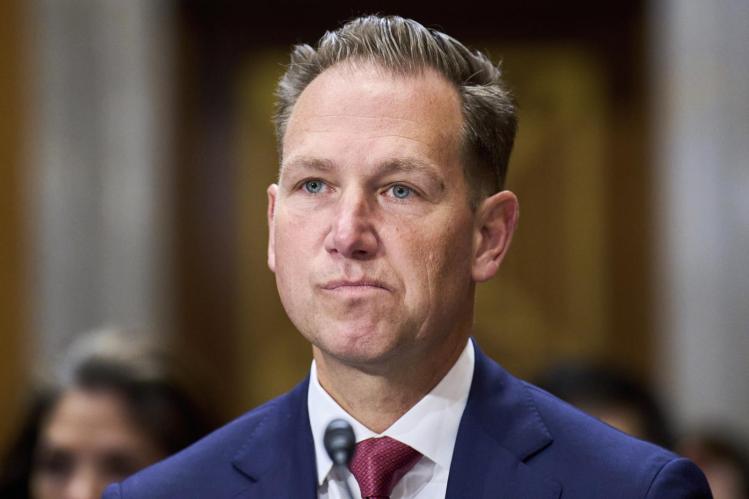
In a rare Saturday session in August, the Senate confirmed Brian Burch, cofounder and former president of the pro-Trump advocacy group CatholicVote, as U.S. ambassador to the Holy See. By what I presume was coincidence, my email inbox the following Monday was flooded with appeals to subscribe to The Loop, CatholicVote’s daily email newsletter.
The Loop’s come-ons exhibited an instantly recognizable mix of dudgeon, grievance-stoking, and idiosyncratic capitalization—the enervating, executive-ordered style of the political and cultural moment. “Today’s media erodes the very values that once anchored our culture…. Our dedicated team is fighting for Faith, Family, and Freedom on all the cultural fronts…. The Loop helps faithful Americans return to godly values of Truth, Beauty, and Goodness.” There were also rave reviews from subscribers, who are called “LOOPers.” “A breath of fresh air in a world devoid of God and patriotism,” read one testimonial. “I know you’ll fit right in,” Loop editor Joshua Mercer promised in his closing appeal. (Let me be the judge of that, I thought.) A couple of clicks and I was a LOOPer—joining a community already half a million strong, according to CatholicVote.
As a newsletter “product”—my job sometimes obligates me to assess things this way—The Loop is similar to many email newsletters I receive: easy-to-scan layout, a selection of newsy highlights, a couple of cultural items and how-tos (example: “Five tips for being a saintly grandma”). Like a diocesan or parish newsletter, it lists the day’s saint, psalm, and Mass readings. As for matters of “Faith, Family, and Freedom,” that’s where The Loop distinguishes itself. It takes these up with identitarian language and phrasing that mimic MAGA messaging, while sounding unmistakable notes of what some have called “Trump messianism.” Subject lines praise the president for taking action on current obsessions. “Trump bars male athletes from receiving visas for women’s sports.” “Trump deploys feds to patrol DC amid rising [sic] crime.” “Trump orders census to exclude illegal immigrants.” “Trump to remove homeless from the capital.” From these, one might also infer what The Loop understands to be “godly” values, as well as what it misunderstands—or chooses to overlook—about executive power and the Constitution.
In one of his relentless follow-up fundraising emails, Mercer writes of The Loop’s origins. “Watching example after example of Catholic perspectives being attacked, dismissed, or ignored in the mainstream media” back in 2013, he decided that Catholics needed a source, in his words, of “no-spin news,” since “the news we received was being manipulated to further an agenda.” That was around the time of the national debate over Obamacare’s contraception-coverage mandate and other “religious liberty” issues, which may have been the catalytic moments to which Mercer alludes. I wouldn’t characterize the mainstream reporting back then as manipulative. But TV pundits, columnists, and bloggers of all stripes held forth with a range of opinions—some indeed dismissive, ignorant, or tendentious. Many unhelpfully framed the debate over the contraception mandate as a “war on women” by the Church or a “war on religion” by the Obama administration. (Catholics themselves, recall, held varying views.) As for the kind of “news” that The Loop delivers, it’s news that Fox and EWTN deliver: lots of spin, all to further an agenda—in this case, to “go on offense” for Trump.
CatholicVote contributed more than $10 million to help Trump get elected last fall. Another fundraising email I received celebrated this achievement: “We were vital to rallying Catholics around voting for Donald Trump and winning the election for a pro-America, pro-family agenda.” Yet another email hailed the passage of the Trump spending package, which eliminates benefits and endangers services for millions of vulnerable Americans—many of them Trump voters: “When President Trump was working to pass his One Big Beautiful Bill, members of the CatholicVote community sent thousands of messages to Capitol Hill urging their elected officials to pass the bill.”
Which brings us back to Burch, a provocateur and cheerleader for Trump who has no diplomatic experience. He was also a persistent critic of Pope Francis, posting attacks on social media and calling synodality “a ruse.” He accused Francis of governing the Church with a “pattern of vindictiveness” after the pope removed Texas bishop Joseph Strickland, who spread right-wing conspiracy theories online and claimed Francis “undermined the deposit of the faith.” (Francis himself had misgivings about Burch, but chose not to oppose his nomination.) So far, Burch has been circumspect in regard to the American-born, Francis-aligned Leo, whose papacy CatholicVote seems cautiously to support for now, despite his strong criticism of the kind of ethnonationalist politics Trump represents.
Will Burch function merely as an extension of CatholicVote’s Trump offensive in Rome? Given that personal fealty is a condition of working for this president, it’s a fair question. But pushing Trumpism at the Vatican is pretty much the antithesis of diplomacy. As for how it aligns with Catholic values, Burch is obviously untroubled by what troubles the consciences of many of his coreligionists. But even if Burch tries to be a real diplomat, something Thomas Reese told Reuters comes to mind: “[Burch] is a lobbyist for the U.S. government in the Vatican. But a lobbyist who’s obnoxious is not going to accomplish much.” Maybe Burch will rise to his new role. Maybe he won’t. As CatholicVote and The Loop demonstrate on a daily basis, obnoxiousness is the brand.