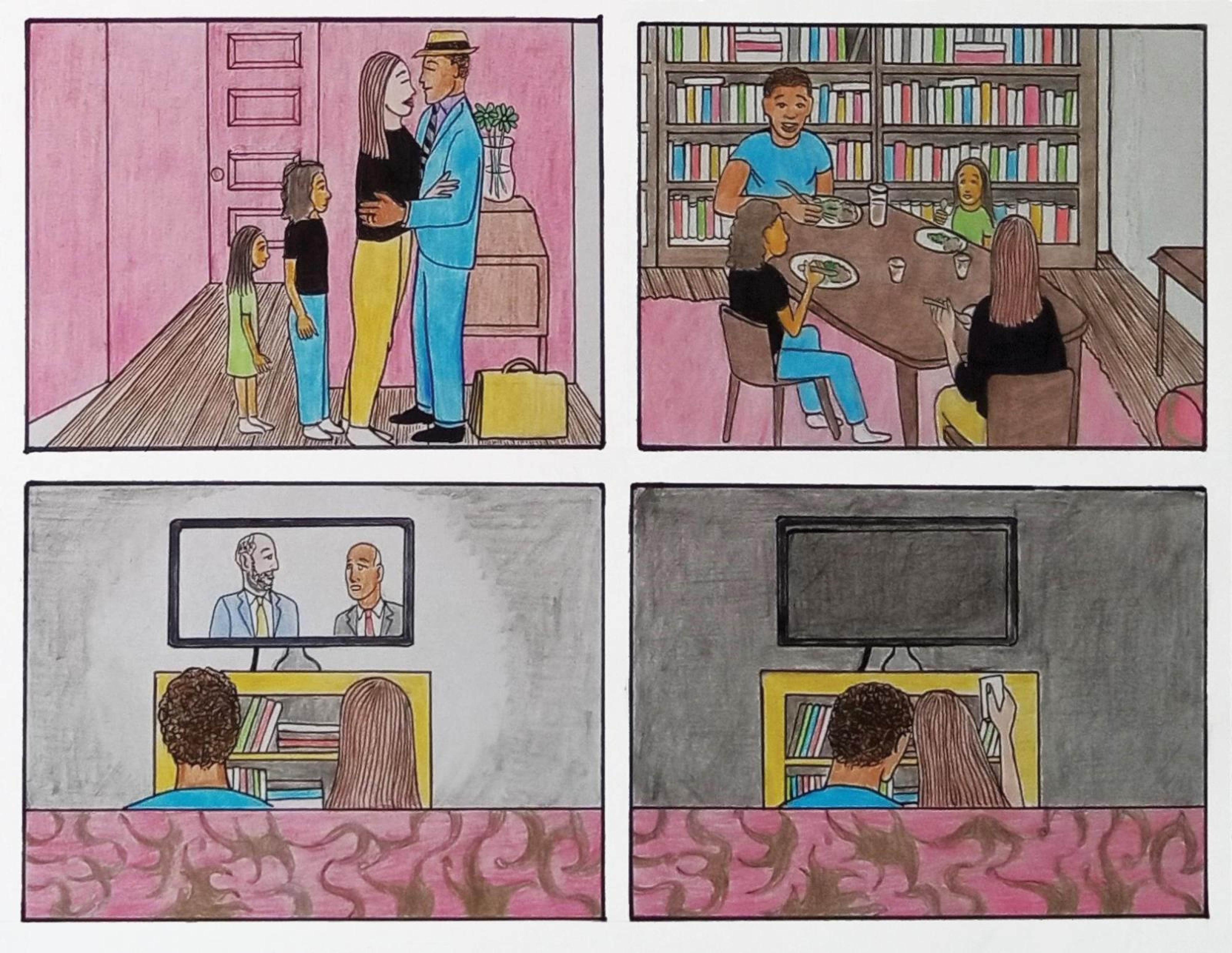
Black Americans have real enemies. That is clearer now than at any other point in recent memory. This is no time for African Americans to disparage one another for our life choices. Yet that is what a number of otherwise good nonfiction books published in the last decade have done. Under the guise of opposing anything that obstructs Black people’s ability to love ourselves and be who we are, they reflect some of the most myopic thinking in society.
On the positive side, these Black authors’ essay collections and memoirs have rejected patriarchal and white-supremacist assumptions. They have rejected toxic masculinity, sexism, homophobia, transphobia, and the notion that Black people should not admit to being depressed, much less seek help for depression. But they have also rejected a sizable group of Blacks: those of us who have white spouses or partners.
“I believe wholeheartedly in the right of all consenting adults to choose the kinds of partnerships that are best for them,” Brittney Cooper writes in Eloquent Rage: A Black Feminist Discovers Her Superpower, from 2018. That is an entirely appropriate attitude to have about one of the most private decisions made by people one doesn’t know. But Cooper doesn’t reach the end of that sentence without contradicting herself: “But I’m tired of the lie that relationships and love are not political.” She goes on to lament that she is “tired of Black men who buy into the lie that their choice of white female partners shouldn’t concern anyone but them…. Maybe we [Black women] should just start admitting that we are angry at seeing some of our best and brightest brothers choose white women for partners.” Even more recently, Carvell Wallace says this in his best-selling 2024 memoir Another Word for Love: “One of the really neat tricks of oppressor systems is how they make you believe that you can be liberated from them [i.e., white people] while still deeply tied to them. I see why people want to believe that. It would be much easier for a lot of people if that were true. It’s just that, well, it’s not.”
These attitudes are not limited to published writers, of course. They can be found among ordinary folks, simply by walking around as part of an interracial couple. A couple of years ago, my wife and I were strolling along a street in New Orleans when a Black man said to me, “You passed it up, brother.” One day in New York, when we got on the subway with our two children, a Black woman saw us and literally shook with anger.
One might hope that the Black intellectual leadership, those who publish serious, widely read works that reflect on racial matters, might seek to have a mollifying influence on those whose basest instincts are called up by the sight of differently colored people keeping company. But here is a passage from Damon Young’s 2019 book What Doesn’t Kill You Makes You Blacker that fairly drips with contempt for families like mine: “A distractingly disproportionate number of beige toddlers with unfortunate tornados of berets and oblivion on their heads—which is what occasionally happens when white women have babies with black men and have no fucking clue what to do with their hair.” One might also surmise that these are the attitudes of the younger generation of Black writers. But chiming in with them is an older icon. This is from Gathering Blossoms Under Fire: The Journals of Alice Walker (2022), in which the novelist—once married to a white man—notes to herself, and now to us, “I suppose I also feel less respect for the black man in such a liaison because I am always wondering—Is it really love, or was he too weak to resist the advertising?” Ms. Walker might consider another possibility: that it’s none of her business.
You might like: Clifford Thompson on his life as an artist
The irony here, of course, is that our intellectual progress toward Black self-actualization has returned us to nineteenth-century ideas about race-mixing, only this time in blackface.
There is much talk in our current era of “othering.” The passages I have quoted make me feel othered. I must emphasize that that is not so important in my own case. I am grown and then some, with an adult’s supply of confidence. But do we really want to plant the seed in young people that, should they happen to find themselves in healthy relationships with those of a different skin color, they are doing something wrong? In an era of deep division between and among Americans, do we really want to introduce another?
This division is a measure of our shortsightedness, lack of imagination, and cowardice. It is hardly new, of course. In the early 1990s, when my wife and I announced that we were getting married, most of those around us, Black and white, celebrated; but the response of one older white person, which was representative of the views of many others around the country, was more reserved. That person (who in the end paid for our wedding) raised a concern I have heard elsewhere: Think of the children. They won’t know what they are. One’s choice of a partner is inherently personal, but if there is an argument in favor of interracial romance, over and above such tired concepts as following your heart and accepting love where you find it in this unpredictable life, the “think of the children” stance may be it. Yes—think of children who could well find themselves loved and cared for, from birth, by family members of different skin colors, children who might just, as a result, come to place a higher value on humanity than on allegiance based on pigmentation. To reject that possibility, that affirmation that something deeper than color unites us all, is to debase our own humanity.
But that is mere philosophy. To return to earth, and to the main point: had the original goal of slavery been to mess with the heads of the future descendants of the enslaved, it could scarcely have been achieved any better. The miracle of Black America is that we have accomplished as much as we have in spite of it all. On an individual basis, we all do what we can to preserve our sanity and our sense of ourselves in the face of this nightmare. Maybe your method of avoiding what might be called toxic whiteness is simply to avoid white people as much as possible. But maybe you’re like me, and your response to the false division of white supremacy is to reject any division based on skin color. Those who approach life this way should not be made to feel shame. The larger point, though, is that Black Americans should never feel shamed by one another. Again, we have real enemies. We should not do their work for them.
We welcome your comments about this article. Please send your response to [email protected].