When Pope Leo XIV took office last year, he indicated that he would devote substantial attention to the challenges posed by artificial intelligence. In this regard, his choice of a papal name was no accident: he specifically referenced Pope Leo XIII, who in 1891 wrote an encyclical, Rerum novarum, that offered thoughts on how to rein in the most dehumanizing aspects of the Industrial Revolution.
With Magnifica humanitas, Leo has delivered on that promise and then some. The hard work now begins to ensure that his teaching reaches its intended audience. In policy circles, there is significant speculation about AI “diffusion”—the rate at which AI becomes integrated throughout our institutions and economy. The issue facing us is to find ways to achieve similar diffusion of the pope’s ethical vision. This is not a message that we can afford to lose in medieval prose or carefully parsed culture-war spin.
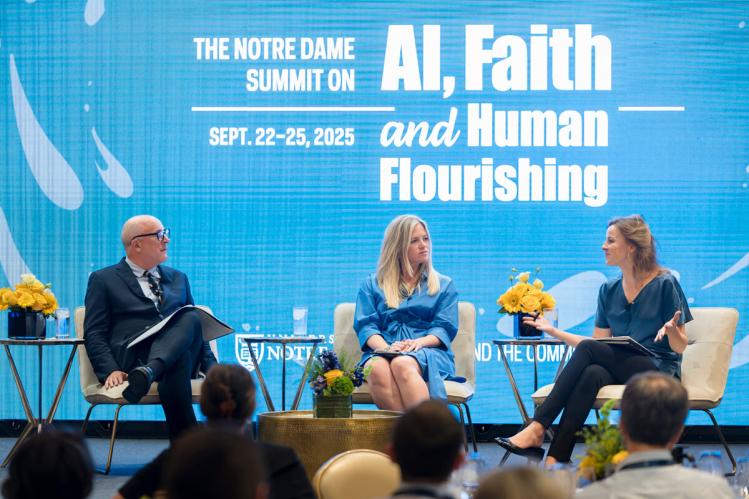
An important first step is distilling how Christian principles are critically relevant to practical decisions we now need to make about AI—and how those principles are relevant to everyone, regardless of their religion. At Notre Dame, we have developed a simple mnemonic to help people remember why human beings are magnificent: DELTA, which stands for dignity, embodiment, love, transcendence, and agency. Each of these concepts features centrally in Magnifica humanitas. Together, they point the way toward a powerful approach to AI.
Start with the principle of human dignity. Before ChatGPT hit the market in 2022, many of us lazily believed that what made human beings special was our capacity to solve abstract problems or entertain abstract questions. Now we have software on our phones that can do those things, often better and faster than we can.
This software has its own considerable value. But for Christians, nothing that makes software valuable is relevant to why human life is valuable. Christians believe that every human life has inherent, particular value because every person is made in the image of God. The fundamental value of your life has nothing to do with your intelligence, say, or your productivity.
This has important implications for how we think about AI and work. Many in Silicon Valley and think-tank circles seem happy to tolerate the short-term immiseration of some workers if AI leads to explosive GDP growth and societal abundance. But in Rerum novarum, Leo XIII offered an important insight: work, he argued, was made for humans to flourish; humans were not made for work to flourish. Leo XIV reminds us that this principle is as relevant in 2026 as it was in 1891.
As AI increasingly pushes people into unemployment or transforms their jobs in ways that force them to behave more like machines, we must prioritize human dignity. In his encyclical, Leo reminds us that unemployment is a grave evil, because meaningful work is a key way in which individuals participate in developing the common good. He also reminds us that we have agency and moral responsibility over the economy we jointly create.
Next, consider the principle of embodiment. For Christians, it is extraordinarily important that God himself took on a mortal human body that breathed, suffered, died, and then came back to life. Since ancient times, Christians have been united in a hope that our decaying, vulnerable bodies could also be someday transformed and given new life. What makes human lives meaningful is the fact that on this earth, at least, they are short, and they depend upon other embodied people.
This affects practical deliberation about AI in several ways. On the science-fiction fringe, there’s the hope that we will make ourselves immortal by somehow capturing our manners of speech and physiological data in computer models, and in that way we will defeat death and achieve eternal life. But Christians think this is a delusion. As Pope Leo writes: “Finitude, when truly accepted, does not diminish us but opens us to recognizing the face of God and others. Indeed, precisely because we experience limits—vulnerability, suffering and failure—we can recognise the inviolable dignity of every person, both our own and that of others” (122).
Yes, AI technology holds out the promise of revolutionizing medicine and health care. Demis Hassabis won the Nobel Prize in Chemistry a few years ago by harnessing AI to discover ways to create proteins and compounds that promise new, lifesaving drugs. Christians will celebrate the fact that AI can help cure diseases. But there is a critical distinction between healing our bodies and trying to deny our basic mortality.
Then there’s the principle of love. For Christians (and the Jewish moral tradition that founded Christianity), love is the bedrock of all ethics. We are commanded in Leviticus and Deuteronomy to love God and our neighbors as we love ourselves. Many of us realized too late in the era of internet and social media that technology, which initially offered us the promise of extraordinary human connection, has eroded our relationships with other people.
Now, we don’t even have a human being at the other end of the connection; we have a sycophantic and highly addictive chatbot. We have to help a generation of human beings habituate to loving other human beings when that simulacrum is in their midst. And we have to resist the Silicon Valley ethos that clean, impersonal optimization is more important than messy and slow relationships. One of the most beautiful parts of the encyclical is when Leo urges us to reject cheap “technocratic” ethics and to pour ourselves into applying the love ethic to our implementation of AI.
What about transcendence? Christians hold that there is objective truth, objective good, and objective beauty in the world that we did not create. My colleague Adam has four young kids. Last January, after the first big snowfall, he was taking them out of the house when his son stopped and pointed. “Dad, look, it’s so beautiful. It looks like it was made by AI.” Adam was understandably horrified. He wants his son to know there are beautiful things that are made by God, things that are simply given to us to enjoy.
Another lesson we learned too late in the online era is that human beings do not always desire the truth. Sometimes we just desire information that makes us feel good. The algorithms of the past twenty years were not optimized for truth; they were optimized for our eyeballs and dopamine production. As we offload more and more of our intellectual and mental lives to powerful forms of AI, we have to ensure that we are still growing as people concerned with truth—and beauty and goodness besides. The Church will play a vital role in teaching people the intellectual virtues required to pay attention to those transcendentals.
Finally, there’s agency. The business model for tech companies is that, in the not-too-distant future, you will pay subscriptions to AI products that will make decisions on you behalf. AI will book your travel and plan your vacation. It will file your taxes and optimize your retirement savings. It will teach your child to read. Businesses and governments will pay for licenses to offload human work. We are already seeing a host of questions emerge about where to draw the line between decisions that are better made by a highly optimized machine than an imperfect human with a conscience. The Christian tradition tells us that our capacity to know and claim our responsibility is essential to our moral life. And it is dehumanizing in the most morally serious way to deprive someone of the capacity to develop and exercise their conscience.
Many ordinary folks right now are caught in an AI doom loop. But we see with Magnificent Humanity that the Church was made for this moment. It is perhaps the only institution powerful enough to provide a voice of moral reason in a debate currently dominated by politicians and technologists. It’s not liberal vs. conservative, rich vs. poor—it’s all of us vs. the robots.
The central idea of Christianity is that faith overcomes doom, and the entire point of the world is God’s love of imperfect and vulnerable humans. It’s time for people of goodwill (regardless of their religion) to get serious about what dignity means in this era of powerful but undignified AI.
This article was included in a symposium about Magnifica humanitas in Commonweal’s July/August 2026 issue. To read all the articles in the symposium, click here.
We welcome your comments about this article. Please send your response to [email protected].