The first months of Donald Trump’s administration have been characterized by a series of fits and starts in policy. In the realm of national security, events like the “Signalgate” scandal, strikes on Iran, and a botched Israeli “ceasefire” are all the products of a government marked by inconsistency as well as ineptitude. The administration’s egregious policies regarding Yemen, Iran, Israel, Ukraine, and Gaza have received much media attention, but its actions in a different region have been mostly unremarked upon: the Balkans, Europe’s southeastern peninsula that includes all or part of eleven countries (including Slovenia, the homeland of Melania Trump).
In a way, that neglect fits with the history of the Balkans more broadly—a geopolitical Joker card lost in the shuffle among the “Great Powers” until it resurfaces in spectacular, destructive fashion. Bloodletting in the Balkans bookended the twentieth century, and issues there continue both to reflect and influence global events.
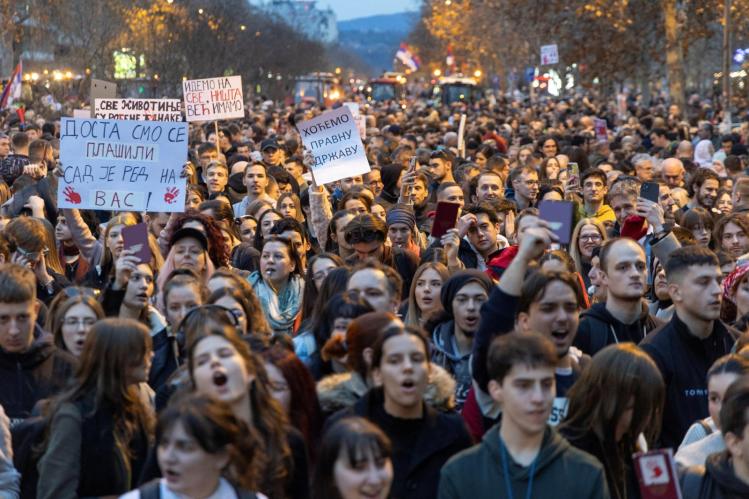
Serbia, the main perpetrator of the 1990s ethnic cleansings in the Balkans, did make some headlines in March, when egregious government corruption led to strikes and thousands of protesters in the Serbian capital, Belgrade. The spark was a deadly infrastructure collapse at a train station, which demonstrators claim was due to governmental negligence and incompetence. More broadly, the protestors have demanded transparency and accountability from the increasingly autocratic regime of President Aleksandar Vučić. Under Vučić’s leadership, Serbia has also sought to reassert control over Kosovo, a former province that declared its independence in 2008. While many countries, including the United States, recognize Kosovo’s autonomy, Serbia still refuses to let it go. To Serbian patriots, Kosovo is the cradle of their national pride: in the Battle of Kosovo in 1389, medieval Slavs are said to have fought to the last man against the invading Ottoman Turks, defending the supposed frontlines of Christian Europe.
Though U.S.-Serbian relations have not been much in the news, Trump does have his eye on the country. His approach to the region is Trumpian in the truest form: fusing his personal business interests with political policies. He has long hoped for a Trump Tower to grace the skyline of Belgrade, and he sent Don Jr. to the capital in March to talk business with Serbian leaders. A year ago, one of Jared Kushner’s businesses secured a ninety-nine-year lease on a plot of Belgrade real estate, though an ongoing Serbian anti-corruption case against that deal has paused the project. The lot they were inspecting is only underdeveloped because of NATO’s 1999 bombing of the Serbian capital. It was the United States that authorized and even pushed for the 1999 NATO bombing of Serbia to bring it to heel over its violent demographic engineering in Kosovo, and to this day, the United States has troops stationed in Kosovo to maintain the country’s autonomy. In 2020, however, Don Jr. tweeted that all U.S. soldiers should be withdrawn from Kosovo—a proposal that Serbians would be eager to embrace. At the very least, taking a friendlier stance toward Serbia would constitute a volte face for U.S. foreign policy in the region.
All of this is exactly on brand for Trump and his government-cum-corporate administration: cut down on America’s foreign entanglements because it ostensibly makes good business sense for balancing the country’s budget. But, as usual, it also pads his bottom line. Though he has not yet indicated so publicly, he has certainly curated lucrative options for himself. He could easily drop American backing for Kosovo as a quid pro quo with Serbia for the right of first refusal for prime real estate in the heart of Belgrade. The whiplash effect of such an about-face is a bonus for Trump, one more gleeful attack on American policy norms.
Since Trump can so easily be led around by his wallet, Kosovo has felt compelled to find some homegrown options for its own protection. That includes Kosovo’s recently signed defensive alliance with Albania and Croatia, both of which also have their own exceedingly violent histories with Serbia. Albania and Serbia fought a host of conflicts over the twentieth century, and it is Kosovoans of Albanian (and Macedonian) descent that Serbian nationalists see as threats to their visions of Greater Serbian glory.
Croatia presents another thorn in Serbia’s western side. By all accounts, Serbians and Croatians should be brothers: neighbors with very similar south Slavic ethnicity and mutually intelligible spoken languages. But historically constructed differences have pulled Croatians to “the West” and Serbians to “the East.” Croats use the Latin alphabet, are majority-Catholic, and were under the umbrella of Napoleonic France’s and then Habsburg Austria’s empires. Serbs use the Cyrillic alphabet, are majority Eastern Orthodox, and were under the umbrella of the Islamic Ottoman empire. Croatia and Serbia had been part of the unified Kingdom of Yugoslavia that was formed after World War I, as a well-intended way of lumping “like with like” in the Wilsonian era of national self-determination. But the line between fraternity and fratricide soon proved thin.
During World War II, just before their grand invasion of the Soviet Union in summer 1941, the Nazis invaded Yugoslavia, and they did what every European empire-builder always did: divide and conquer. They played up and played upon the Croat-Serb divide for their own advantage, setting up a fascist Croatian puppet state in Yugoslavia to do their dirty work. At its helm was the Ustaša political-paramilitary organization. Meaning “Insurrectionists,” the Ustaša were the right-wing Croatian terrorists responsible for assassinating Yugoslavia’s king in 1934, at which point they found asylum in Mussolini’s Italy. During the Second World War, the Axis Powers turned to them to administer a collaborationist new regime: the Independent State of Croatia.
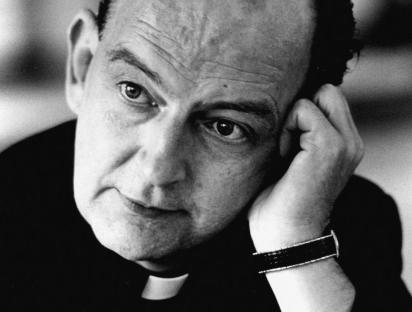
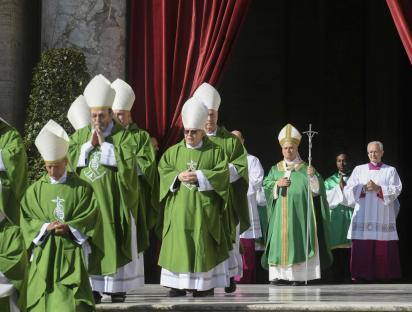
The Catholic, fascistic, Ustaša-dominated Independent State of Croatia unleashed hell on Orthodox Serbs, Muslim Bosnians, and Jews across Yugoslavia. They built and operated their own concentration camp at Jasenovac to eliminate their now racialized enemies. The Catholic Church in Croatia had a will-they, won’t-they dynamic with the Ustaša: they supported the revanchism of a Catholic Croatia in broad terms, speaking favorably toward the Ustaša’s goal of making Croats the dominant south Slavic ethnoreligious group. But over time, the Church shied away from the Ustaša’s genocidal, fascistic project. The lines between the Church’s complicity, condonement, collaboration, and cheering on were never quite clear and remain debatable to this day. The Church’s leader in Croatia during the war, Archbishop Alojzije Stepinac, remains a highly controversial figure in the Balkans—a tragic Christ figure to Croats and a Satanic priest to Serbs. Indeed, the newly liberated Yugoslavia placed him on trial after the war for his wartime record, and it remains to be seen whether the Vatican will canonize him as a saint persecuted by Communists.
The Second World War thus brought to the fore longstanding rivalries and offered a chance to settle old scores. When Yugoslavia was reconstituted after the war, those wounds did not go away. Rather, they were temporarily frozen over by Tito’s Cold War Communist dictatorship. Tito was born in Croatia, but his Communist ideology, undeniable wartime record as an anti-Nazi partisan leader, and sheer cult of personality kept the multiethnic country together. After Tito’s death in 1980 and Communism’s fall in 1989, Yugoslavia lost its two main binding agents. Without the centripetal forces of Titoism and Communism, the centrifugal forces of nationalism spiraled out of control until the country pulled apart in the 1990s. And the divorce was violently messy, even genocidal.
This fast ride through the turbulent history of the region provides a bit of context for the geopolitical map of the Balkans that exists today, along with the origin of the condescending word “balkanization”—meaning tribalist division that repeats in miniature ad absurdum. But it also helps us make sense of the ongoing dynamics at play as the Trump administration careens along a rollercoaster of its own making, bringing the peoples of the world along with it. Kosovo clearly feels compelled to seek defensive alliances from its neighbors to secure itself against Serbia, which Trump will probably no longer restrain with U.S. policies, troops, or with NATO, whose unity is itself under threat from the Trump administration.
Kosovo’s use of regional Balkan politicking is a perfectly logical response to being left in the lurch, but it means we are possibly seeing the Balkans fall back on bad habits. The Balkans have been such a geopolitical quagmire for their own inhabitants and for “Great Powers” alike because of these ensnarling webs of alliances, which have infamously escalated regional scuffles into much larger conflicts.
The kleptocracy against which the Serbian people have been protesting probably sounds pretty good to Trump, whose particular brand of economic foreign policy combines nationalist protectionism with neoliberalism for himself and his entourage of fellow billionaires. Given his businessman’s approach to foreign policy and to governance more broadly, his exact path forward is often left intentionally unclear for the sake of destabilizing his opponents and keeping his options open.
What is clear is that, to Trump in particular, the Balkans present yet another card to be shuffled around in the game of power politics, potentially with Russia and China. Neither Russia nor China recognize Kosovo as an autonomous, sovereign country. Instead, both back Serbia’s claim on the breakaway region. Sacrificing Kosovo to Serbia is not about just Kosovo or Serbia—with the Balkans, it’s never just about the Balkans.
Trump, who undoubtedly cannot place Kosovo on a map, would not hesitate to relinquish it to Serbia as a bargaining chip in his relations with Moscow or Beijing. If America went to bat for Serbia at Russia’s behest, it would prove Karl Marx’s adage true: history repeats itself, first as tragedy and then as farce. The tragedy of the First World War stemmed in no small part from the Western Great Powers—France, the UK, and later the United States—backing Serbia as Russia’s Trojan Horse in the Balkans. It’s a role that the Balkans have been made to play many times throughout the modern period. This time, it would be for the prospect of a new Trump Tower in Belgrade.
Perhaps Trump and his team would do well to keep in mind the greatest lesson of the Balkans for outside powers: any attempt to manipulate the region for external benefit always backfires spectacularly. The Balkans are the graveyard of empires, and for all its exceptionalism, America would be no exception.