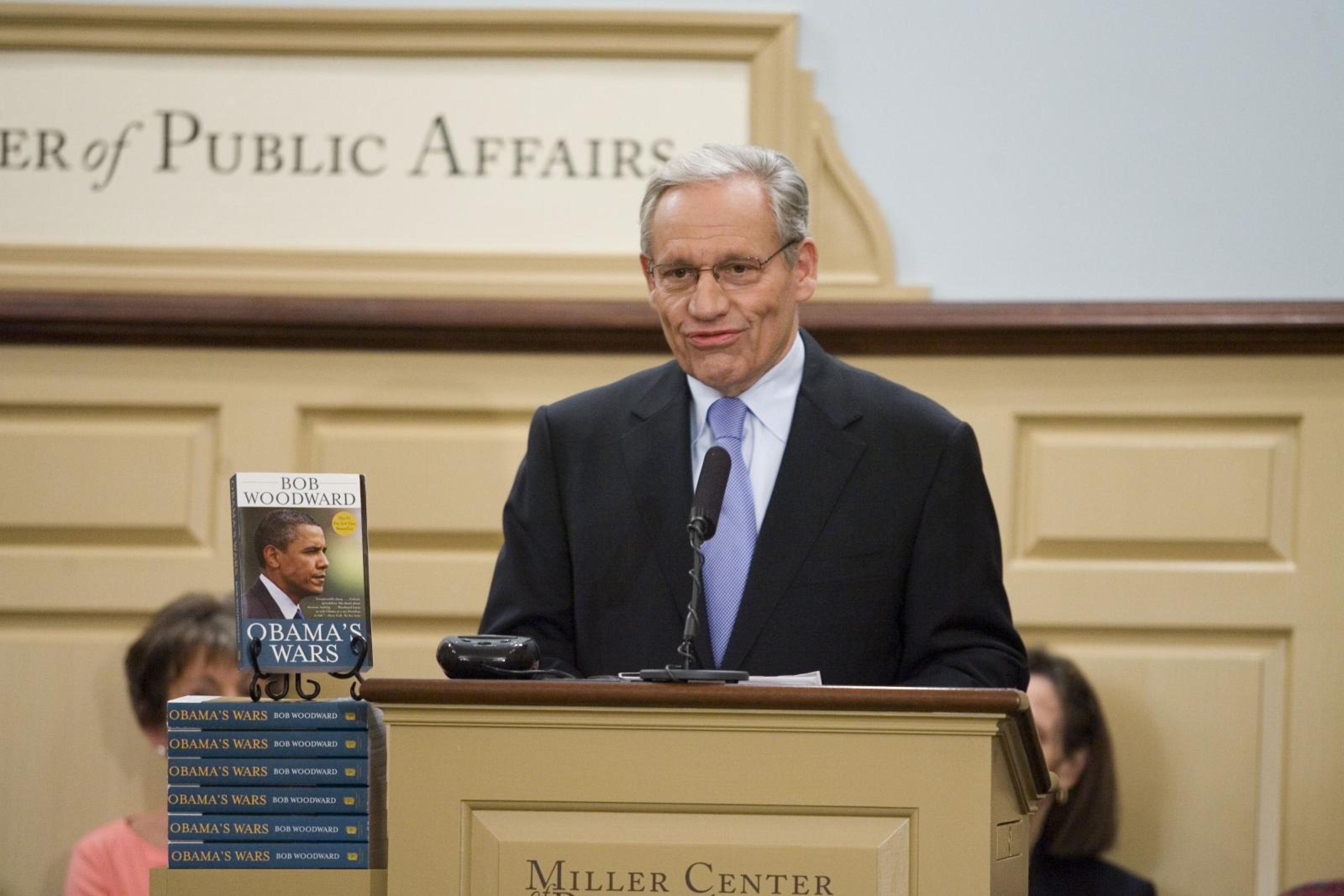
Noam Chomsky once remarked that Watergate was equivalent to the revelation that the directors of Murder Incorporated cheated on their income tax. Not very significant, considering the magnitude of their other crimes. Bob Woodward would have no idea what he meant.
Woodward has become America’s chief celebrity journalist by collecting gossip in high places. What the White House chief of staff said to—or better, about—the secretary of state; how the national security adviser outmaneuvered the secretary of defense; a carefully calibrated, sycophantically reticent estimate of exactly how dumb one or another Republican president was—this is Woodward’s metier. Power struggles and personal idiosyncrasies; how decisions are made but never the deep social forces that determine what is or is not up for decision; and never, above all, whether his carefully cultivated sources have decided to do something criminal, as American governments so frequently do—that defines Woodward’s purview.
Woodward’s shortcomings were thrust upon the readers of The New Yorker’s October 26 issue, in which he reflects on his long friendship with Richard Darman, a high White House staffer in the Reagan and two Bush administrations. Darman was Woodward’s closest non-journalist friend; he admired Darman enormously. This reader, at least, cannot understand why. Darman was a “hatchet man,” a leaker and backstabber for James Baker, the folksy Texan chief of staff who came out on top in the Reagan White House. Darman gave Woodward and other reporters dirt on Baker’s rivals within the Reagan administration. Secretary of State Alexander Haig was a “joke,” an “ass-kisser,” “insane,” and “a danger to the republic.” Presidential councilor Edward Meese was ignorant and a tax cheat. CIA director William Casey was “hopelessly out of touch.” How thrilling and edifying it all sounds.
Meanwhile, what else was happening in the Reagan White House? In November 1985, the great historian Walter Karp published an essay in Harper’s, “Liberty Under Siege,” chronicling the first campaign of the now decades-long Republican war on accountable government under the rubric of the “unitary executive.” “What we are witnessing,” warned the American Civil Liberties Union as early as November 1981, “is a systematic assault on the concept of government accountability and deterrence of illegal government conduct.” Apparently, Woodward wasn’t witnessing it, even though his best friend and source was right in the middle of it and central to implementing it.
In June 1981, The Washington Post reported: “Administration Attempting to Stem Information Flow to a Trickle.” On the pretense of cutting “wasteful expenditure,” the Reagan administration drastically reduced the publication of government reports, which had served as the public record, and on which journalists and public-interest researchers relied to monitor the government’s performance. In July 1981, The New York Times reported: “The White House is structuring key advisory panels so that they do not fall under the public meeting rules of the Advisory Committee Act.”
During the same year, the administration submitted to Congress the Orwellian Freedom of Information Improvement Act, which made it much more difficult and expensive for citizens to use the Act and greatly restricted its range. The Reagan administration pioneered the use of cost-benefit analysis to narrow the use of the Act and to begin the long Republican campaign to extend the jurisdiction of the Office of Management and Budget in order to restrict the exercise of congressionally mandated rights. (Darman was director of the OMB under Bush I, so he may well have been one of the architects of this strategy.)
In October 1981, “in the most sweeping assertion of executive secrecy in our history,” President Reagan declared that all information that is part of the executive branch deliberative process lies beyond the oversight of Congress. In December, he signed an executive order authorizing the CIA for the first time to collect “foreign intelligence” inside the United States by surreptitiously questioning U.S. citizens.
In March, an assistant secretary of commerce declared that the administration was “determined to combat the strong belief in the academic community that they have an inherent right to conduct research…free of government review and oversight.” He proposed fines of up to $100,000 for exporting technical data without a government license, defined to include lecturing to even a single foreign student. Similar penalties were proposed for revealing “vulnerabilities or capabilities of systems, installations, projects, or plans relating to the national security”—an absurdly vague and over-general formulation clearly meant to deter revelations of waste, fraud, and abuse in military spending.
The Department of Health and Human Services proposed that “all changes in rules affecting the aged, the poor, the young, and the disabled henceforth be promulgated without public notice or comment.” A cost-benefit analysis had persuaded the department that the “delay” caused by public participation in the rule-making process “outweighed the benefits of receiving public comment.”
The declassification program begun by President Eisenhower in 1953 was halted and many declassified documents were reclassified. Executive Order 12291 provided that Congressional enactments could be declared not “cost-efficient” and not enforced—an assertion of executive prerogative that would metastasize in the Bush-Cheney and Trump administrations, enabled by the judicial radicals of the Roberts Court.
In January 1983 the While House proposed new rules, according to which “thousands of private organizations that received federal grants…from the Girl Scouts to the Association for Retarded Citizens, must forfeit federal funds if they speak out on public affairs.” Two weeks later, Reagan signed an executive order banning “any organization that seeks to influence the determination of public policy” from participating in the federal government’s lucrative charity drives. The White House proposed stopping funding the publication of the Survey of Income and Program Participation, which assessed the effects of welfare policies, the Annual Survey of Child Nutrition, the Annual Housing Survey, several bulletins on occupational hazards and newly discovered toxins. It eliminated or reduced fifty major statistical programs. Clearly, that administration did not want to know, and did not want the public to know, very much about the health and welfare of the population.
Next, the Reagan administration’s war on open government turned to national security. In March, the president’s National Security Decision Directive 84 provided that all government employees with access to “sensitive compartmentalized information” must sign contracts that subjected them to an extraordinary system of official censorship if they wished to publish a book, article, or even letter to the editor containing “any information” related to “intelligence”—a clear attempt to prevent criticism of the administration by those most qualified to provide it. To prevent criticism of the Reagan administration’s notoriously wasteful military buildup, a provision was slipped into the 1984 Omnibus Defense Authorization Act to “withhold from public disclosure any technical data with military or space application that could not be released to a foreigner without obtaining an export license”—an obvious ploy to prevent the release of such information to Americans.
In September, the OMB decreed that all government agencies must submit to the White House clear proof that any information they make public must pass a cost-benefit analysis. The American Library Association posed the obvious question: “What is the dollar value of an informed citizenry?”
There is much more. Relentlessly, Karp detailed the Reagan administration’s all-out war on accountability and open government. And on Woodward’s showing, his friend Darman, one of the half-dozen key figures in the Reagan White House, was at the center of it all—evidently a prime villain and a menace to liberty and democracy. Either Woodward did not notice all this malign activity or he did not think it worth mentioning. Either his ignorance or his judgment was appalling—then and now.
Many great journalists have appeared in The New Yorker: Seymour Hersh, Jonathan Schell, Jane Mayer, Bill McKibben, among others. (Not, to its shame, Walter Karp.) Bob Woodward emphatically does not belong in that company.
We welcome your comments about this article. Please send your response to [email protected].