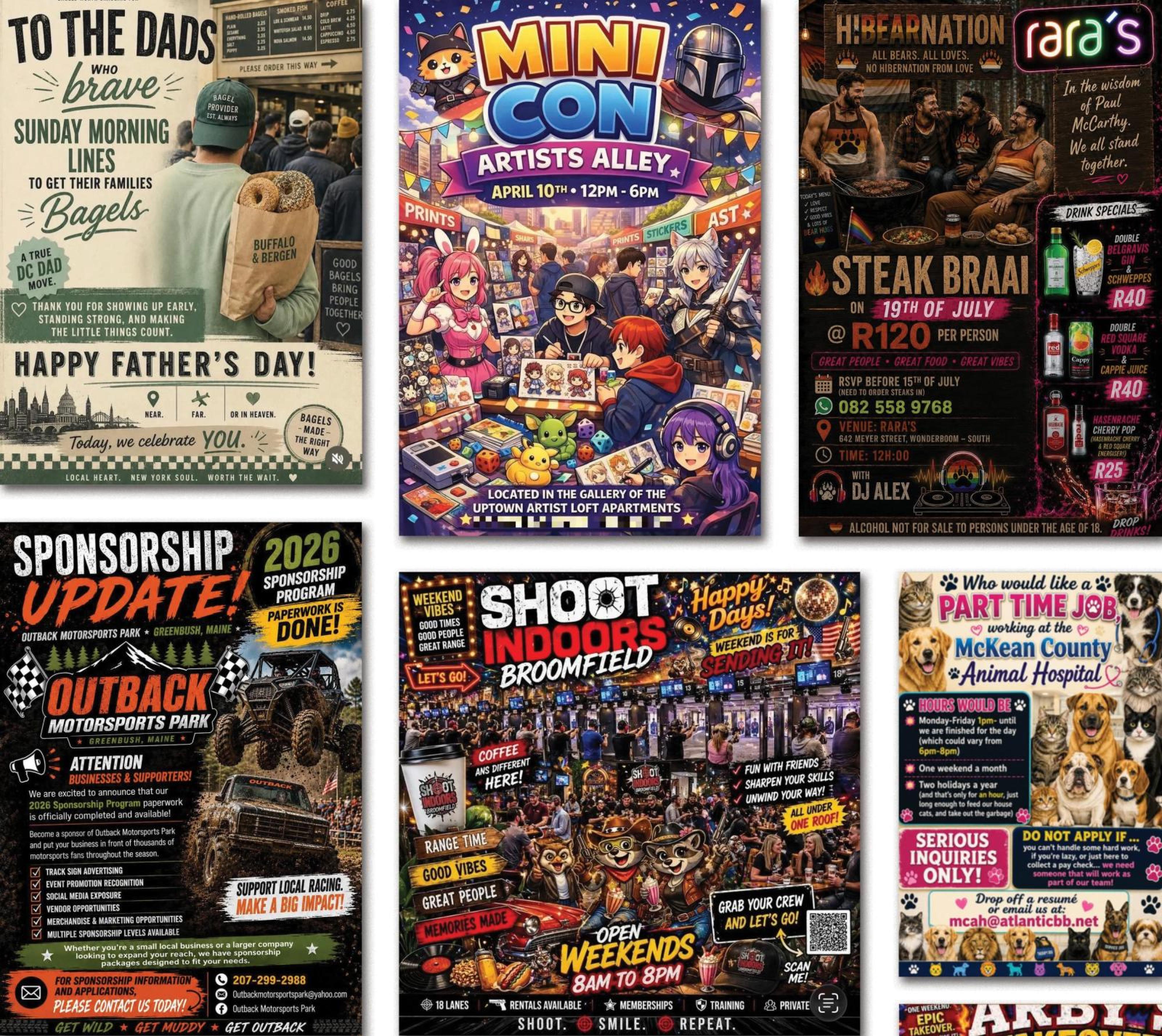
As a professor, the ingression of artificial intelligence into academic thinking and writing troubles me. But nothing depresses me quite like the AI takeover of ephemera. I’m talking about the humble flyer—the one-off sign you make by hand or fire off in Microsoft Word (or Canva if you’re fancy) to advertise the parish picnic or the hiring fair or the restaurant grand opening. The world is awash in what can only be described as offensively ugly AI-generated flyers.
If you don’t know what I’m talking about, I regret to inform you that you do. Look around, and you will see it. The AI-generated flyer features so much visual stimuli that it makes a person lament the invention of color. Six different typefaces. Giant words. Tiny words. Brushstroke effects. Gradients. Meaningless icons. Flames. Confetti. If Lisa Frank were an HR department and also a fireworks superstore, it would look like an AI-generated flyer.
As with all AI-produced content, the novelty of this busy, overproduced graphic-design form has quickly given way to banal, embarrassing sameness. Given that the large language models (LLMs) that drive AI output have ingested the entire internet, it is remarkable how rapidly and conclusively AI has consolidated its aesthetic style. Not long ago, we fretted over what seemed like growing indistinguishability between human and AI writing. But today, AI’s literary tropes have become comically easy to identify: the fawning, sycophantic affirmation of human interlocutors, the “not x but y” sentence constructions. If a student paper about, say, changes in Catholic practice after Vatican II sounds suspiciously like a TED Talk (“It wasn’t just a council. It was a revolution.”), I can be 90 percent sure it was written by a computer.
AI-generated images—both those masquerading as photos and those purporting to be art—bear a similar stylistic uniformity. At the turn of the millennium, we all imagined the twenty-first-century technofuture cast in metallic shimmer. But today’s virtual subjects glow from within with bilious warmth, seemingly incubating in some empty limen between indoors and outdoors. A recent Google search for a back-to-school haircut for my daughter—the same search that for years has turned up photos of actual kids with actual shoulder-length bobs—this time returned image after uncanny image of glowing, doll-like girls with too-shiny eyes and too-pointy chins and too-glassy skin. It felt pornographic, this AI-produced sea of adult-fantasized child beauty.
You might like: Susan Bigelow Reynolds on the Cybertruck
Next to creepy deepfakes and plagiarized term papers, AI-generated event flyers seem like a minor thing to complain about. But their sudden ubiquity and bizarre visual style help us decipher something fundamental about the cultural reception of AI today. In her 2023 book Immediacy: Or, The Style of Too Late Capitalism (reviewed in the November 2025 issue of Commonweal), philosopher Anna Kornbluh argues that contemporary cultural production is defined by the rejection of mediation—that is, by a demand for instantaneity. From fiction to material culture, from theory to film, contemporary cultural aesthetics renounce distance—whether it’s symbolic, temporal, theoretical, or narrative—in favor of the immediate: the first-person, the raw-and-in-your-face, the literal, the immersive; in short, the “real.” The roots of this cultural shift are multiple. Algorithm-driven capitalism rewards constant circulation and on-demand production optimized on a granular level to match consumer desire. The shattering of grand-history metanarratives has made theory seem callous and fiction feel cringe. And then, of course, there is the fact of living within irreversible planetary catastrophe (the titular “too late”). We grasp for a frenetic, oversaturated style to match the relentlessness of the present and the impossibility of the future.
AI is, in an obvious sense, a technology of the immediate. Type a prompt into Claude; get a response. Train an AI agent; automate your workflow. But alongside the mediated and the immediate, AI seems to be doing a third thing, or perhaps several things. On the one hand, it outsources the work of mediation. Whereas the immediacy economy thrives on the commodification of first-person self-disclosure (think of Instagram influencers, or the rise of autofiction and autoethnography), AI builds a beltway around the inner life, creating products that come to birth without passing through the inner worlds of their creators. AI conjures images without backstories and pretends them into life. On the other hand, AI overmediates. In a recent interview with Ezra Klein, experimental musician Brian Eno described AI-generated art as “over-digested.” One imagines the LLM as an enzymatic tract, sucking in, breaking down, regurgitating, and reingesting until what we’re left with is proverbial AI slop.
“Nothing in the world of AI is immaterial or magical,” cautions Pope Leo in his recent encyclical Magnifica humanitas. “Every seemingly immediate and flawless response is the result of a long chain of mediation, involving vast networks of natural resources, energy infrastructure and, above all, people.” Perhaps it’s accurate to say that AI feeds—and feeds on—the cultural demand for immediacy, both in the speed of its output and in its prevailing aesthetic sensibility. AI flyers certainly epitomize Kornbluh’s description of immediacy style’s “image overload” and “hyperfunctioning…visuality.” But AI’s immediacy is primarily an illusion. Concealed behind the frictionless user interface is the “long chain of mediation”—human, algorithmic, and environmental—responsible for doing the generative work of generative AI. It is the disguise of immediacy that enables AI-made content to masquerade as neutral and self-evident rather than perspectival, ideological, and powerful.
Ironically, unmasking such interests is what prompted the large-scale cultural rejection of mediation that Kornbluh identifies. Claims of universality by the great institutions of mediation—the Church, the sacraments, the academy, the classics—were problematized and deconstructed; in their place rose the postmodern culture of the fragment, and now, the post-postmodern culture of the immediate. By embracing AI, we haven’t abandoned mediation so much as hidden it where we don’t have to look at it, pretending instead that what we see is ourselves.
The Ugly AI Flyer rose to ubiquity mainly, I imagine, because it offers ordinary people the illusion of competence in graphic design. I myself certainly do not know how to produce something that looks like that on my own. But now that they’re everywhere, the spell has worn off. It’s a reminder that we are too easily impressed—too charmed by AI’s flattery, too wowed by its pretend magic.
We welcome your comments about this article. Please send your response to [email protected].