Many readers will be familiar with “The Little Drummer Boy,” a 1941 Christmas song (and 1968 Rankin & Bass claymation TV special) about a boy who, too poor to offer a real gift to the infant Jesus, breaks through the silent night playing his drum as an offering. Fewer readers may be familiar with Gian Carlo Menotti’s 1951 opera Amahl and the Night Visitors, despite the fact that its title character shares the little drummer boy’s predicament. When the caravan of the Magi stops by Amahl’s humble shack en route to Bethlehem, the limits of generosity and the meanings of charity are probed and transformed.
Although the Little Drummer Boy’s “pa-rum, pum-pum, pum” has proved more irresistibly catchy, it has been estimated that Amahl and the Night Visitors has—or at one point had—been heard by more Americans than any other opera. On Christmas Eve 1951, NBC broadcast the world premiere of the work live from 30 Rockefeller’s Studio 8H, the current home of Saturday Night Live, across the United States, where it reached an estimated 5 million viewers. It was the first opera expressly written for television, and within a year it had become a holiday tradition.
For those of a certain generation, Amahl and the Night Visitors fit in snugly alongside The Nutcracker and Messiah not just as a Christmas fixture but as one uniquely accommodated to their living rooms. Running under an hour, it tells a simple and sincere original story about a physically disabled young boy who encounters the Three Kings on their way to meet a child who has “the moon and the stars at his feet.” Menotti’s opera, for which he provided both the music and the text, was performed annually on NBC until the mid-1960s when the composer withdrew performance rights from the network following a dispute.
But despite its origins, Amahl was never intended to be confined to the television screen and has lived on since its premiere in recordings, opera houses, school auditoriums, and church basements. This month, Amahl comes to a new basement—the underground Mitzi E. Newhouse Theater at Lincoln Center, where it opens on December 16 in a new production starring mezzo-soprano Joyce DiDonato and Tony Award–winning director Kenny Leon.
“It’s a perfect opera and a perfect piece of theater offering, what I would deem a perfect message,” said DiDonato over email. She told me she grew up listening to Amahl, and this particular production came about at her behest while she was performing in The Hours at the Metropolitan Opera:
I looked over during a stage rehearsal to one of the young singers of the cast and thought, “Oh, he would make the perfect Amahl!” And I stopped myself in that exact moment and said, “Why have I never sung in Amahl? It’s my favorite opera! I want to sing the Mother!”
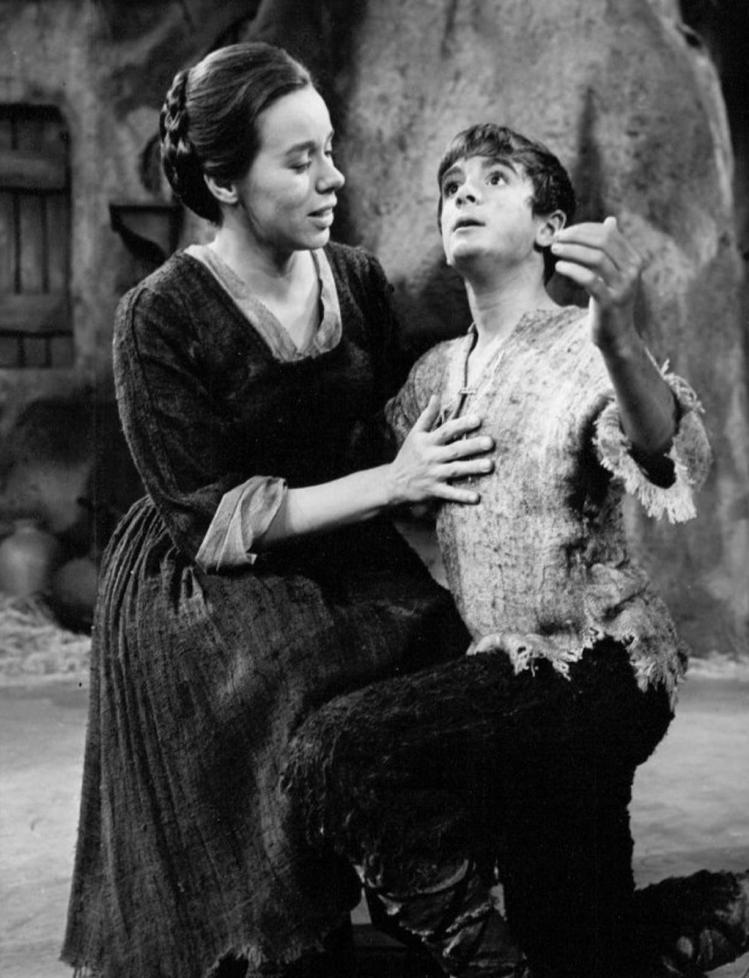
The question at the center of Amahl is what, exactly, generosity looks like—and whether one needs material possessions in order to be truly generous. The young Amahl, performed by a boy soprano, is wily and witty but moves around his hut with a crutch. He and his mother live in deep poverty that they predict will soon drive them to start begging. One evening the three Kings appear on their doorstep to ask for hospitality for the night.
Arriving with animals, a page, and chests of riches, they are bringing gifts to “the child.” “Which child?” the mother asks. “We don’t know,” they respond. “But the star will guide us to him.” The child they seek is both lowly and regal, noble and poor, mild and powerful. The Mother, a well-meaning but short-tempered widow, knows a child who matches the description, “but no one will bring him incense or gold…though sick and poor and hungry and cold. He is my child, my son, my darling, my own.”
It’s a combination of the mother’s jadedness and precarity that spurs her to try to pilfer some of the gold from the Kings once they have all lain down to sleep for the night. “All that gold!” she muses. “I wonder if rich people know what to do with their gold?” Whomever “the child they don’t even know” that the kings are looking for might be, the mother knows that a bit of it would make all the difference for her child, who is just as worthy and lowly as the one the Kings described.
Even though she’s caught in the act, the Kings quickly turn their outrage into mercy: “The child we seek doesn’t need our gold. On love, on love alone he will build his kingdom,” Melchior says. Inspired by this, Amahl and his mother now desire to pay tribute in some way to this child who is in many ways so like Amahl. Just as the drummer boy offers his drumming, Amahl offers up his crutch as a gift. “Who knows, he may need one,” Amahl hazards. “And this, I made myself.”
It’s the “pure generosity” of this moment that encapsulates the spirit of the opera for DiDonato. “Selfless. Pure. Generous,” she says, grounding the upcoming Lincoln Center Theater production in the present moment. “These are the values I strive for and that I mourn as I see our world shifting far from them.”
In the nearly three decades of her professional career, DiDonato has made a priority of threading an activist streak through her distinguished interpretations of baroque, bel canto, and contemporary music. Her career has taken her inside notorious prisons like Sing Sing as a notable interpreter of the character of Sr. Helen Prejean in Jake Heggie and Terrence McNally’s Dead Man Walking, and she has been an advocate for music education in underserved communities internationally through her work with charities like World Voice and El Sistema Greece.
“A few years ago,” she recalled, “I was working with young children in a refugee camp in Athens, and it astonished me [that while I was] surrounded by young children living far from their homes in total poverty, no homeland, they were there at my side offering me some of their food and giving me gifts of hair bands and ribbons.” She sees the same “she may need it” generosity pervading Amahl and the Night Visitors, a generosity that cynics might consider as outmoded and naïve as the flowing, tonal musical language of Menotti’s score. “Wouldn’t it be glorious to have it re-enter the standard repertoire so we can all remember the joy that comes from genuine, abundant generosity?”
Amahl’s genuine, abundant generosity is ultimately rewarded in a miracle that frees him from his crutch and inspires him to join the Kings and undertake the trip to Bethlehem unencumbered. As he sets off, promising to return to his mother and playing his shepherd’s pipe, there’s a slightly plaintive tone; indeed, Menotti never directly resolves the question of how the pair will go on living and feeding themselves once Amahl has returned to his mother. But the opera leaves us with the sense that this humble pair has been somehow elevated through their participation in a new economy of generosity and mercy. The piece moves from a place of desperation to calm, from envy and suspicion to trust and tranquility—all pivoting around the simple and unconditional kindness of one young boy, and his mother’s willingness to overcome her own cynicism to embrace that kindness.
The paradox of Amahl and the Night Visitors is that in its brief run time, limited scope, and straightforward storyline geared toward children, it manages to feel so expansive. While its emotional impact may have been amplified in close-up by the work’s early appearances on primetime TV, Amahl and the Night Visitors takes on a different and equally powerful dimension of intimacy and intensity in a live-performance setting such as the one at Lincoln Center. “A piece like this pulls me back into the place I want to live,” DiDonato told me. And while she “wouldn’t give up any of the other holiday traditions,” she hopes that one day Amahl will regain its stature in the rarefied Christmas entertainment pantheon—to remind us of “a world where true joy and freedom are nurtured through the act of giving.”