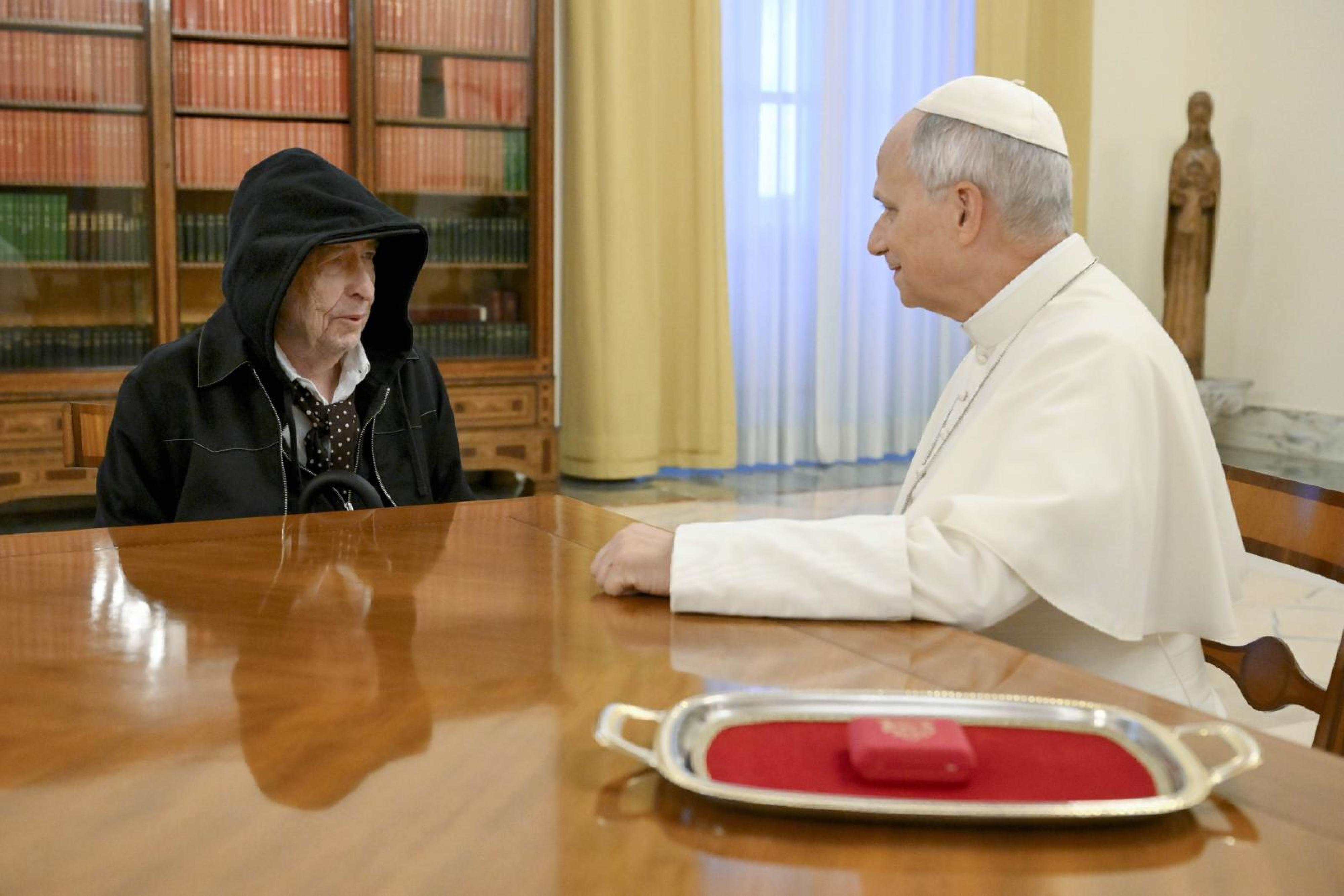
There is something reassuring about the photos released by the Vatican on Wednesday, November 4, of Bob Dylan and Pope Leo XIV. Some have conflated their meeting with the Democratic romp in Tuesday’s midterm elections—the aspiration being that we are witnessing some sort of new American dawn, a resurgent hope for the city on the hill. Perhaps, but Dylan didn’t rock up to the Holy See because Talarico flipped Texas. As ever, Bob will do what Bob will do and there’s no doing anything about it.
Dylan’s career has been remarkably peripatetic, and not just as it pertains to his Never Ending Tour, which has ensured his constant shuffling around the world since 1988. Musically, he has traversed through almost every genre, theme, perspective, time and place, and he has worn a multitude of masks: baby-faced folk singer; dark-eyed, strung-out rockstar; Woodstock hippie; desperado; con-man carny; Christian preacher; and, in his meeting with the pope, Emperor Palpatine in a hoodie. Dylan’s refusal to stay in one place may, in fact, be his most reliable characteristic. But his movement has rarely seemed arbitrary.
Early in his career, Dylan described his upbringing in Minnesota as “an accident of geography.” That was after his high school yearbook was made public. Previously, he claimed to have grown up in Gallup, New Mexico, before running away from home to join a traveling carnival. His tendency for evasion has since made him a mythical figure—but his deflection, indirectness, and even dishonesty don’t obscure his character, or at least the character he wants the public to see at any given moment. Dylan’s career-long slipperiness reveals something essential about him and his art; it also hints at everything inexplicable about him, demanding from fans and chroniclers alike regular revisitation and reflection. “I was born very far from where I’m supposed to be, and so I’m on my way home,” Dylan explained in No Direction Home, Martin Scorsese’s documentary about him.
Dylan’s meanderings have always been intentional and exploratory. Rolling Thunder Revue: A Bob Dylan Story by Martin Scorsese, the filmmaker’s second “documentary” about Dylan, is another instance of masquerade and misdirection. At least two Dylans appear in the film, which recounts Dylan’s eponymous tour between fall 1975 and spring 1976. There’s Dylan in whiteface playing small venues across the United States and parts of Canada with Joan Baez, Joni Mitchell, Roger McGuinn, and other musicians. There’s also seventy-eight-year-old Dylan chronicling the tour as he wants to remember it, telling tall tales about the real artists and fabricated characters who joined him on the road. Dylanologists dismiss the film as a sham-documentary, a clumsy attempt at self-mythology that plays way too fast and loose with the historical record and reality, even for them. (Many of the made-up characters appear in the film as talking heads, recounting their experiences on the tour.) A real person who appears in the film is Rubin Carter, the prizefighter wrongfully convicted of murder and the subject of Dylan’s 1974 protest song “Hurricane.” He said this of Dylan: “Bob always been searching. Every time I see Bob now…I ask [him], ‘Have you found it yet Bob?’ And Bob say, ‘Yeah, I found it.’ But I know he hasn’t, because he keeps searching.”
In a near-perfect exchange, Scorsese cuts to Dylan, who responds:
[Hurricane] always say, “Hey, what are you searching for today,” and I say, “Uhh, what?” He’d say, “I know you’re a searcher, what are ya searching for?” I’d say, “Well, Hurricane, I’m searching for the Holy Grail.” He’d say, “What?” I’d say, “I’m gonna search until I find it, like Sir Galahad. That’s what I’m looking for.”
The boundaries between myth and fact have never existed for Dylan. In “False Prophet,” a song from his most recent album Rough and Rowdy Ways, he sings, “I’ve searched the world over / For the Holy Grail / I sing songs of love / I sing songs of betrayal.” In Dylan’s quest for truth, paradox is all that prevails.
Dylan’s visit to the Vatican means one thing for certain: he’s still searching. Importantly, he has never claimed to have found it, whatever it is. Dylan remains a person who is becoming, or, to borrow one of his iconic lines, someone who’s learned to keep on keeping on: wherever you think he is, he’s already gone. Conversely, the Catholic Church has remained anchored in time, something that, for many people, simply is—history, fact, and unambiguous capital-T Truth.
Pope Leo, who quoted an unpublished 1963 Dylan song (“Go Away You Bomb,” which would likely be considered Apocrypha, even for devoted Bobcats) in his book Disarmed and Disarming: Peace Is a Gift, requested to meet with him a second time and reportedly introduced himself to Dylan as “a son of St. Augustine.” On Dylan’s 1967 record John Wesley Harding (named after an infamous nineteenth-century Texan gunslinger) is the ostensibly incongruous track “I Dreamed I Saw St. Augustine,” on which he sings: “I dreamed I saw St. Augustine alive as you or me / Tearing through these quarters in the utmost misery / With a blanket underneath his arm / And a coat of solid gold / Searching for the very souls / Whom already have been sold.”
The son of St. Augustine is similarly concerned with the selling of souls and the exploitation of man. In his first encyclical, Magnifica humanitas, he warned about the encroachment of Big Tech’s artificial intelligence on human dignity and art. And while Leo is anchored to the Church and its Truth, it seems that he is still searching, too: for a way to discern flourishing, elevate the mind, and retain our creative instincts in an age of chatbots and cognitive surrender. Dylan’s career, in all its different iterations, certainly runs parallel to that pursuit. His tendency to shapeshift, his drive to reinvent himself and his songs, is so absolutely original, so unequivocally human, and so wonderfully true to the act of creating art that it’s no wonder the pope, a longtime fan, recognizes him as a kindred spirit and a fellow traveler looking for something more.
We welcome your comments about this article. Please send your response to [email protected].