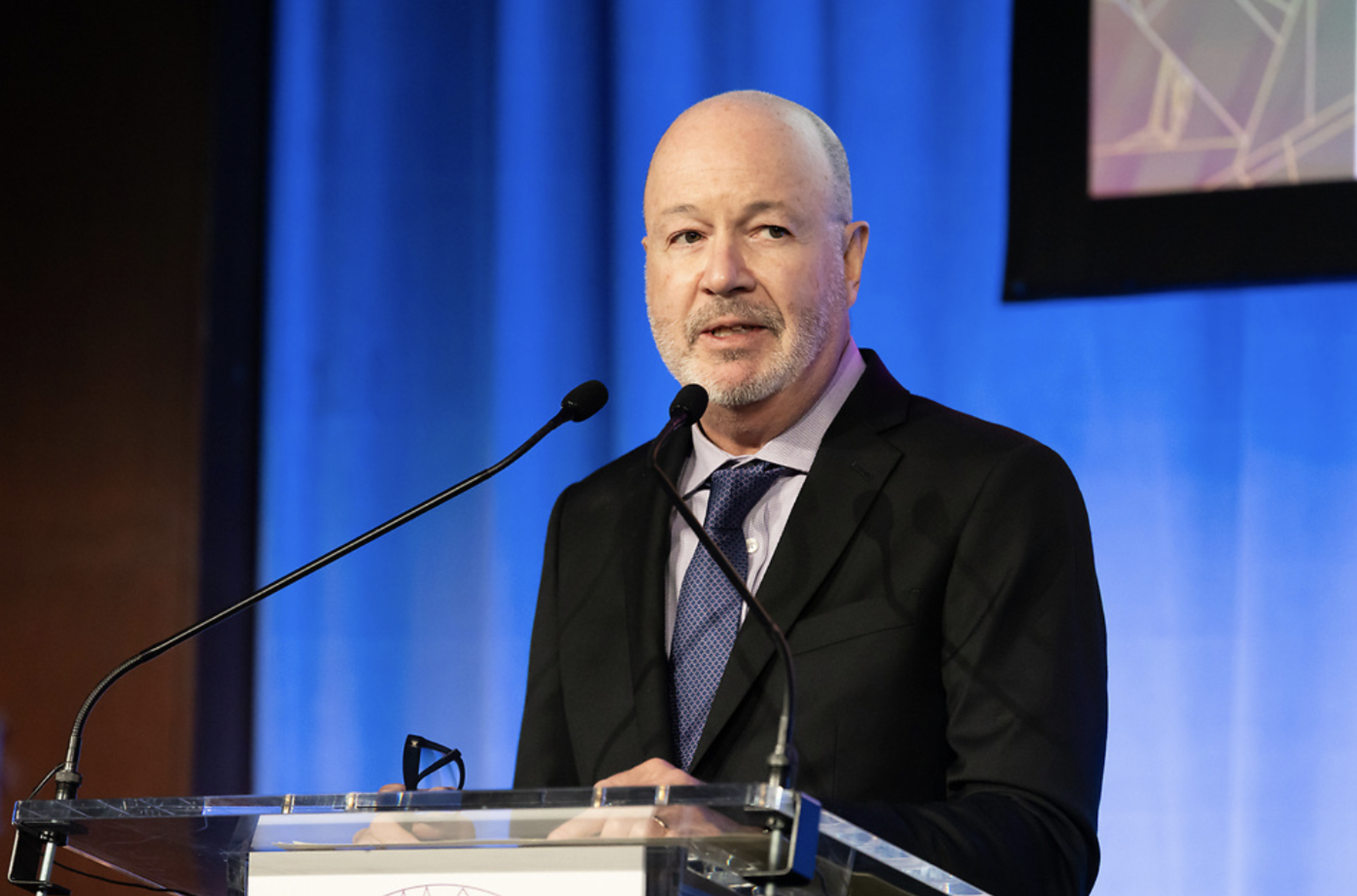
Commonweal editor Dominic Preziosi delivered the following remarks at the Commonweal Benefit Dinner on October 5, 2026, in New York City.
My name is Dominic Preziosi and I am the editor of Commonweal. I am delighted to welcome you all to the 2026 Commonweal Centennial Gala, where we have gathered to celebrate our Centennial Award honoree Fr. John Jenkins, president emeritus of the University of Notre Dame.
I want to begin by extending thanks on behalf of Commonweal to all who have made this gathering possible. These include our event committee co-chairs, our good friends Tom and Allison Franco, along with Jack Brennan, Connie O’Brien, Kerry Robinson and our entire dinner committee. I also want to mention previous Commonweal honorees in the room with us tonight — including Kerry, president and CEO of Catholic Charities, who was our honoree in 2022. And Fordham University president Tania Tetlow, our inaugural Centennial honoree at this event two years ago.
Then there are our featured guests, the writers who’ve made so many contributions to the magazine over the years.
I also want to take this moment to highlight our Commonweal writing fellows. Some of them are in the room with us tonight, and there is some news to share about them as well—but I’ll ask that you hold your applause until all is revealed!
First I want to welcome Aaron Robertson, our inaugural Centennial fellow, whose work for the magazine and whose multipart podcast on Black Catholic parish closures in Detroit have been highlights for Commonweal over the past year — work we feel incredibly honored to have brought to our audience.
I’m also proud to announce our 2026-2027 Centennial Writing Fellow: Arvin Alaigh. Arvin recently earned his Ph.D. in history at the University of Cambridge, and his fellowship project will examine the historical and current state of nonviolent activism by faith-based groups. We are very much looking forward to featuring Arvin’s work in the year to come. And we are most thankful to Karen Sue Smith and Rose DiMartino — also here tonight — whose generous support has made the Commonweal centennial fellowship possible.
Now, there are two more awardees to mention — the winners of our inaugural Edward Skillin Society awards, which celebrate the work of promising new writers. One award recognizes excellence in journalism related to Commonweal’s mission and values. The other is presented to a writer actively involved in advancing social justice through their writing.
The winners this year are Naomi Fisher, an assistant professor of philosophy at Loyola University Chicago, who won the Society’s excellence in journalism award for her essay “Little Life Ruiners,” which ran in the February 2025 issue of Commonweal. And Julian Asselle, for his essay “Forgiving My Mother’s Killer.” Julian is a joint-degree MA/MSW student at Yale Divinity School and Quinnipiac University training to be a social worker. His essay ran in the February 2026 issue — and we’re happy that Julian is here in attendance tonight. Now, please now join me in congratulating all of our writing fellows.
There are many connections between Notre Dame and Commonweal. A number of our editors, staff, contributing writers, and board members are Notre Dame alumni — undergraduate and graduate alike. I am not among them. An oft-told story in my family is about the time my father, back in the fall of 1982, when I was a high-school senior, handed me a small highly curated list of colleges I was allowed to apply to. Most if not all were Catholic. But one was conspicuous by its absence. “Why not Notre Dame?” I asked. He answered: “No son of mine will ever go to Notre Dame.” I assumed it was because of the distance — South Bend was very far from New Jersey, where I grew up, or perhaps because that it wasn’t a Jesuit school (we were a Fordham family). But the real reason, it turned out, was Digger Phelps. If no one knows that name, he was at the time the coach of the Notre Dame men’s basketball team. But before that he had been the coach at Fordham—for all of one year, in 1971, leading Fordham to a No. 9 national ranking and the Sweet 16 in the NCAA tournament before abandoning the Bronx for blue-and-golder pastures. “When Digger Phelps stiffed Fordham after one year,” my father said, “I swore I would never let any of my children go to Notre Dame.”
I’ve since been able to visit Notre Dame many times, and I have met many wonderful people, some who have become good friends. I’ve gotten to look at the Commonweal archives, housed at the Hesburgh library. I’ve even been to some of the spectacular spaces atop the football stadium — though I haven’t yet been to a game. The ties between the magazine and Notre Dame are deep, dating to our earliest days. One particular episode is illustrative — and I know that Fr. Jenkins will speak to it more directly, but it involves our first managing editor — Notre Dame graduate George Shuster — and his role back in 1925 in sparking a long and fervent discussion over the state of Catholic education — prompted by a controversial and critical editorial he wrote about his alma mater, for which he was branded “a liberal Catholic” bent on undermining the Church as well as the nation. This was a charge to be leveled at Commonweal with some regularity in the century to come. But, more to the point, the episode kicked off a long and “free-swinging discussion of the state of Catholic colleges education” in general.
These debates would emerge again and again through the 20th century, in time leading to another controversial, Notre Dame-related editorial published by Commonweal, this in January 1994, assessing a papal declaration entitled victoriae splendor. Victoriae splendor, the editors explained to readers, “apparently orders American Catholics to recognize the University of Notre Dame as the nation’s No. 1 football team.” It warns against “undue acquiescence” to polls and computer rankings that officially awarded Florida State University the national championship, even though Notre Dame had earlier beaten them head-to-head. Now, the issuing of such a papal declaration has never been confirmed, though given Our Lady’s influence, the possibility of its authenticity is not entirely farfetched. But the Commonweal editorial went on to make a promise, in true Commonweal fashion, that “the magazine’s next issue would be completely devoted to a symposium on Victoriae splendor aimed at promoting a discussion that will go beyond the sterile polarization of the Right and Left.”
Promoting discussion. Encouraging debate. Fostering rigorous and reflective exchanges about faith, public affairs, and the arts — it’s all there in our mission statement. Our October issue, which features a multipart symposium on the 60th anniversary of the famous Time magazine cover “Is God Dead?” is emblematic. But it is only one example among recent others that include a discussion on the future of Christian Democracy worldwide, another on how the Vatican might handle the difficult challenge presented by the undermining of democratic institutions in this country by the second Trump administration, one on how the Church and civil society can recognize and honor the humanity of those dealing with mental illness, and a forum on the notion of “universalism” featuring a Jewish theologian, a legal scholar and intellectual historian, and a Catholic philosopher of religion. All of these are very Commonweal in their intent and execution.
We also devoted a symposium to Pope Leo the Fourteenth’s encyclical on artificial intelligence, Magnifica Humanitas, which he issued last May. In our July/August issue this past summer, six authors took to our pages to comment on the encyclical, an encyclical that reorients Catholic social teaching toward the political and economic problems that have emerged in this century, and that proposes a robust Christian humanism in opposition to those who hope to transcend the human condition or replace the human race. Leo reminds us in his encyclical that “Finitude, when truly accepted, does not diminish us but opens us to recognizing the face of God and others. Indeed, precisely because we experience limits—vulnerability, suffering and failure—we can recognise the inviolable dignity of every person, both our own and that of others” and that, further, “No computational system, however sophisticated, can create a heart that gives itself, or a conscience that discerns good from evil. Even when machines excel in efficiency, a human face that asks to be gazed upon remains the center of our history.” On the cover of that issue, we teased the symposium with the cover line “The Human Difference.”
The human difference is something we experience and indeed appreciate when we gather in spaces like these, with friends like you, and when, whether in the pages of our magazine or on our website, or through our podcast or email newsletters, or in public panels like yesterday’s at Fordham University led by Aaron Robertson, we continue to provide a platform for reflective discussions about faith, public affairs, and the arts. We recently felt it necessary to implement a fairly stringent AI policy regarding articles submitted to us — but we did so for a reason. We believe that for such discussions to exist at all, our readers must be able to trust that the articles they are reading, considering, and engaging with are written by humans.
Increasingly, I’m happy to say, “the human difference” is also being made manifest through the many new partnerships and collaborations Commonweal is developing with like-minded organizations, academic institutions, and other groups. You already saw the video describing our work with the Franco Family Institute at Notre Dame—whose mission we’re truly honored to be associated with. In recent months Commonweal has been an active participant as well in gatherings across the United States and abroad. We were on hand for this summer’s colloquium of the Academy of Catholic Hispanic Theologians, where we got to spend time in conversation with established scholars and young writers alike. We recently traveled to Santa Clara University’s Jesuit School of Theology for sessions with students and faculty and to take part in a panel on Pope Leo’s AI encyclical. We’ve been to Georgetown for convenings on Latino Catholics and on Pope Leo’s exhortation Dilexi te sponsored by the Initiative on Catholic Social Thought, as well to Georgetown’s Berkley Center for Religion, Peace, and World Affairs for a convening on the relationship between democracy and encounter. All of these on top of a multiday gathering co-sponsored by USC’s Institute for Advanced Catholic Studies and Oxford University, held at Oxford, on religion and democratic resilience. And I think we have representatives of many of these organizations and initiatives here with us tonight.
And I’m so glad that there are so many of you here with us tonight. It is, to say the least, a challenging time in our country and in the world — what with the concerns and worries posed by the rapid rise of artificial intelligence, the violent and inhumane mass deportation program targeting our immigrant brothers and sisters, and, as we approach elections likely to have significant stakes for our country, the continued assaults on the supports of our democracy.
One essential element of democracy is the search for truth, which is itself a means of contributing to the common good. This is something else that Pope Leo expressed in Magnifica Humanitas. “Democracy,” he said, “does not consist of rules and procedures alone, but above all of a solid concordance with the facts and a genuine commitment to the good of individuals and society as a whole.” The truth of facts in public discourse “has a rational dimension,” he said, “as it requires verification, cross-checking of sources and responsible argumentation. It is deeply relational, built through bonds of trust and shared practices, as well as an honest exchange with others and with the world.”
I’m sure I’m not alone in thinking that sounds like something Commonweal has demonstrably committed itself to from its earliest days, when freshly minted Notre Dame graduate George Shuster came to work for the magazine. With belief in our convictions, with attention to the “human difference,” we’re excited to carry on with the project that commenced more than a century ago. Thank you for reading, thank you for visiting the website, thank you for listening to our podcast — and thank you all for being here with us tonight as we honor Fr. John Jenkins.