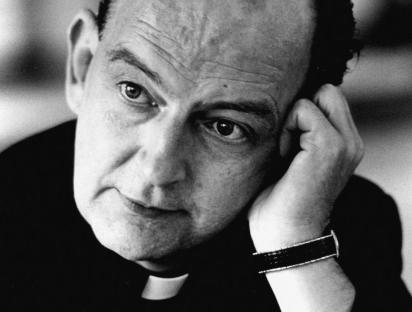
I worked with Patrick Jordan at Commonweal for more than twenty years. Pat was one of the most decent people I have ever known—and in my experience, Commonweal attracts a lot of exceptionally decent people. He was also one of the most diligent, hardworking people I’ve ever sat next to or broken bread with. As managing editor, he was responsible for most of the unglamorous work involved in putting out a magazine: shepherding copy through seemingly endless rounds of corrections, coordinating with the production editor, keeping track of who needed what and when, etc. I never heard him complain, which, given my own tendency to grouse, was humbling. He was also blessed with a preternaturally youthful appearance. When we first met, I assumed he was my age or possibly younger. He smiled and sheepishly confessed he was a decade older. I like to think that this Peter Pan aspect of his character had something to do with the fact that he was a great soul.
A Catholic Worker and a colleague and friend of Dorothy Day, Pat was a pacifist and tax-resister. I was neither. Despite those strong and personally costly convictions, he had the unusual ability to disagree with you without showing any rancor. He was kind, compassionate, and good-humored—with a sometimes-fatal weakness for puns. We laughed together as often as we disagreed. Edward Skillin, Commonweal’s longtime publisher, continued to commute to our office in Lower Manhattan from his home in New Jersey well into his eighties. Pat, whose own commute by ferry from Staten Island was no lark, would meet Edward when he got off a different ferry on Manhattan’s West Side and walk him across town to our office just a few blocks from the East River. He did selfless things like that all the time, and I’m sure I remained ignorant of most of them.
I’m a bit ashamed to admit that when I joined the Commonweal staff in 1990, I had never heard of the Catholic Worker or read anything by Dorothy Day. Frankly, I could not make heads or tails of the idea of embracing a life of “voluntary poverty.” It seemed positively un-American, which I suppose it is. But that is what Pat had done when he joined the Worker in the late 1960s at the height of the growing opposition to the war in Vietnam. He had been a Franciscan seminarian in California but exchanged that religious vocation for a lay life of serving the poor and protesting against the militarized state. With a talent for organizing things and people, he became the managing editor of the Catholic Worker newspaper. It was at the Worker that he met Kathleen. They would marry and soon welcome two children, Hannah and Justin, into that very uncertain world. I once asked Pat why he and Kathleen had left the Worker. “It is not possible to raise children there,” he explained with his usual honesty. In a piece remembering Dorothy Day (“‘The Gospel Is Hard,’” January 25, 2013), Pat candidly quotes her acknowledgment of the same considerations. “The Catholic Worker is madness,” she said. Or, as she mischievously liked to quote G. K. Chesterton, “if something is worth doing, it was worth doing badly.” Commonweal, and Kathleen’s work as a nurse, would subsequently engage and sustain the Jordan family, although he and Kathleen remained devoted to, and participants in, the Worker community.
In addition to being an exceptionally fair-minded journalist and something of a pacifist revolutionary, Pat was also an avid baseball fan, a very American passion. It was in the blood. His father had been the business manager of the California Angels when they were a Triple A club on the West Coast. In fact, the first piece Pat wrote for Commonweal was a review of three books about Major League Baseball—what Pat called “our truest civil religion”—and the struggle to integrate the game. With a sure eye for the telling quote, he calls our attention to fabled sportswriter Red Smith’s description of Branch Rickey, the iconoclastic owner who broke the color line when he put Jackie Robinson in Dodger Blue. Among the many words Smith used to capture Rickey’s contradictory personality were “lawyer, preacher, horse-trader, spellbinder…obscurantist, reformer.” When I think of Pat the words that come to mind are “colleague, friend, devoted husband and father, humble, faithful, joyful, courageous.” During his two-and-half-year struggle with pancreatic cancer, I tried to stay in touch. As you might imagine, he was the one always looking on the redemptive side of what I had a hard time acknowledging and accepting about his illness.
In his article about Day’s fierce faith, Pat in many ways described his own. “Dorothy Day had such powerful, unadulterated faith,” he wrote. “It was not based on creedal propositions or on catechetical formulas but on a passionate relationship with the living God.” When you meet someone possessed of such belief, it can change your perception of what is possible and what is true. Pat Jordan did that for me, and still does.