It’s more than an hour before kickoff, but Augusta’s Pizzería in the heart of La Boca, a proud working-class neighborhood in Buenos Aires, is already packed with men, women, and children sporting blue-and-gold-striped jerseys.
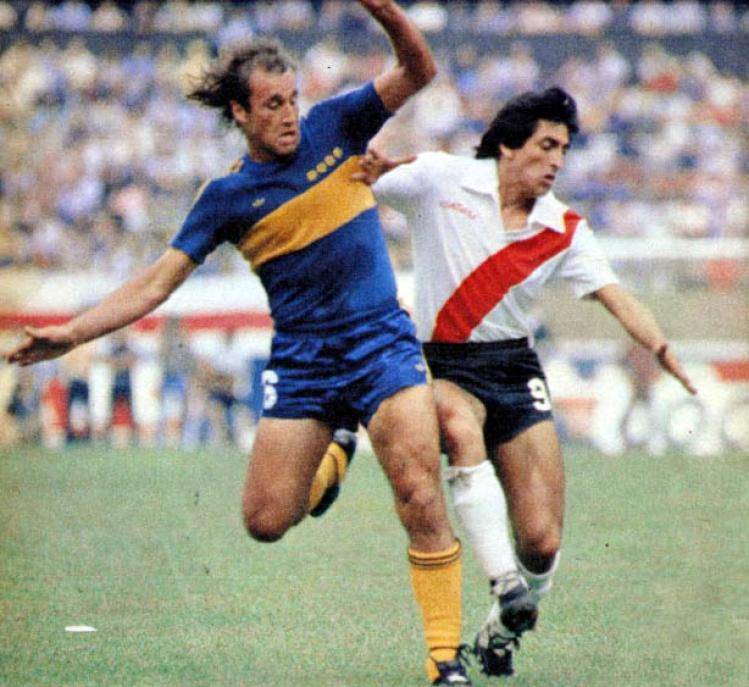
Those are the colors of Boca Juniors, Argentina’s most popular professional soccer team. Today, on a sunny Sunday in late October, Boca is playing its eternal archrival, River Plate, in the super clásico of Argentine soccer, the match that brings the nation to a halt.
Forget Sampras-Agassi, or Yankees-Red Sox, or even Ali-Frazier. When Boca Juniors and River Plate meet, it’s more like India-Pakistan.
Nearly a thousand police officers stand alert in and around River Plate’s Monumental Stadium, the site of the match. The morning newspapers include city maps detailing the distinct routes Boca and River fans should take to the match. The presidents of both teams have publicly called for Argentina’s notorious pockets of violent fans—the barras bravas—to remain under control.
In a nation battered by political corruption and economic collapse, River-Boca is much more than just a security concern. The match also offers a rare chance for Argentines to forget their well publicized woes. For ninety heart-stopping minutes, there are no financial crises, no upsurge in poverty, and no painful negotiations with international creditors. There is only Boca-River.
“Driving a Ferrari, or traveling around the world…those are joys for the rich,” explains Sergio Noguera, a thirty-eight-year-old salesman and lifelong Boca fanatic. “But there is no happiness a rich man can buy that compares to what Boca Juniors has given me over the years.”
Play begins. “Dale, dale, dale, Bo!” (“Go, go, go, Bo!”) The crowd at the pizzeria echoes the fans in the Boca section of the stadium.
The seventh minute provides early drama, as Boca forward Carlos Tévez speeds past the River defense on the left side of the penalty box. “Pass it back, pass it back!” roars the restaurant, but Tévez doesn’t see his teammate trailing the play. Dozens of fans throw their hands up in disgust.
Minute thirty-one. A River player finesses through the Boca defense. A lone cry of “olé!” emanates from the front of the restaurant, revealing a smattering of infiltrated River fans. “Che, they’re going to kill you, friend!” warns Sergio. Minute forty-two. Marcelo “El Chelo” Delgado scores for Boca on a beautiful free kick from outside the penalty box. Augusta’s erupts. Grown men jump up and down, howl in delight, and hug strangers. Boyfriends kiss their girlfriends. Girlfriends kiss back. Sergio dashes outside and lights two thunderous firecrackers in the street. The celebration continues into halftime. Boca leads 1-0.
Sergio reminisces during the break. “My first clásico was April 10,1981. We won because of Diego Armando Maradona,” one of Argentina’s all-time soccer greats. “He was just a pibe [a kid] then.” Maradona, who led Argentina to a World Cup, would eventually leave Boca to play for Italy’s Napoli soccer club. Today, many of Argentina’s top soccer stars play for higher-paying European squads. “What can they say when they are offered that kind of money?” asks Sergio ruefully.
The second half kicks off, with so much confetti on the field that the ball seems to disappear. River slowly takes control. “These are not normal matches,” mutters an annoyed Boca fan. “Sometimes the intensity gets in the way of the técnica, the quality of play.”
Minute fifty-two. River Plate’s Esteban Fuertes ties the game after a well-executed crossing pass left him virtually alone in front of the Boca goal. The audacious River fans fill the sudden silence with vociferous cheers.
Sergio complains to the manager. “Why do I come here, all the way to La Boca,” he demands, “to have someone cheer a River goal in my face? It is a deliberate provocation. You should throw them out!” He then turns to this reporter. “I don’t justify the violence some people feel, but I understand it. Read the papers tomorrow—you’ll see.”
Twelve minutes left. That most unsatisfying of outcomes—a draw—seems inevitable until “El Chelo” fires a blistering, unstoppable kick from thirty-five yards out. River Plate’s goalkeeper cannot even move before the ball inflates the net behind him.
Pandemonium at Augusto’s. Chairs are knocked over. Tears are shed. Sergio gropes for his two remaining firecrackers and runs outside again. “Golazo! Stupendous! Masterful! Brilliant!” The emotive television announcer cannot find sufficient adjectives to convey the import of the moment.
The referee finally blows the whistle, and Boca Juniors have notched another win over their nemesis. Boca now leads the all-time series against River with sixty-three wins, fifty-seven losses, and fifty-one ties.
Sergio is back, running around the restaurant, not knowing whom to hug next. “Boca, Boca, Boquita!” he yells deliriously. The River fans slink out, quickly disappearing among the throngs filling the streets.
The next morning, the Buenos Aires daily El Clarín would report clashes between disgruntled River fans and police that left sixty-two people injured. Sergio was right. Yet the violence seemed a footnote amid the twelve full pages of breathless clásico-related analysis and commentary. “I was supposed to eat a roast with my mother today, but I called her and explained about the match,” confesses a jubilant Sergio as he leaves the restaurant. “It is not that I love Boca more than my mother, of course. But I can eat with her tomorrow, or maybe next week. Boca-River is only today.”