As Israelis went to the polls this fall for the first time since October 7, 2023, viable space for Palestinian life between the Jordan River and the Mediterranean Sea continued to shrink. I was recently in the West Bank accompanying Palestinians during the olive harvest, a social and economic enterprise that has come under attack by state-backed Israeli settlers. As one Palestinian activist told me, these and other Israeli occupation measures are not merely about claiming territory but about fragmenting a people.
While Israel’s chokehold on the West Bank has provoked some international outcry of late, Gaza has faded from the headlines and is increasingly isolated. A UN commission recently issued a report asserting that Israel continues to commit genocidal acts. In the year since the so-called ceasefire, the Israeli military has killed more than 1,400 Palestinians. Palestinian territory in Gaza has also rapidly shrunk, with the “yellow line” that demarcates Israeli control steadily advancing. Nearly 70 percent of the destroyed enclave is now under the IDF.
Meanwhile, inside Israel itself, Palestinian citizens are made to feel invisible. My taxi driver told me that, whenever possible, he doesn’t reveal his Palestinian identity so as to retain Jewish Israeli passengers and preserve his livelihood. The 80-percent turnout of Palestinian voters in Israel’s elections, which many boycotted in the past, has been described in stark terms as an “existential” act of sheer “survival” in the face of a narrowing and increasingly fascist political reality.
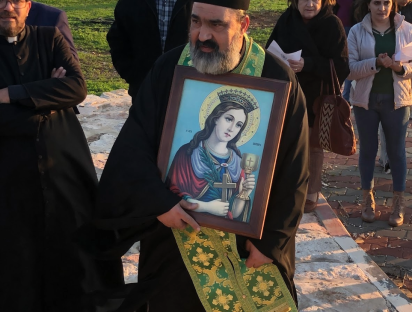
During my weeklong visit—which also included time in Jerusalem and Tel Aviv to meet with Palestinian and Israeli civil-society colleagues—the intensity of the pressures on Palestinian life stood in striking juxtaposition to the ways Palestinians persist in exercising their right to exist. On Sunday, October 18, Fr. Bashar Fawadleh, a Palestinian Catholic priest in the West Bank village of Taybeh, issued a call in his homily to those in positions of authority: “We are asking for something simple and fundamental: the right to live safely in our homes, to reach our land without fear, and to raise our children without threats.”
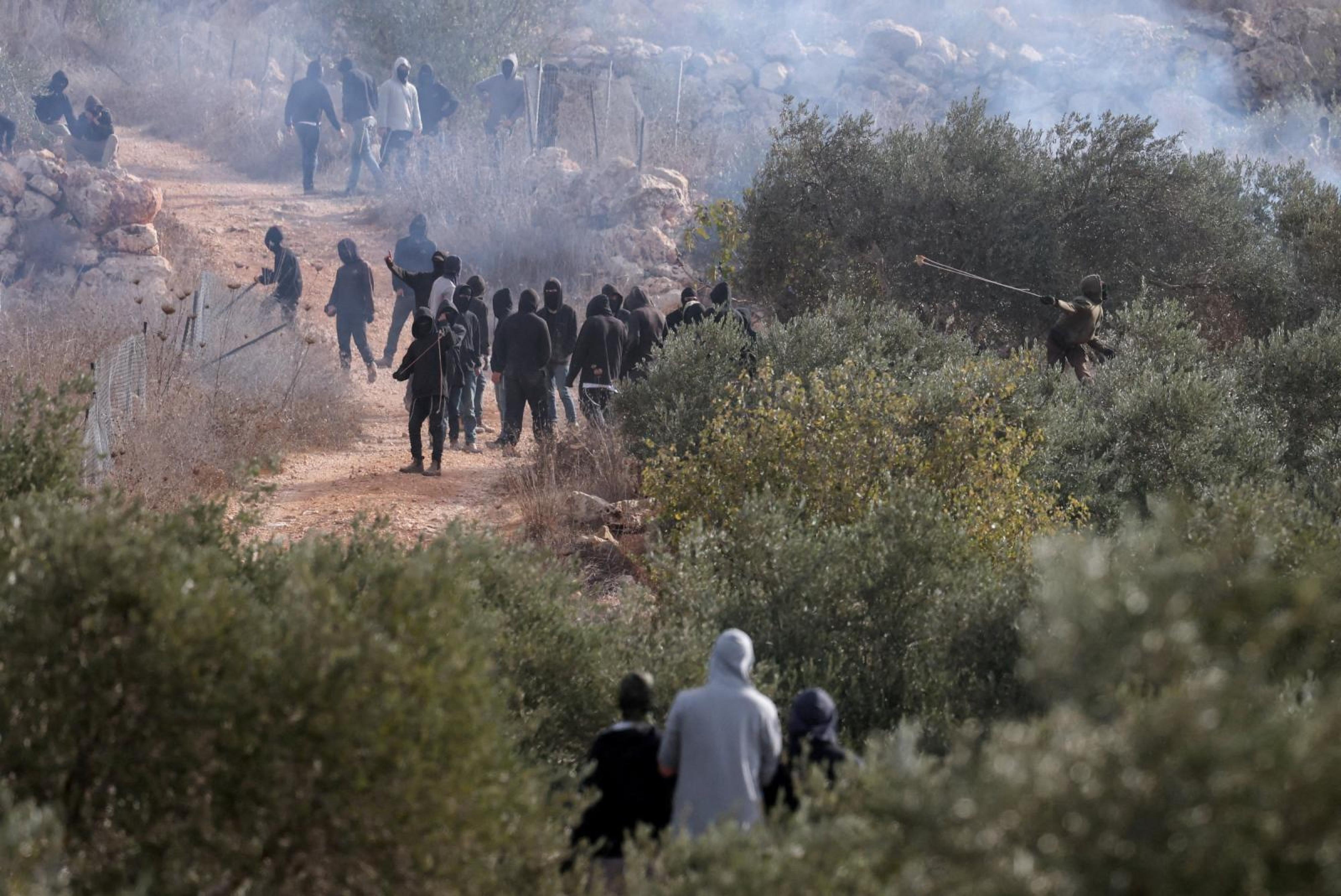
The day before, a visiting delegation of European dignitaries had come under attack by Israeli settlers. Masked and armed with metal bars, they assaulted the French mayor Bernard Baudoux, who had traveled to the village to commemorate the twinning of his city, Aulnoye-Aymeries, with Taybeh and to pick olives in a show of solidarity. While this and other attacks on media and activists receive broad attention, violence against Palestinians is rarely news, and the perpetrators are rarely punished. Following the Taybeh attack and the severe beating of a Washington Post journalist in Khirbet Abu Falah north of Jerusalem, ten Israeli settlers were arrested. All have since been released.
Our group of American Christians, including several Catholics, was in a nearby village when the Taybeh attack unfolded. Our travel to Taybeh and environs, timed for the St. Francis Jubilee—the eight-hundred-year anniversary of the death of a saint who sought to be an instrument of peace—came at the invitation of Fr. Fawadleh and was facilitated by the Palestinian Christian organization Sabeel.
Palestine’s Christians suffer the same consequences of Israel’s military occupation as all Palestinians do. However, because the community is so small, departures have a disproportionate impact, and like everything else, emigration has grown more severe. The last all-Christian West Bank village, Taybeh had a population of three thousand in the 1980s; today, it’s down to around 1,200. During our visit, we were able to accompany our Palestinian friends in relative calm even as violence unfolded around us. Some villagers shared that they often try to harvest their olives at night. “It feels like we are stealing from our own land,” they said. On our first full day in Taybeh, we helped a farmer who was berated over FaceTime by the young son he left at home due to the danger. The olive harvest is supposed to be a multigenerational celebration, but the father was the only person in his family out in the fields.
In the next field over, another group, which included Canadian and Finnish diplomats, was surveilled by Israeli drones and settlers driving along adjacent roads. A little further away, at Taybeh’s edge, close to neighboring Deir Jarir, Jewish Israeli activists were sent to help deter settlers. On that day, they were successful, but on many others, their presence, or that of other non-Palestinians, does not prevent confrontations with settlers, who are often directly supported by the Israeli military.
At dinner in a Taybeh family home one evening, young people talked about their difficulties in reaching jobs in Palestine’s urban center, Ramallah. What should be a fifteen-minute drive can turn into an hours-long odyssey with unpredictable waits at checkpoints and risky encounters with Israeli soldiers and settlers. It’s necessary to bring an overnight bag to prepare for every contingency. They hoped Netanyahu’s coalition, with its ultranationalists Itamar Ben Gvir and Bezalel Smotrich, would be defeated not because a new government would usher in true justice or peace, but because it might yield some modicum of day-to-day relief.
When I met with staff of the Israeli human-rights group B’Tselem in Jerusalem, we discussed their recently issued report, “The Elimination Project.” It describes part of Israel’s apartheid system, an unfolding political framework in the West Bank “that is systematically and at an accelerating pace dismantling the foundations of Palestinian existence,” making Israeli control “continuous, institutionalized, and permanent.” Another 2026 report, by the Palestinian Balasan Initiative for Human Rights, similarly explains how Israel’s policies have “reshaped” the West Bank through a strategy that “fragments contiguous territory” into isolated “enclaves,” creating a pressure that “erodes the economy and quality of life.”
That fragmentation was evident everywhere we went. En route to Taybeh, we spent an afternoon at Tent of Nations, a family farm near Bethlehem where settlements now come right up to the fence and an orange gate with an Israeli flag cuts off the road, providing only one way out. Despite having documentation dating from the Ottoman era to prove their ownership, the Nassar family continues to defend itself in a protracted legal battle in Israeli military courts, where they lack full rights.
On an excursion to Palestine’s first eco-village, Farkha, we heard how the community has come together to resist the violent system that surrounds them by securing food independence and engaging youth in hyperlocal democratic committees. For the rest of the olive season, they had devised a risk-management plan that involved the entire town banding together to harvest the olive-grove areas closest to the encroaching settlements, areas that contain 70 percent of the town’s olive trees.
From Bethlehem to Taybeh to Farkha and beyond, the West Bank is under siege. And yet amid these harsh realities our Palestinian hosts invited us into the vibrant spaces they continue to create—children performing the dabke folk dance; feasts of the specialty dish maqluba; and the practice of “al-ouneh,” or “helping hands,” part of the tradition of “sumud,” or steadfastness to stay in ancestral land. As Fr. Fawadleh preached, “we do not want the world to remember Taybeh only when its land is attacked or its people are injured” but also through “its faith, its olive trees, its churches, its children, and its message of love and peace.”
During our trip, Gaza was out of sight but ever-present. Our Jubilee group’s orientation began with a somber reminder from Sabeel director Omar Haramy: “We were not able to stop a genocide.” Over the last three years, various experts—from Holocaust scholars to prominent human-rights groups—have increasingly used the term “genocide” to describe Israel’s assault on Gaza in the wake of Hamas’s attack on October 7. As I write, the first winter rains have flooded the coastal enclave, where most Palestinians live in tents squeezed into around 30 percent of the territory. While meeting with Caritas Jerusalem, which continues its humanitarian efforts in Gaza, I learned from secretary general Anton Asfar that every one of its Gaza employees—more than a hundred people and their families—has been internally displaced.
In the face of international impunity, Israeli and Palestinian scholars and activists have adopted new terminology to explain what is unfolding. British-Israeli architect Eyal Weizman of the NGO Forensic Architecture coined the term “ungrounding” to describe how Israel’s action in Gaza “aims to remove a society from its place and erase all traces [of] its previous existence.” Palestinian legal scholar Rabea Eghbaria, in articles initially censored in American university law reviews, asserts “the ongoing Nakba” as a legal framework to explain the many crimes committed by Israel against the Palestinian people, including in Gaza.
As Gaza drops off the front pages of global newspapers, its residents, subject to a corrupt and colonial “Board of Peace,” lose more possible points of leverage. And yet Gaza made a significant appearance in a place many might not have expected a year or so ago—the U.S. midterm elections. Back in November 2025, Senate candidate Abdul El-Sayed—then a long shot, now Senator-elect—said Gaza has become a “moral Rorschach test on values.” He and other candidates were unabashed about their support for Palestinian rights—and they won. Heading into the 120th Congress, Palestinians in Gaza appealing for their freedom can expect more support than ever from a new class of U.S. lawmakers.
Israel’s elections on October 27 were a much less clear repudiation of its government’s reprehensible policies. Among the most notable dynamics was the strong showing of the non-Zionist Arab-majority parties, Ra’am and the Joint List, which together garnered a record nineteen seats. This historic result was less a sign of Palestinian voters’ faith in Israeli democracy to reverse the paths of genocide and apartheid than of sheer desperation to drive out those systems’ worst actors: Ben Gvir, Smotrich, and Netanyahu. Netanyahu’s main rival, Gadi Eisenkot, whose bloc won forty-eight seats to Bibi’s fifty-three, could have swiftly joined hands with the Arab parties to form a coalition with a sixty-seven-seat majority, but as Haifa-based Palestinian political analyst Diana Buttu suggested, Netanyahu’s opposition might not be able to “get over their racism to finally oust him.” The indefatigable Israeli prime minister, wanted by the International Criminal Court for war crimes in Gaza, accused Palestinian citizens of “raiding the polling stations and stealing the elections” and then tried to block the appointment of Joint List chairman Ahmad Tibi as the Knesset’s deputy speaker, a role he has previously held.
These dynamics are part of a broader assault on the Palestinian people within Israel itself. The situation of Palestinian citizens of Israel, long relegated to second-class status and “constructed” as “enemies” in their own land, has only grown worse within a society that, since October 7, is increasingly awash in racism, deflection, and denial.
Whatever the final outcome of the elections in Israel, the impact of its Palestinian citizens’ vote has been significant. Jaffa-based journalist Abed Abu Shehadeh, released on November 8 after a five-day unjust detention by Israel’s Shin Bet security service, recently wrote: “Precisely those whom the government sought to portray as a threat to the state have become the ones who may open the door to a different political path forward.”
Wherever they reside, Palestinians face some exclusionary or eliminationist tactic meant to make life unbearable. And yet at our Taybeh dinner, when the father of the house was asked why he doesn’t leave, given the oppression and lack of safety, he said: “This is my home, my life, my land.”
On that land, the olive tree stands out as a physical symbol of Palestinians’ insistence on collective belonging despite dispossession, displacement, and disenfranchisement. Palestinian theologians John and Samuel Munayer cite the late Palestinian Catholic scholar Geries Khoury in their recent book to explain the tree’s significance: “Rooted in drought and stone, yet it endures. It lives for generations, growing steadfastly. Even when its branches are cut, new life emerges.”
We welcome your comments about this article. Please send your response to [email protected].