The road to Aboud runs through terraced hills and rich agricultural land, in an area north of Ramallah long famed for its olive trees, figs, almonds, and citrus. Like many Christians in the Holy Land, I have visited Aboud over the years for the feast of St. Barbara, who tradition says was martyred there in the third century. Today, about eight hundred Christians still live in the village alongside their Muslim neighbors, and the ruins of Byzantine churches lie hidden among the old stone houses.
The feast of St. Barbara falls on December 17, during Advent in the local Greek Orthodox Calendar. (Though Barbara was removed from the General Roman Calendar in 1969 because Church officials could not verify her historical existence, she remains on the Church’s list of saints and is celebrated by Catholics on December 4 in the Middle East.) On the evening before her feast, Christians from all over the Holy Land travel to her church in Aboud, where they sing vespers and light candles. The feast is part of an ancient tradition of pilgrimage festivals that animate local Christian life in the West Bank and mark the start of the holy season. The feast of St. Saba is celebrated on December 18 at the fifth-century monastery of Mar Saba in the Judaean desert, and the feast of St. Nicholas, which falls on December 19, is celebrated in Beit Jala near Bethlehem. These festivals are part of the cultural heritage of Christians in the Holy Land, and making pilgrimages to those sites is a means of transmitting faith.
When I journeyed to Aboud for the feast of St. Barbara last year, however, I encountered a community increasingly cut off from the other Christians. A yellow gate stood at the entrance to the town, one of hundreds installed by the Israeli government at the entrances to towns throughout the West Bank after the Hamas attacks on October 7, 2023. When I arrived for the procession, there were fewer than two dozen people in the Greek Orthodox Church of St. Mary, also known as the ancient Dormition of the Theotokos or Al-Aboudiyah. Locals told me that many Christians who usually come to Aboud for the feast stayed away because they were afraid of running into Israeli settlers on the roads.
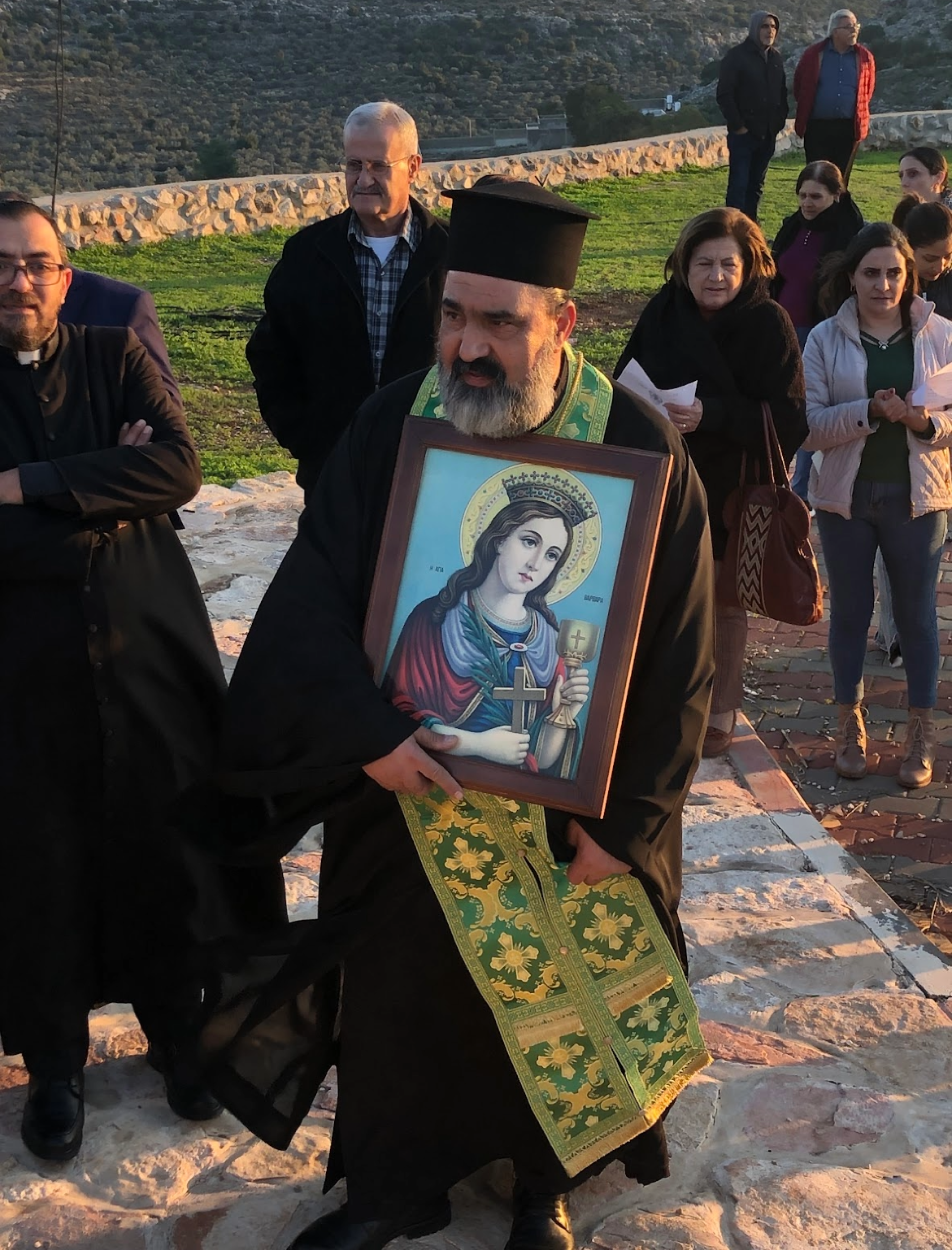
After the prayer service in the church finished, I followed the procession to the cave of St. Barbara, which is located just beyond the village. Other villagers joined us as we passed their houses. Leading the way, Fr. Emmanuel Awwad, the priest in charge of the church, held an icon of St. Barbara in front of him. When we passed by Our Lady of the Seven Sorrows, the local Catholic church, Fr. Remon Haddad joined Fr. Awwad at the head of the procession in solidarity. Beside me, Kamal Mukarker, a Palestinian Christian from Beit Jala, phoned his uncle Ibrahim Mukarker. A renowned and beloved singer of Greek Orthodox chants from Beit Jala, Ibrahim had recently followed his children, who had emigrated to Sweden. Kamal turned on his phone’s speaker, and Ibrahim started singing. From more than three thousand miles away, his famous voice rang out among the procession.
As we traversed a dirt path among the trees, everyone around me continued singing in Arabic. Their voices grounded me. Still, I was aware of how vulnerable we were, how exposed to settlers on that open road. I was afraid. It had been a terrible three years. After a long drought, the olive trees had barely given fruit. Everyone seemed exhausted. I was struck by the risk of walking to that cave on St. Barbara’s feast. When we arrived, we lit our candles. The inside of the cave glowed with a soft amber light. Fr. Awwad begged those gathered, many with families who had lived in the village for generations, not to leave their ancestral home despite the tensions and economic despair.
For many Palestinian Christians, St. Barbara represents resilience in the face of adversity. Against the will of her father, she converted to Christianity and refused to be married. Enraged, her father ordered that she be killed. She escaped, according to oral tradition, by fleeing to the village of Aboud outside of Ramallah in what is today the West Bank. She hid in the fields of wheat, which grew out of season to provide her with cover. To survive, she ate from the wheat. She sought shelter in the cave where we gathered together in remembrance. Eventually, she was martyred.
As part of her feast day, Christians cook burbara, a porridge of wheat berries, pomegranates, dried apricots, and candied chickpeas. Though the ingredients are all sourced locally, every village prepares burbara differently. Some versions are thicker. Some have pomegranate seeds or raisins or candied fennel seeds. Parents put the burbara out at night, and in the morning children look to see if St. Barbara left her thumbprint in the dish overnight. In the past, children would plant wheat seeds in moist cotton on her feast day, then decorate nativity sets on Christmas with the tiny sprouts that had grown during Advent.
Because St. Barbara is most often associated with wheat, her story is often told by invoking a verse from the Gospel of John: “Amen, amen, I say to you, unless a grain of wheat falls to the ground and dies, it remains just a grain of wheat, but if it dies, it produces much fruit.”
“For us, she is a Palestinian saint,” Hanadi Younan, a Christian from Jerusalem who is well known for the burbara she distributes to dozens of people each year, told me. “It’s very important that the burbara is not eaten alone. It must be shared with neighbors, because we believe that the more you give, the more you are given.” For Hanadi, burbara is not only a dish. It is a means of transmission. She remembers her father telling her and her siblings the story of St. Barbara whenever they ate the dessert as children. “He used to tell us the story of St. Barbara every year. One time we told him: ‘Enough! We know the story.’ But he had to tell the story.”
In October 2026, I returned to Aboud to see how the situation in the village had changed since my last visit. I met with Fr. Awwad, a Palestinian from the village of Ain Ariq who is now based in Ramallah. He was asked to temporarily fill in when the local priest of Aboud died in 2010 until they could find someone to fill the position. That was sixteen years ago. On weekends, he travels between villages to serve local communities.
During our conversation, he described a community in crisis. Many of the local Christians worked in Israel before the war in Gaza. After October 7, however, their work permits were revoked by the Israeli government, along with the permits of many Palestinians living in the West Bank. Because the lands around the village are under Israeli government and civil control, locals must apply for permission to harvest their own trees, which means farmers in Aboud can no longer count on the local harvest to get by, even when the harvest is plentiful. Farmers also fear attacks during the harvest from armed settlers who live nearby. “The church must support them with milk, pampers, medicine,” Fr. Awwad said, “but we cannot pay for everyone and everybody.”
The recently erected gate at the entrance to the village has made locals feel even more isolated. On any given day, the people of Aboud have no idea if or when they will be able to leave or return to their village, including high schoolers who study at nearby Christian schools in the city of Ramallah and older students who attend classes at the university in Birzeit. Pilgrims have largely stopped visiting.
“We are suffering,” Fr. Awwad continued. “The majority of the people here are thinking about leaving. We ask them to stay here because we cannot imagine this Holy Land without Christians.”
In Arabic, Aboud means “worship,” and local tradition says that Christians have lived in Aboud for about 1,700 years. Fittingly, Fr. Awwad and I spent the afternoon visiting the ruins of the village’s many churches. The remnants of eight churches and a monastery are scattered around the center of the old town. Fr. Awwad’s church is the only ancient church still standing, and Our Lady of the Seven Sorrows, the village’s lone Catholic Church, had been built beside the ruins of the Church of St. Anastasia and St. Simon a little more than a century ago. A man brought a ladder so that I could peer over a collapsing stone wall and see what was left of a Byzantine church. A fig tree was growing inside. He explained that the town was nicknamed “the city of flowers” in Arabic. In the ruins of another church, I found a towering oak tree.
I asked Fr. Awwad why there were so many ancient churches in Aboud. “It’s a peaceful village, full of peaceful people,” he replied, before telling me that local tradition says Queen Helena, the mother of Constantine, passed through Aboud on her way to Jerusalem in search of the Holy Cross. When she found the cross, Christians lit a chain of signal fires on mountaintops throughout the Holy Land to relay news of her discovery to Constantinople. Every September, on the Feast of the Exaltation of the Holy Cross, each Palestinian Christian community in villages and towns throughout the West Bank lights a bonfire to carry on this tradition. In September 2026, however, the Christian community in Aboud didn’t process to the cave of St. Barbara to light the traditional fire in a high place because they were scared of getting attacked by settlers. Instead, they lit the fire in the town below.
Recently, following a series of settler attacks, Christian leaders in the Holy Land and around the world have raised concerns about the fate of the Christians in Taybeh, the last fully Christian village in the West Bank. Yet the fate of the Christians in Aboud has rarely been discussed. There are other Christian communities in the West Bank—in villages like Ain Ariq, Birzeit, Jifna, and Zababdeh—who are also struggling. Those overlooked and underdiscussed Christian communities, quietly living out their faith, are an essential part of Christian life in the Holy Land. Their smallness does not make them less relevant; on the contrary, it gives greater meaning to their presence, the single grain of wheat that roots and bears fruit.
Before I returned home, Fr. Awwad told me that one of his parishioners asked him for help obtaining a visa to leave the country. The man said that he could no longer stay in Aboud. “I had no answer for him,” Fr. Awwad said, “because I don’t see what the future will be.”
We welcome your comments about this article. Please send your response to [email protected].