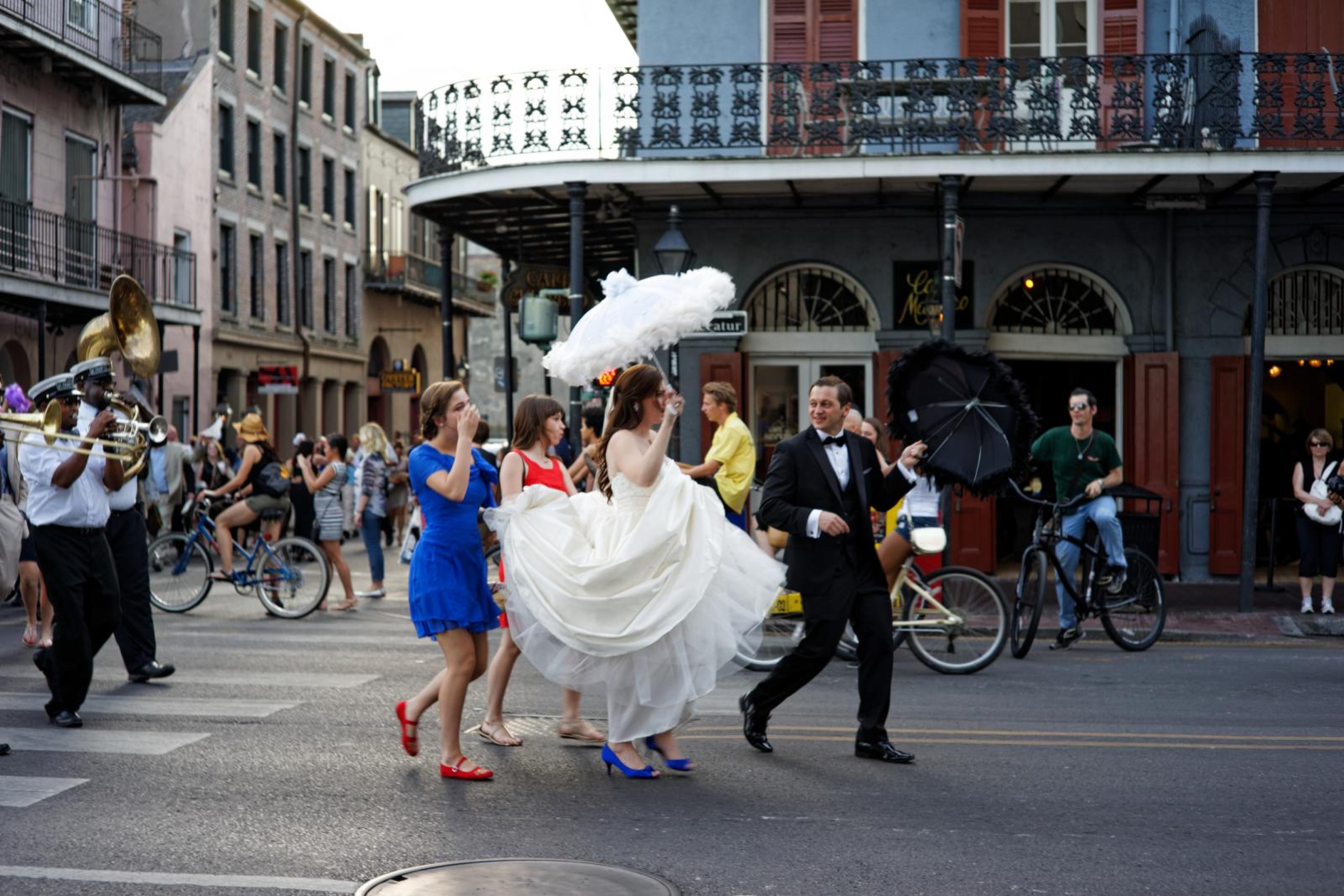
Before I moved to New Orleans, I was indifferent to weddings. They’re often stiff, and there is always a chance your table assignment will prove untenable. But a typical New Orleans wedding skips the long speeches and assigned seating (these are reserved for the rehearsal dinner) and goes straight to a free-flowing reception with food and tables to use as and when you want. Then there’s the second line. After my wife and I were married in January, we paraded out of our reception into the streets of the Bywater with a brass band at our backs. Outside of New Orleans, I will go to great lengths to avoid a parade, but the second line is the purest expression of joy I’ve ever known.
New Orleans, it is said, “knows how to party,” but that trivializes it. New Orleans knows—amid a culture that has otherwise debased celebration into mere “fun”—that celebrating well is something that must truly be learned. The city takes celebration seriously and invests it with meaning, to such an extent that having a good time there can feel like a spiritual practice. At his shows, Jon Batiste, the savant New Orleans musician, insists that it is. But things can also go wrong in New Orleans, and they do with tragic frequency. Several burnt-out cars on our second-line parade route were reminders of that—the work of a late-night arsonist who briefly terrorized the neighborhood.
Nancy Lemann’s Lives of the Saints (New York Review Books, $16.95, 208 pp.) starts with a disastrous, tragicomic New Orleans wedding. People are constantly having “Breakdowns” at this “Very Long Party” where the groom “was made to get in rages…and have nothing in his icebox except an old head of broccoli” and the bride is
the type of girl you see being dragged screaming from a convertible sports car outside of the bar at the Lafayette Hotel at three in the morning by her father and brothers, and then, the next day, in the bank or shoe store looking as though she had been shedding a lot of tears.
The novel’s narrator, Louise, tries to observe all the dissipation and disintegration impassively. “I went into this wedding armed with a philosophical acquiescence I had learned from the poets, but I found in society their principles did not hold weight. Everyone was too drunk.”
Lives of the Saints came out in 1985 and eventually gained something like cult status, but it remained insufficiently appreciated until its reissue by New York Review Books this year. The plot, such as it is, revolves around the narrator’s relationship with Claude Collier. The ever-drunk scion of a wealthy family, Claude has a knack for inventions (slipping on a banana peel gives him an idea for a shrimp peeler) and getting in trouble, but also perfect manners, “sterling character,” and indiscriminate kindness. He’s “an angel on earth” whose “heart was constantly breaking into a million pieces on the floor.” Louise’s love for him mostly takes the form of observations of his character made from a philosophical distance as they orbit each other at a string of New Orleans bars, restaurants, and parties.
What it lacks in story the novel makes up for in atmosphere. Its evocation of a timeless New Orleans is so exquisite that you’re surprised, as Geoff Dyer notes in his introduction, when the mention of disco and a Walkman cassette player places you in the 1980s and not some mythic long-ago. Dyer also notes an obvious connection with Walker Percy, Lemann’s hero and mentor. “He was the first writer I ever read who made me want to write, or see a way to,” Lemann has written. “He was my epiphany.”
Lives of the Saints shares with Percy’s The Moviegoer a sense of “the search”: a puzzled, half-comic quest for meaning that sees in both the frivolity and grandeur of New Orleans life “something like God, a kind of existential beatitude,” as Dyer puts it. At one point, wandering the French Quarter after a Friday afternoon cocktail party at the law office where she works, Louise stumbles upon a parade—maybe a jazz funeral:
[It] came out of nowhere and passed through the unsuspecting street, heralded by African drumbeats in the distance vaguely, then the approach of jazz, the smell of sweet olive, ambrosia, the sense of impending spectacle. Then it passed in its fleeting beauty, this glittering dirge, and, as suddenly as it came, I was left, rather stunned, in its wake.
In Lemann’s hands, the parade becomes life itself in all its splendor and strangeness, its beauty and despair. “It is this passing parade which I chronicle,” she writes.
The Copywriter (Scribner, $26, 224 pp.) is a reflective search for meaning too, albeit one less alcoholic and more mid-Atlantic. Its narrator—a version of its author, Daniel Poppick—is part of a cohort of downwardly mobile Brooklynite Millennial poets and academics drifting apart and toward middle age. “We’ve seen each other through some kind of crisis. But of what? Faith?” the poet-copywriter D___ writes in one of the notebook entries that make up the novel.
Early on, D___ loses his job as a “permalancer” for a trendy home-goods company—“‘Yas Queen’ throw pillows” and “lavender-scented yoga mats”—that is “hemorrhaging money” and has recently brought on a twenty-four-year-old CEO. Without a job, D___, who had spent his work hours “trying to imagine what people who are in the market for a coat hook shaped like a panda want to believe about themselves,” goes through a period of reflection and aimless searching. “Perhaps being fired would be more dignified if I were to put it in a novel,” he muses, but he has trouble actually getting anything done. Meanwhile, his seven-year-long relationship with another poet, Lucy, who works in magazine publishing, is limping toward a melancholy finish line.
It’s in the nature of the book’s aphoristic style to be hit (“If the telephone reduced us to an essential quality of voice, email made us extra”) or miss (“The night, like a cat, suffers from resting void face”). Prose poems, microfictions, and dream descriptions alternate with verse poems and fragments of plot often given headings as “parables.” D___, in spasms of activity that almost seem forced on him from outside, goes on a disastrous road trip with an old friend, formulates an idea for a novel, and gets a new job. The Copywriter belongs to—and exhibits some of the limits of—the genre of fragmentary, self-conscious novels both expressive of and reflecting on our decimated attention spans. It may not add up to too much more than the sum of its parts, but many of the parts are quite good.
At one point, D___ declares, “I am not a religious person, but sometimes I find myself in a situation that seems concocted elsewhere—in a parallel dimension, created by an intelligence with narrative omniscience.” Like Louise, he often slips into reveries of silence that end only when he takes up the burden of describing the created world and thereby, in some small measure, redeeming it.
If Lives of the Saints loves New Orleans and The Copywriter needs Brooklyn (it couldn’t happen anywhere else), John Tottenham’s Service (Semiotext(e), $17.95, 328 pp.) has a more ambivalent relationship with Los Angeles. Much like The Copywriter, its author is a poet and its main character is struggling to write a novel. But instead of working in marketing, the narrator of Service, Sean, pays the bills—or, at least, contends with them—by clerking at a bookstore in the fast-gentrifying Echo Park neighborhood just north of downtown. It’s fair to say that customer service isn’t Sean’s calling. Much of the book’s humor and plot come from increasingly unhinged run-ins with the bookstore’s clientele—a “tide of human debris” who “can’t stop fucking texting,” care more about the store’s “dreaded knickknacks” than the books, use the shelves as an Instagram backdrop, and are helpless at finding the bathroom. They jeopardize Sean’s job with a stream of negative “yelpings” in response to his rude service. “If I wasn’t already a misanthrope,” he informs us, “this job would have turned me into one.”
Tottenham’s author bio reports that he “has been described as ‘Los Angeles’s foremost poète maudit.’” His alter ego in Service is not quite Baudelaire, but unlike Poppick’s D___, who remains within the rough boundaries of bourgeois life, Sean lives resolutely and splenetically on the outside. He is striving to write in the tradition of what he calls “The Literature of Impoverished Solitude”—Beckett, Emmanuel Bove, and Kafka are among its exemplars, while Dostoevsky’s Notes from Underground is “perhaps the bedrock.” But this ambition has to be tempered by the narrator’s inability to escape an autofictional register he despises. Several times, he explains to those inquiring about his novel, “Well I have no grasp of plot, character or dialogue and my imagination dried up years ago, so I’m obliged to rely on personal experience rather more than I would prefer or approve of.” Asked in an interview about contemporary fiction, Tottenham similarly responded, “I don’t read any contemporary fiction. What am I supposed to do? Read Sally Rooney? She’s in the book, of course.”
This degree of self-pitying, self-contradictory self-consciousness risks turning the novel into a hermetically sealed hall of unflattering mirrors—and some readers will no doubt find it insufferable. But, for me, Tottenham’s self-hating autofiction and his “light-hearted mean-spiritedness” (a phrase he’s used to describe his poetry) work because he doesn’t only wallow in negativity. He luxuriates in it while mining it for humor and insight. In her back-cover blurb, the novelist Rachel Kushner astutely refers to him as a “nihilistic romantic.”
Sean’s attempt to write a novel is his search and, despite his cynicism, it is based on a sincere love of books, “which have provided the back-drop, often the substance, to every day of my existence.” And so, despite resolving never to stoop so low as “to write in a thinly disguised autobiographical manner and document the life of a middle-aged bookseller with frustrated artistic aspirations,” he eventually accepts the absurd and takes his sure-to-fail step toward Beckettian redemption.
We welcome your comments about this article. Please send your response to [email protected].