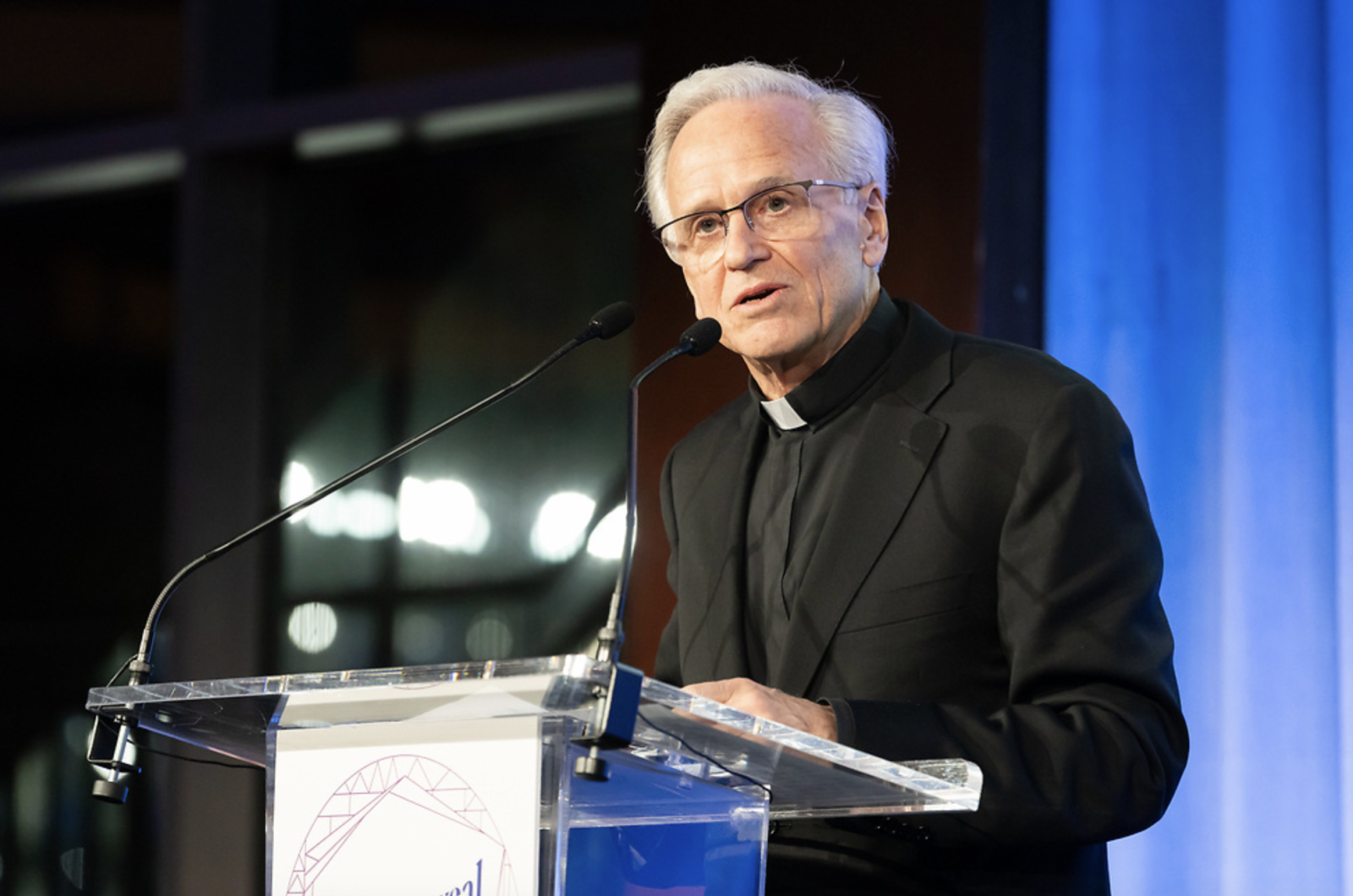
Rev. John I. Jenkins, CSC, delivered the following remarks upon receiving the 2026 Commonweal Centennial Award at the Commonweal Benefit Dinner on October 5, 2026, in New York City.
I cannot adequately express my gratitude for the honor of the Commonweal Centennial Award. It means so much to me because it speaks to my life’s deepest commitments. I accept the honor on behalf of the wonderful people with whom I have worked and those who have shaped my life, especially my mother, my father and my family. Some of them are here tonight, some are not, and some have died. This recognition reminds me of the debt I owe to so many people.
As some no doubt know, the ties between Notre Dame and Commonweal go back to the magazine’s founding over a century ago. George Shuster was a 1916 graduate of Notre Dame who joined the faculty of the University’s English Department in 1919. In 1924, he left to pursue a doctorate at Columbia University here in New York. In that year, Commonweal was founded as a periodical for lay Catholic voices. Shuster was an early and frequent contributor, and was named the magazine’s Assistant Editor in 1926 and its Managing Editor two years later.
Shuster, however, did not use his pen to endear himself to his Alma Mater. In 1925, he wrote an essay, “Have We Any Scholars?”, that was sharply critical of the academic quality of American Catholic Colleges and Universities at the time. He criticized the inadequacy of Catholic graduate education, the proliferation of small schools with meager resources, the lack of support for lay faculty and the low academic preparation of students, many of whom came from poor immigrant families. Though his critique was general, one essay made it clear that he had Notre Dame in mind. At the time, Knute Rockne’s football teams were in the middle of a run of national championships. Shuster wrote that we Catholics have not developed the leadership needed for excellent academic institutions “because we have not led in education. Apart from a number of good professional schools, we have superimposed upon a splendid system of elementary training little more than excellence–in football. There’s the rub.”
No doubt Shuster’s words, from an alum in a national publication, stung at Notre Dame. Yet it is a sign that such leadership had emerged when Fr. Theodore Hesburgh, C.S.C., in 1960, invited Shuster back to Notre Dame to help him build the academic excellence Shuster had written about. Jack Brennan and I teach a class at Notre Dame, and we agree that a mark of strong leadership is having the humility and confidence to bring trenchant but responsible critics into the conversation so the organization can become better. Shuster played that role for Hesburgh, serving at Notre Dame until his death in 1977. I hope he would be proud of what his alma mater has become. We still, however, proudly play football.
Shuster, Hesburgh, and so many others gave their lives and talents to serve Catholic institutions, whether at Commonweal magazine, the University of Notre Dame, or so many others.
Catholicism, it has been said, has a genius for institutions. A long history attests to the Church’s knack. Perhaps the prime example is its organization of the Church into dioceses and parishes worldwide over the past two millennia. In its early centuries, monasteries arose that became, after the collapse of the Roman Empire, centers of learning and culture in Europe for centuries. In the thirteenth century, the Franciscans and Dominicans were founded to minister to people in cities and towns, rather than in the seclusion of monasteries. At this time, the first universities in history emerged in Bologna, Paris and Oxford as institutions under the auspices of the Church. In the modern world, a multitude of religious communities were established, and they founded and sustained countless schools, hospitals and charitable organizations. In this country, the U.S. Bishops, along with many dedicated lay people, established Catholic Relief Services and Catholic Charities.
My own community, the Congregation of Holy Cross, was founded in the wake of the French Revolution. Revolutionary leaders dismantled the system of education and health care run by the Church and its religious orders, but they failed to replace them adequately with secular substitutes. The Congregation of Holy Cross sought to rebuild these institutions. That mission brought Holy Cross to the United States and Canada, where they founded and helped staff grade schools, high schools, universities and hospitals.
Catholic institutions have profoundly shaped my life. My father was a doctor at St. Joseph’s Catholic hospital in Omaha, Nebraska and was on the faculty of Creighton’s medical school, a Jesuit institution. At St. Joe’s Hospital, my father met my mother, who was a nurse there. I was born there, as were a number of my siblings. My mother and I were at my dad’s bedside in a room at St. Joe’s when he died.
Our parish, St. Pius X and then St. Leo’s, was where my eleven siblings and I went to school, played sports, and made our friends. I went to a Catholic high School, Creighton Prep in Omaha, and then to the University of Notre Dame. I’ve read Catholic publications such as Commonweal for all of my adult life, and I’ve given my life to serve at Notre Dame.
The Church, through the centuries, has built institutions, and these institutions in turn have shaped my life and the lives of millions around the globe.
For an institution to thrive, two things are necessary. First, people with a wide range of skills must come together in various roles around a common mission. As President of Notre Dame, I often marveled at the array of people and roles necessary to make the University work. The founding religious community, the governing board, administrative leaders, faculty in philosophy and physics, arts and engineering, staff to maintain the buildings, technicians for our digital network, coaches and athletes, librarians and residence hall staff, custodians and groundskeepers, and, of course, generous benefactors who make it all possible. As St. Paul said of the Church, “the body has many parts, and all the parts do not have the same function” (Rom. 12:4-5). So it is with institutions.
Truly great institutions, however, do more than bring people together at a particular time. They are the work of successive generations. When Fr. Sorin founded Notre Dame and called it a university in 1842, it was largely a dream. For roughly the first seventy years, most of its students were at the elementary and high school level. It was only the persistent effort of successive generations, the weathering of crises, and the seizing of opportunities that allowed Notre Dame to realize its founding vision.
Institutions have both a spatial and a temporal dimension. They draw people together for a work at a particular time and place, yet they also unite people across time to serve a mission that both endures and adapts to changing circumstances.
Institutions serve people through their vital work; they also create communities that enrich the lives of those who serve in them. While institutions do vital work, they also create communities across space and time. Universities educate and foster scholarship, hospitals care for the sick, homeless centers give shelter, and periodicals like Commonweal provide a forum for expression and discussion. As people come together for these efforts, community emerges. We have many kinds of relationships in our lives. I’d suggest that among the deepest and most enduring are those formed around a common work. In some cases, we form close friendships with co-workers, but in others, it is simply the bond formed by sharing a common effort transcending narrow self-interest. Among my favorite films are the stories of the young men in Band of Brothers and of the young women in A League of Their Own. Each is about a common endeavor, but they are just as much about the communities forged in the process.
It may seem odd that I would choose this moment to extol institutions. Confidence in institutions among Americans generally is at a historic low, according to Gallup polling. We in the Catholic community continue to struggle with the institutional failures made manifest in the sex abuse scandals in the Church. Perhaps, though, it is precisely at this moment that we must continue to remind ourselves of the value of institutions.
Many in this audience are aware that Manicheanism was an early heresy that accepted Jesus’s divinity but denied the Incarnation, claiming that he was a spirit that only appeared in bodily form. Our bodies are the locus of unsavory biological processes, unruly desires and sin. For the Manichees, God was pure spirit who stood aloof from an inherently evil physical world.
Perhaps a modern variation on this theme is to deny God’s presence in our often all-too-human institutions. Institutions, the argument goes, are bureaucratic and impersonal. They are instruments of social control and manipulation where human greed and lust for power find expression. God stands aloof from them and encounters us only as autonomous individuals in the aether, apart from the institutions that shape us.
Catholic orthodoxy, of course, rejected the old Manicheanism. Our bodies are indeed the locus of unruly desires and sin, but Jesus, in becoming fully human, became flesh. A parallel claim may be that while human institutions are often messy, fallible, and sinful, grace can nevertheless work in and through them to heal, elevate, and draw us closer to God and one another.
Ours is an age when society is fragmented and lonely. Divisions are deep; mistrust is high. A 2023 Surgeon General report spoke of an epidemic of loneliness in our nation, and more recent studies confirm the negative trends, particularly among the young. And on top of all this is the specter of AI, which seductively promises to satisfy our urges while robbing us of the work that brings us together and gives our lives meaning.
At least part of the response from those of us in the Catholic community should be to lean into our genius for institutions. Dioceses across the nation report a surge in people entering the Catholic Church, and many of these new Catholics say that it is a yearning for community that is drawing them. At least part of the answer to this yearning, I want to suggest, lies in the centuries-old practice of fostering institutions that serve needs while creating communities. Commonweal is one of these institutions. Notre Dame is another. There are so many more. At their best, those institutions provide valuable service while they enrich the lives of those who serve. In giving our time and effort to serve those institutions, each of us may find, in the words of the great writer and contributor to Commonweal, Flannery O’Connor, that the life you save may be your own.
Thank you for listening, for being present tonight, and for this great honor.