It’s early morning, chilly, and there’s a steady breeze blowing off Upper Narragansett Bay, the sun hidden behind a thin cloud cover. I wear only what’s necessary for the race I’m about to run, a tank-top singlet over a thin T-shirt, shorts, gloves, and a cap; I carry a water bottle and several energy gels in my pockets. I shiver, both because of the weather and in anticipation of what lies before me. After months of preparation, marathon day is finally here.
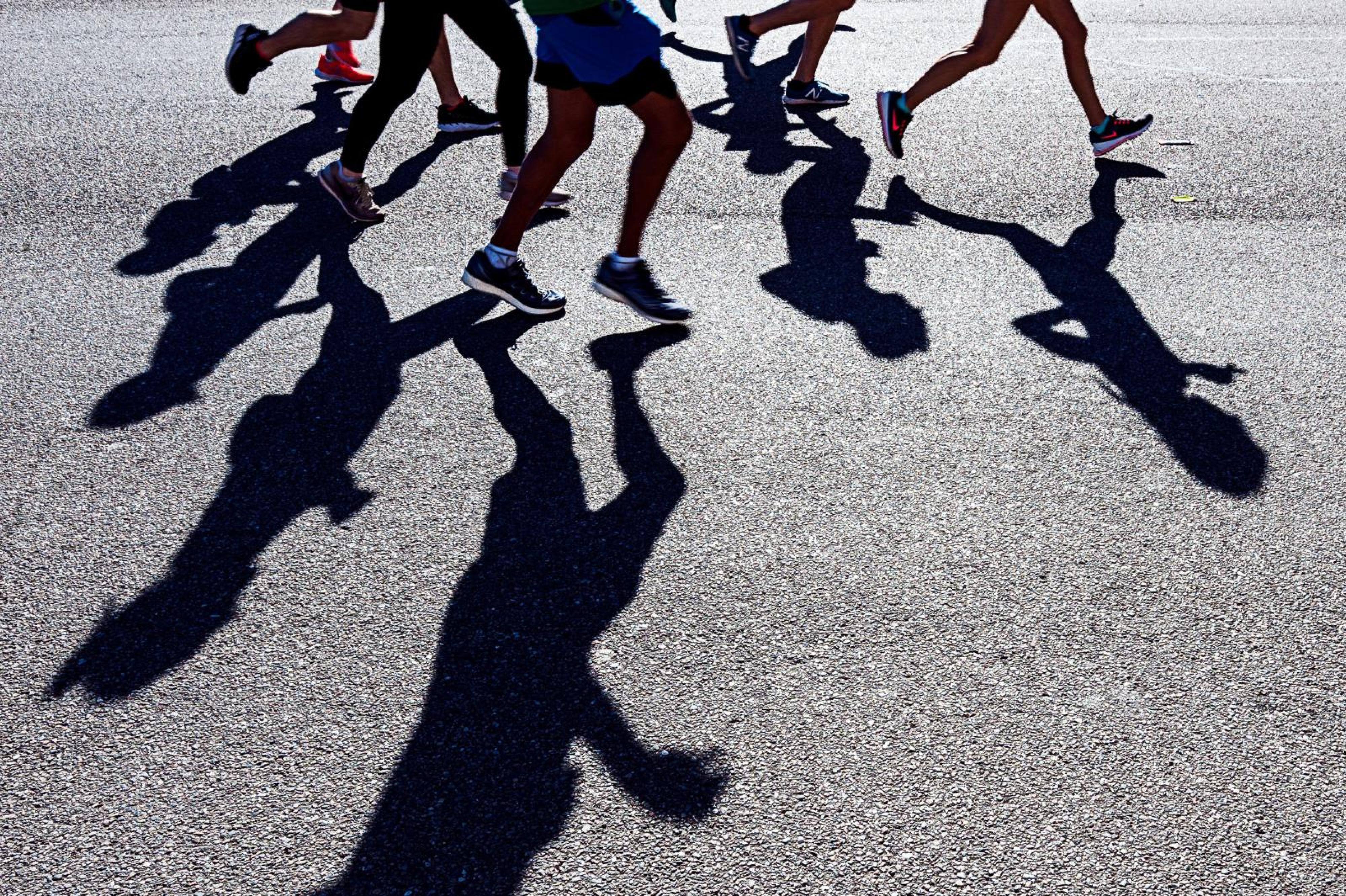
The crowd of runners around me near the starting line have taken their own journeys to get here. There are the old-timers wearing woolen hats atop their graying hair. Runners in their twenties and thirties are clad in spandex and wear hydration belts or vests. Most carry their phones in their hands. Others, new to the sport, gather in twos or threes and edge back as far as possible, chatting nervously. Still others are already running the course, having started an hour early so they can finish before the race’s six-hour cutoff.
I move toward the front. These runners are my people, lean and hungry. They are practiced in the art of pre-race fidgeting, and though they hop and twitch before the gun, their gazes are calm and focused. A countdown begins; the starter raises the pistol, and as it has so many times before, my right hand touches my forehead, chest, and shoulders in the sign of the cross, then rests on the start button of my watch. Lord, I pray, bless this body. And help it run fast.
When I run outside I don’t carry a phone, and I don’t wear earbuds. To pass the time, I do what my family used to do on long car trips as a child: pray the rosary. My mind often drifts, but my ten fingers reliably count the decades as my legs click through my route. If I’m lucky, several miles into a run, the repetition stills my wandering mind, and I become all lungs and legs, as if they themselves are reciting “thy will be done.” Prayer and running fuse.
If there’s one inviolable principle of distance running, it’s that you can stretch the limits of your body through consistent effort. Or, as I often tell the cross-country team at the high school where I teach and coach, great runners are made, not born. Genetics may make some more suited to running fast than others, but it is constant training that unlocks fitness, and anyone healthy enough to walk can improve as a runner. In my high school and college days, the accessibility of our sport lent a devilish pride to my own modest success. As I ran upwards of seventy miles per week and saw my times drop steadily year over year, I grew satisfied in knowing that through my own efforts I could distinguish myself from the masses in this most universal of human actions.
Now in my forties, I am slower, closer to the rest of the pack, and dreading the precipitous drop in fitness that awaits as I near fifty. Training for my first marathon this year was a concerted effort to forestall that inevitable decline. Truth be told, I wanted more: I wanted to set myself apart from the crowd once again. My goal was to run 2:50, which would qualify me with room to spare for next year’s Boston Marathon, an event so storied and prestigious that it allows only the fastest runners to participate. I was confident in my fitness, but the unknowns terrified me. Could I devote enough time to training? How would I respond mentally and physically to a race that was twice as long as any I had attempted before?
I picked the wrong winter to train in New England. This past year, record-setting snow and cold gripped the region from January until March. Much of my running was done inside; twenty-two miles on a treadmill is a unique kind of torture. When I did run outside, a combination of poor circulation and eczema, both of which came on in my forties, meant that even in running gloves my fingers were constantly white, purple, and covered with blisters.
The warmth of spring rejuvenated me. In March I bumped up my mileage to sixty miles per week. I read Nicholas Thompson’s just-published memoir The Running Ground, and was motivated by his story of running 2:29 at age forty-four. On the third Monday in April, I watched as ideal conditions and a loaded professional field yielded the fastest Boston Marathon ever. The following Sunday, in the London Marathon, Sabastian Sawe and Yomif Kejelcha became the first human beings to break two hours. Suddenly, a week before my own Providence Marathon, the eyes of the world were on the event for which I had been training in obscurity throughout the dark, icy winter. I was ready.
Because my race is on a Sunday, I should say the Glorious Mysteries, in honor of the Resurrection. Instead I start with the Joyful, and plan to proceed chronologically through all four segments of Christ’s life. By the time I see my family members during the early miles on a wide, tree-lined boulevard on Providence’s East Side, I’m on the Luminous Mysteries, counting Hail Marys on my still-gloved fingers. My wife and children yell and scream and I high-five my eleven-year-old. She has been tasked with handing me a secondary water bottle and dutifully sticks it out to me. “Not yet,” I say as I sweep past, my breath under control. My pace feels easy. Hundreds of half-marathoners stream in the opposite direction, following the same route I just ran. I spy my sister-in-law among them, and we wave and shout to each other. The sun glints brightly off the water, and I put my gloves in my pocket. The ice of winter might never have held us in its grip.
The runner-hero is reliably a solo performer. No one else could run as far as fast as Pheidippides, the first marathoner. The image of him that endures in my mind is not so much the scene at Athens when he arrives, announces the Greek victory over the Persians, and expires; it’s of a man whose exceptional fitness meant that he had to run those miles alone, his isolation heightened by the communal import of the message he carried. In the twentieth century, Alan Sillitoe’s short story “The Loneliness of the Long-Distance Runner” built upon that trope, as did John L. Parker Jr.’s cult classic Once a Runner, a novel whose hero is cast out of his university to train alone in the woods, mentored by a reclusive Olympian. From a young age, whenever I envisioned my best race, I always thought of myself as running alone.
I am companionless as the course enters its second half, a long loop down a bike path on Rhode Island’s East Bay. With the exception of one too-fast mile, my splits have been even, and I hit my goal time at the halfway mark. As far ahead as I can see, runners shuffle along in small groups. They are the ones who started early, the slowest runners on the course, for whom qualifying for the Boston Marathon might as well be walking on the moon. Instinctively, I speed up as I go by the first group, as if to remind them of the salience of that fact.
Their instinct is the opposite. As I pass, they shout encouragement over the music that plays from their phones or through their earbuds. “Great job!” “Good work!” The first of these catches me off-guard, and I feel ashamed for not responding in kind. As I prepare to pass the next group, I ready a thumbs-up to acknowledge our shared struggle, and shout back over my shoulder to urge them on. Though alone in my own race against the clock, I find myself, unexpectedly, in the midst of a larger, more human one, in which we all struggle against the limits of the same flesh.
The first signs of trouble emerge for me as my fingers begin to tick off the Sorrowful Mysteries, around mile sixteen. A small knot begins to take shape in my right calf. I was worried about this—on my longest workouts, it often acted up. I steady my breathing and try to relax the muscles around the afflicted spot. While the tension subsides enough for me to maintain my pace for another mile or two, it returns with a vengeance. My thoughts verge on panic, and I force them to return to the mystery at hand, the Scourging at the Pillar: “Our Father, who art in heaven…” But this is not like the mind-stilling invitation of the rosary on an easy run: no amount of praying will free my shackled legs. I turn north for the last stretch of the race, and prepare myself to battle eight miles of headwinds and muscle cramps, which have now infiltrated my hamstrings as well.
I am forced to smile despite my struggle when I pass my family for the last time. They are so raucous that other spectators turn to watch them scream and shout my name at embarrassing volumes. The whole group sprints across a field to catch me again on the other side. I high-five a gauntlet of my children and nieces and nephews, and look up to see my father hustling across the grass and urging me on, just as he did years ago during my high school cross-country races. His Irish face flushes with exertion and emotion.
Somewhere in the twenty-third mile, the bike path runs naked along the shore of Narragansett Bay. The wind is whipping now, and another runner and I, like actors in an amateur production of King Lear, do a bad job of sticking together for protection against the howl. Each time as we yo-yo past each other we gasp incoherent encouragement through the vicious headwind. Several times I have to stop and stretch my knotted legs. My fingers have forgotten what mystery they are on, and my mind is on a loop: “Thy kingdom come…thy kingdom come…”
Just then, as if in an apparition, I see an old family friend up ahead. He is in his seventies, never married, and not far removed from a life-threatening stroke. I did not expect to see him today. He moves more slowly than he used to, and through the fog of my mind I consider how much effort it took for him to get down to this isolated spot. Not a year before I was with him in the hospital, encouraging him as he struggled to swallow water with thickener. Now he is returning the favor. “It’s awful windy,” he croaks, his voice gone reedy after the stroke. “Keep going!” I slap hands and grin. He certainly knows what headwinds are, and this thought lifts my spirits. Edgar’s are similarly lifted when he sees the suffering of Lear. “How light and portable my pain seems now,” he muses, “when that which makes me bend makes the king bow.”
My friend hasn’t been to church since he was a child, and if he knew I was praying the rosary while I was running he’d likely scoff and make a jab at “those pedo priests.” But what he offers me here, in the twenty-third mile, is his own kind of prayer. Just as the light of Easter conquers the darkness of the grave, what passes between us on this Sunday morning is not carried off by the wind.
It’s all my mind can do to command my legs in the last few miles, and I never make it to the Glorious Mysteries. But I do make it to the finish line, where a sea of humanity awaits. Runners from the marathon and half-marathon are all coming through the chute at the same time. The crowd is roaring, the music on the loudspeaker is blaring, and I shuffle across the line like the Tin Man. Though the last few miles felt like I was walking, my watch tells me that I only lost a few minutes. I didn’t run as fast as I was hoping for, but I still finished in under three hours, good enough to qualify for next year’s Boston.
My family surrounds me and we embrace. Shivering, I stuff a banana in my mouth. My muscles are so weak and my hands so cold that I have to ask my sister-in-law to zip my jacket for me. I attempt to sit, but my legs start cramping uncontrollably, and my wife and father help me to my feet and catch me when I start to fall again.
Despite the ordeal, my quaking and shivering might as well be songs of praise. The trial is over, and I’m on the other side, in a kingdom whose boundaries are demarcated not so much by fitness as by frailty. I look up to see an unlikely throng arriving in this strange Canaan. A lean and hungry type I passed midrace staggers in at a snail’s pace. Two twenty-something women, no longer huddled at the back of the pack, link sweaty hands as they finish. A man in nothing but a bow tie and a thong patterned with the stars and stripes raises his hands in celebration as he crosses the line. “Even their virtues were being burned away,” writes Flannery O’Connor of the parade into heaven at the end of “Revelation.” I know I could have run faster, but right now, that doesn’t matter much at all.
A half-hour later, I find myself in the crowded kitchen of my brother-in-law’s house, surrounded by members of my cheering squad and others. Several of them offer me chairs, but I decline. I’m not sure what would happen if I tried to sit down again. My host, who has run marathons himself, hands me a twelve-pack of Miller High Life. “Congrats on qualifying,” he beams. I didn’t feel like a beer a minute ago, but now I do, and thank him.
The case must have been shaken, and when I crack a can it foams wildly onto the floor. The amount of froth that gushes forth seems impossible, but somehow, I am not surprised. Over the course of 26.2 miles, somewhere along the gamut of elation and despair, I stumbled upon a superabundance of riches, inordinate to my own effort. I set out to conquer the weakness of the flesh but instead fell into an unexpected communion with the frailty and humanity I was trying to outrun. Poor naked wretches, Lear calls us, the whole horde.
I drink and the foamy beer is warm, glorious indeed.