Once upon a time, in the far-off ’90s and aughts, the internet was widely, if wishfully, touted for its potential to give anyone a voice. Online, we would join new communities, make a difference, go viral. The internet, it was thought, would strengthen a democratic public sphere against regimentation by corporations and suppression by governments.
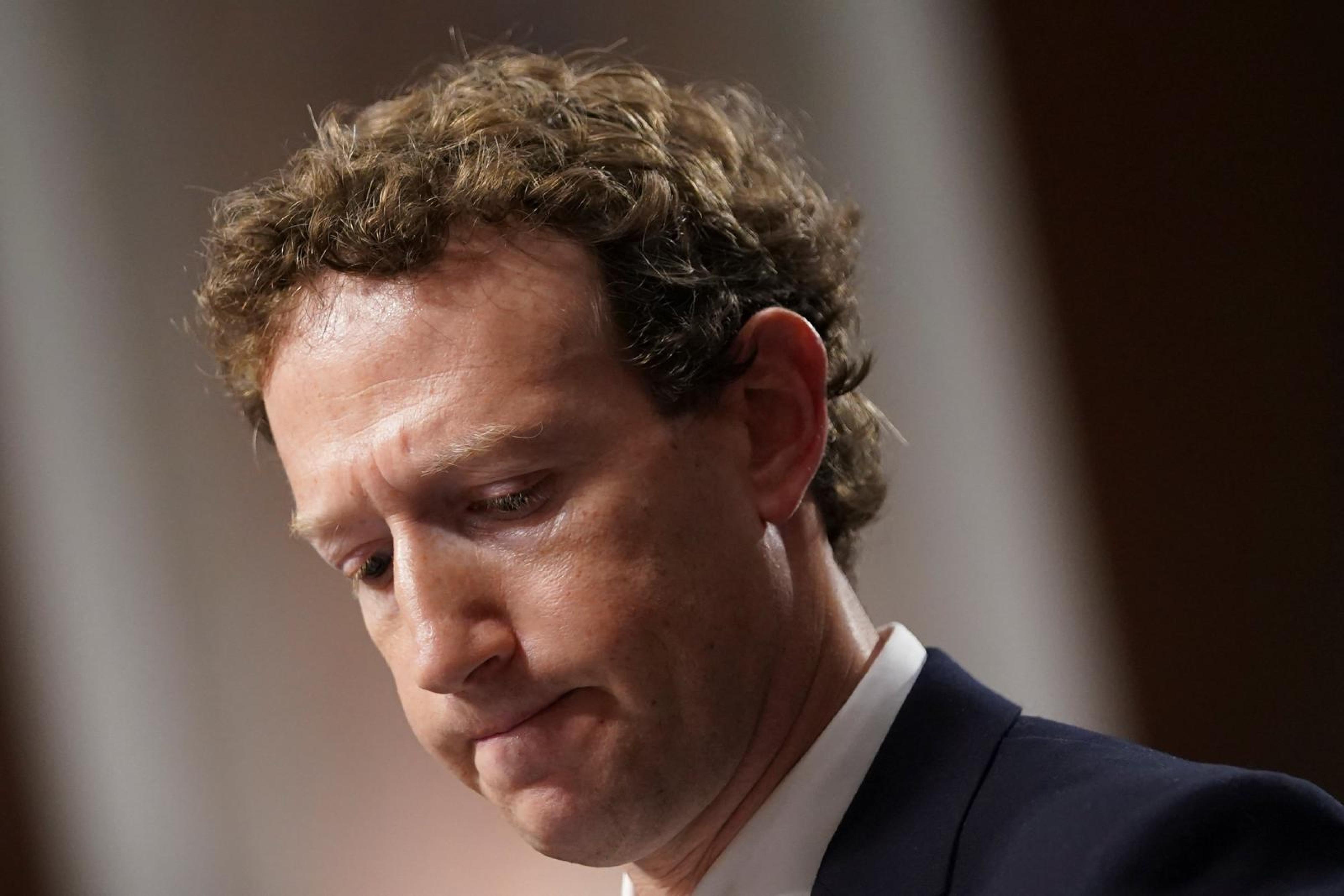
That historical moment ironically shadows the recent $17.1 billion settlement reached between state governments and Mark Zuckerberg’s Meta. Sued by dozens of states ranging from California to Kentucky on behalf of plaintiffs who claimed Meta’s addictive products endangered teen users, the company will have to reconfigure its tools and practices to prevent such abuse from happening again.
Zuckerberg, who was scheduled to testify in the federal trial, published a somewhat preemptive, 6,500-word “defense” titled “The Future Is for Everyone” that drew, unconvincingly, on ’90s-era tech optimism. He repeated Meta’s longstanding plea that it strengthens “community” and claimed that, by incorporating AI, it would empower users and, through them, democracy itself. Critics of Zuckerberg’s manifesto, writing in The Guardian and many other venues, warned credibly that Meta’s AI will simply serve to lock users ever deeper into its ecosystem.
The most authoritative counternarratives to Zuckerberg’s have come from outside the courtroom. In a riveting conversation with The New York Times’s Ezra Klein, Helen Toner, a former board member of OpenAI, explained that even AI researchers—more than a thousand of whom signed on to an open letter titled “Pacing the Frontier”—are unnerved by what they consider the “real risk that capability development rapidly accelerates beyond our ability to understand or control the resulting systems.” These employees of the top AI companies request “that the U.S. government support an international effort to develop the technical and governance tools needed to deliberately pace the frontier of automated AI development.” As Toner put it, they “are basically saying: ‘We wish we had a brake pedal.’”
You might like: Nathan Dufour Oglesby on the rise of the Catholic chatbot
The settlement against Meta may prove a brake pedal of sorts, though it is yet to be designed and will not explicitly target AI. Still, it provides important proof that tech’s self-congratulation can be effectively challenged—and that one needn’t be a Luddite to challenge it.
An early, prototypically American herald of our supposed cyber-liberation was a Wyoming-born poet, essayist, cattle rancher, and libertarian activist, John Perry Barlow. A sometime lyricist for The Grateful Dead and a founding member of the Electronic Frontier Foundation (EFF), Barlow posted “A Declaration of the Independence of Cyberspace” on EFF’s website in 1996. An excerpt captures its grandiosity and wishfulness:
Governments of the Industrial World, you weary giants of flesh and steel, I come from Cyberspace, the new home of Mind…. You have no sovereignty where we gather… You have no moral right to rule us nor do you possess any methods of enforcement we have true reason to fear…. You have not engaged in our great and gathering conversation, nor did you create the wealth of our marketplaces…. We are forming our own Social Contract.… We are creating a world that all may enter without privilege or prejudice accorded by race, economic power, military force, or station of birth.… We will spread ourselves across the Planet so that no one can arrest our thoughts. We will create a civilization of the Mind in Cyberspace. May it be more humane and fair than the world your governments have made before.
Equally rosy about the promise of the internet was 2008’s Here Comes Everybody: The Power of Organizing Without Organizations, a book-length declaration of cyber-liberation written by Clay Shirky, formerly a vice president of Barlow’s EFF and now the Vice Provost for AI and Technology in Education at New York University.
Barlow and Shirky proclaimed a manifest destiny for tech to bring the world “change we can believe in”—a campaign slogan of another American herald in his 2008 presidential campaign. The Obama campaign leveraged the power of the internet. His administration, as one New York Times headline put it, “brought Silicon Valley to Washington.” On the night Obama won the 2008 presidential election, he announced, “If there is anyone out there who still doubts that America is a place where all things are possible…who still questions the power of our democracy, tonight is your answer.” But he and his campaign’s digital designers, Chris Hughes and Teddy Goff (a former Yale student of mine), couldn’t have known then that their unskeptical trust in the power of the internet could eventually undermine the principles and commitments that had gotten Obama elected.
Since those heady days, techno-optimism has not so much faded away as gotten meaner and moved right. In 2023, Marc Andreessen, the billionaire software developer and Netscape cofounder, wrote the aggressive “Techno-Optimist Manifesto.” In place of Obama-era prosocial hopes for technology is the promise that technology and markets will overcome human error. “We believe markets do not require people to be perfect, or even well intentioned—which is good, because, have you met people?” Shortly after publishing his manifesto, Andreessen became a close advisor to Donald Trump.
The internet has, of course, empowered many people, but most of them were already well-nurtured, educated, and “connected.” As the suit against Meta charges, the company and, by implication, many of its counterparts have been seducing and enchaining their more vulnerable users through a deluge of flickering images on screens in a postmodern equivalent of Plato’s fabled, imprisoning cave. Recently, the cave’s designers have introduced AI, a new inhuman participant whose outputs confound its programmers and are further deranging our understanding of independence and reasoned debate.
History shows that manipulative communications networks aren’t invulnerable. In 1989, Eastern Europe’s Solidarity movement broke the totalitarian grip of the weary Soviet Union. In 2011, Twitter and other social media helped rouse the “Arab Spring” rebellion against repressive states in the Middle East. In 2025, Zohran Mamdani, a little-known Indian-African immigrant to New York City, won its mayoralty with a digital social-media campaign that shocked the city’s power brokers and legacy journalists, who warned that his promises were delusional.
Mamdani’s victory is, of course, complicated, because he’s trying to wield the tools of the captured internet against many of the interests that control it. Like Barlow, Shirky, and Obama before him, he may be skipping like Pollyanna through a ravaged public sphere swarmed by conmen, desperadoes, demons, demagogues, and monsters.
I’ve noted elsewhere that the nineteenth-century “lords of the loom and the lash”—those who owned and operated the brutal mills and who enslaved people to grow and harvest their cotton— were superseded by magnates of mines, oil wells, railroads, and tabloid newspapers. In turn, they are now being superseded by tech overlords, including Zuckerberg, Andreessen, Peter Thiel, and Alexander Karp.
Thiel and Karp cofounded Palantir Technologies, the national-security-oriented software and data-mining giant facilitating lethal violence not only against terrorists and other “enemies of the West,” but also against nonviolent American citizens and surveilled immigrants in our cities, towns, and workplaces. (Thiel named Palantir for the “palantiri,” the magical seeing stones in The Lord of the Rings.)
Notwithstanding vows like Zuckerberg’s to advance the public good, the new overlords’ algorithms are far more intrusive and addictive than previous corporate interventions into the lives of consumers. They overdetermine users’ searches and choices and are now drawing the power to do so from energy-devouring data centers and from billions of dollars in Trump-administration contracts and concessions.
In 2016, on the twentieth anniversary of Barlow’s “Declaration of Independence in Cyberspace,” he told The Economist that, had he known what was to come,
I probably wouldn’t have imitated the grandiloquent style of a notorious former slave holder. And I would have been a bit more humble about the “Citizens of Cyberspace” creating social contracts to deal with bad behavior online…. I hate spam, and viruses, and worms, and surveillance, but the fact remains that if you can censor one of these bad behaviors, you’ve endowed yourself with the ability to censor almost anything you don’t like online. This is not an ability I wish to extend to any existing government in the physical world.
But would the libertarian Barlow (who died in 2018) now resist granting “the ability to censor” to algorithmically driven maximizers of profit like Google and Meta, which steer users toward favored options while sidelining others? Can truly free speech be rescued not only from government censorship but also from what the media critic John Keane calls “market censorship”—the outcome of a public sphere controlled by private pseudogovernments run by the likes of Thiel, Musk, and Bezos?
Bezos’s diminished Washington Post announces that “Democracy Dies in Darkness,” but democracy is dying now in the brightly lit cacophony of messaging that confuses, degrades, and outright scams. In Trump advisor Steve Bannon’s famous words, the zone is now thoroughly “flooded with shit.” The line between fact and fiction is blurred, leaving an opening for demagogues like Trump to declare they “alone can fix it” while they profit from the destruction of democratic deliberation.
Before his death in 2023, the Italian political activist and philosopher Antonio Negri warned that the web risks becoming “the reproduction of the Panopticon in a democratic and friendly form.” He went on:
[The internet] deceives us into thinking we are connected and have freedom of speech, while in reality it measures, predicts, and modulates our every desire and political gesture…. We must exit the digital simulacrum, where every act of rebellion is already predicted and monetized…. We must reconstruct the physical assembly…of a new politics…in the slowness and complexity of real encounters, not in the binary speed of the network. We must stop producing surrogate activities—entertainment and social media rhetoric—and focus on the production of the necessary, such as welfare, ecology, and education.
Doing so will require overcoming the passivity fostered by these technologies. During the 1960s, some of us citizen-rebels against the Vietnam War hurled terms like “drones” and “good Germans” at our young peers who were working unthinkingly with a military-industrial complex that even President Eisenhower had mistrusted. Hannah Arendt used the phrase “the banality of evil” during the trial of Adolf Eichmann to characterize his unthinking facilitation of mass murder. The Yale psychologist Stanley Milgram’s postwar experiments suggested that many ordinary Americans would obey an authority figure who ordered them to hurt someone else.
Are Americans, famously facile in our optimism, doomed to swallow promises like Zuckerberg’s of liberation through submission? The failure of prophecies such as Barlow’s can offer some comfort. Those past misinterpretations can remind us that the self-understandings of the present rarely endure. They ride on an undercurrent that still needs to be revealed, reckoned with, reassessed, and transcended.
If a Trumpian panopticon is emerging to hobble our freedoms, it may isolate and hobble Trump and his vassals themselves, along with their accomplices and apologists. No matter if they claim to defend America and “the West,” as Karp does, or pretend to nurture some folksy, faux-communitarian society, as Zuckerberg does. Today’s tech leaders and their followers are heading the way of their nineteenth- and twentieth-century predecessors. The rest of us should resist their call to distribute submission more widely and instead work ever more energetically to organize a stronger democracy.
We welcome your comments about this article. Please send your response to [email protected].