Ross Douthat’s departure from the op-ed page of The New York Times to join 60 Minutes at Bari Weiss’s revamped CBS News has generated different reactions in different ideological quarters: a collective wave of “good riddance” from the liberal and progressive Catholic left, and, among his fans, a wistful combination of something like grief and shared pride in the project he carried out as a columnist for the “paper of record.”
The latter sentiment was expressed in an article by my friend Bill McCormick, SJ, in America, which praised Douthat for bringing back the voice of the lay Catholic intellectual in the public square. I think there are a few things to add to that mostly admiring piece, given my own interest in the role of the lay Catholic public intellectual in times like these.
Douthat started as an op-ed columnist at the Times shortly after I had moved to the United States. I will miss his columns, as they have helped me understand America better, see my own blind spots, and measure my position against the various shades of American Catholicism, from academic gray and clerical black to Democratic blue and Republican red. He also helped me understand the differences between Italian/European and American Catholicism, especially in the context of the Catholic public intellectual. His Catholic public intellectualism goes back to William F. Buckley Jr., Richard John Neuhaus, and the First Things circle, so different from the believers among Italy’s secular media: Catholic and communist, dissenter and frequent guest at the cardinal’s table, insider and outsider at the same time. Here in America, Douthat (and now J. D. Vance) have taken the “us vs. them” rhetoric to even greater heights, aided and encouraged by an evolving media and social-media environment. This has affected perceptions of the Catholic Church, and the self-perceptions of Catholics, in the United States.
In his farewell column on August 8, Douthat opens with a description of how he saw his mission:
The columnist’s job contains multitudes, but it’s useful to have a primary antagonist, a specific worldview that you think needs to be challenged and critiqued. For me, for many years, that worldview was the elite consensus of the early Obama era—a mostly left-of-center perspective that also belonged to Silicon Valley moguls, centrist politicians in the style of Michael Bloomberg and portions of the Republican consultant class.
But readers paying attention to Catholic affairs between 2013 and 2025 surely noticed Douthat had identified another antagonist: Pope Francis. Here are just a few of the headlines of his op-eds in The New York Times: “The Plot to Change Catholicism” (October 17, 2015), “Expect the Inquisition” (September 20, 2017), “Pope Francis Is Beloved. His Papacy Might Be a Disaster” (March 16, 2018), “What Did Pope Francis Know?” (August 28, 2018), “The Slow Road to Catholic Schism” (September 14, 2019). Those all seemed to contrast what the newly hired Douthat told Charlie Rose in 2009: “I think Catholics owe the papacy a certain kind of deference even when they don’t owe it explicit agreement.”
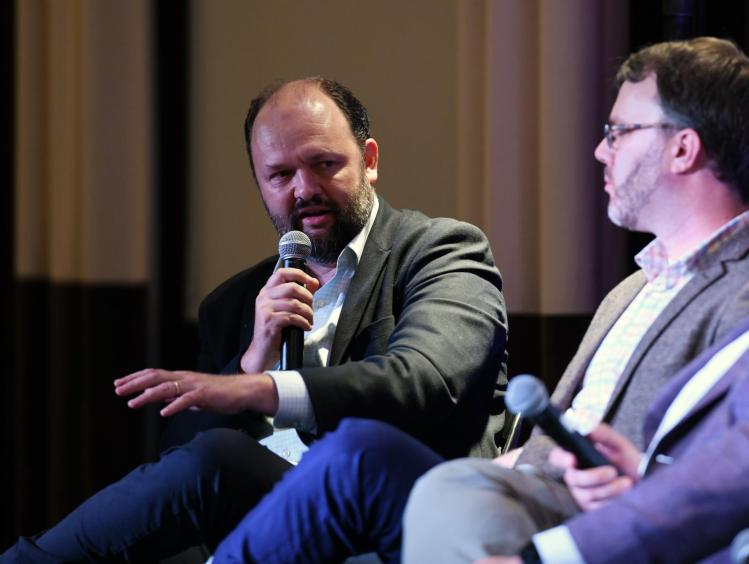
The problem was not Douthat’s lack of deference towards Pope Francis; the age of deference is over. The problem was his glib dismissal of the content of Francis’s teaching and lack of engagement with the sources, which I found astonishing when I had the pleasure of debating with him at Fordham in 2018.
If he had shown some understanding, for example, of John chapter 4 (the Samaritan woman at the well) as a model for pastoral accompaniment, perhaps he might not have been so displeased about the Synod on the Family or Amoris Laetitia.
Douthat’s mode of interpreting Catholicism tends to prioritize the political in the context of an American Catholicism that he views as orthodox and normative for the universal Church. He is a lay Catholic intellectual who does not seem to have had the time or patience to engage with theology or Church history prior to 1800 or outside of the West. The rest of the global Catholic Church is reduced to an exception or a deviation—and this could at times include the Vatican. He saw Pope Francis’s challenge to American Catholic conservatism not just as an abrupt change in Church politics and ecclesiastical etiquette, but as a threat against doctrinal purity—though he didn’t provide proof. One thing that my brother-in-the-faith is liberal about is handing out charges of heresy to Catholics whose opinions differ from his own: myself, and, in a more subtle and important way, Pope Francis. But I guess that over the past two decades, both of us learned a thing or two about the dangers of social media.
In his farewell column, Douthat writes, “I’ve lost my sense of which contemporary worldview is most in need of criticism or opposition, where the good guys and bad guys are.” The timing of this admission is interesting, coming fairly soon after the arrival of the first U.S. pope. I would have liked to hear what this leading conservative Catholic columnist—who has written that Vatican II was a failure—might have said about Leo’s decision to dedicate all the general audiences of 2026 to the documents of the Second Vatican Council.
Douthat’s departure also coincides with what he recently described as the possible beginning of the end for Trumpism. His somewhat cavalier attitude toward Trump and the MAGA movement overall has long struck many readers—Catholics and non-Catholics alike—as puzzling. In normalizing Trump, he’s helped foster willful obliviousness to the damage Trump’s regime has done: democratic decline, damage to the rule of law and religious liberty, retribution against political foes, pressure campaigns against universities, rewriting of the past, attacks on the free press, and a mass-deportation program that daily confirms that, with this administration, cruelty is the point. Still, Douthat in his final column complained, “I lived through the years of peak woke, and it was a McCarthyite experience.”
But what sheds the most light on how he approached his position as columnist is his admission that “all of these political forces—the unpopular populists, the flailing establishment, the rising left—are displaying their vices in the shadow of the artificial intelligence revolution, which is creating new zones of power in which the friend-enemy distinction is almost impossible for me to parse.” It reasserts his need for an antagonist—to use “the friend-enemy” distinction as a compass. This is difficult to square with contemporary Catholic teaching. It reshapes the Catholic incarnational-and-sacramental imagination to fit binomial categories brought over from the Nietzschean will-to-power realm.
The final-column confession also verbalizes that beneath his intellectual acuity there lies the crude realization that we live in a time of war, militarily but also culturally. The fervor of the civil and religious revolutionary combatant in plainclothes drove his interpretation of Catholicism, Vatican II, Pope Francis, and Donald Trump. Perhaps, however, Douthat’s candid disappointment with those whom he thought were “the good guys” is a sign of what Pope Leo calls “unarmed and disarming peace.” I wish him well in his new endeavor.
We welcome your comments about this article. Please send your response to [email protected].