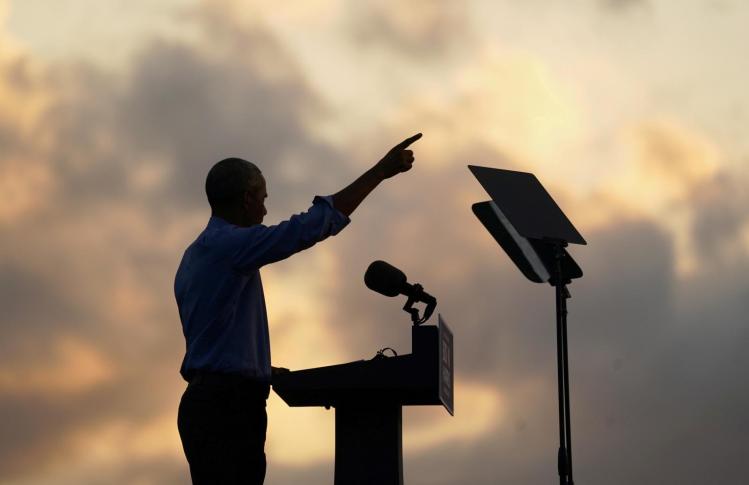
In 2008, Barack Obama’s opponents in the Democratic primaries sniffed at his rhetoric. He was talking more about hope than his policy preferences, they complained. In response, he quoted famous lines from monumental speeches in a tone of passionate disbelief. “‘I have a dream.’ Just words?” “‘We have nothing to fear but fear itself.’ Just words? Just speeches?” At a rally in Wisconsin, he ignited the crowd with a new refrain: “Don’t tell me words don’t matter.”
For the bookish among us, Obama’s belief in words was always central to his political appeal. He was undeniably literary: he read novels, wrote memoirs, and was spotted with Derek Walcott’s Collected Poems under his arm. One of his parting services to literary culture was to interview Marilynne Robinson for The New York Review of Books. At the newly opened Obama Presidential Center in Chicago, words from his famous Selma speech adorn the museum’s Skyroom and are permanently sculpted into the building’s grand exterior.
Like Obama, Ben Rhodes has a writer’s sensibility and remains entirely earnest in his faith in the power of words. As a White House staffer for eight years, he drafted some of the President’s major foreign-policy speeches. Now, almost a decade after leaving Washington D.C., he has written a trilogy of books that wrestle with the legacy of his boss’s administration. His 2018 memoir, The World as It Is, tracked his evolution from an idealistic aide to a melancholic strategist. 2020’s After the Fall reckoned with the disturbing rise of authoritarian governments and caught glimpses of the old hope in the lives of beleaguered dissidents from Hungary, Russia, Hong Kong, and elsewhere.
In the recently published All We Say, Rhodes adopts the voice of a lay historian, explaining why the fifteen speeches he glosses in this volume “tell the story of our argument over American identity.” The prologue is a direct rebuke to J. D. Vance’s impoverished blood-and-soil nationalism, which the vice president laid out in typically soulless fashion to the Claremont Institute last year. The rest of the book, which begins with Benjamin Franklin and ends with Donald Trump, makes the case for a more progressive view of the American creed and insists that public speeches are the best means of persuasion. In the closing pages, he references Obama’s guiding refrain. “We have no common story of divine creation, no single racial or tribal solidarity, no connection to a piece of land,” he writes. “What we have are words.” The Declaration of Independence; the Constitution; our treasure of national speeches—the ones that “call us to be that better version of ourselves.” In short: “Words matter.”
The likeliest readers of this book will already believe in its vision of America. This doesn’t mean the message isn’t worth reiterating—especially on the occasion of our semiquincentennial—but it does mean that Rhodes, an opinion writer for The New York Times, an analyst for MS NOW, and co-host of Crooked Media’s “Pod Save The World,” can afford a few platitudes (“the greatest speeches tell hard truths,” to take one example). He also tends to reduce historical analysis to cable-news talking points or social-media formulations: “On March 21, 1861, Alexander Stephens said the quiet part out loud.” That kind of lapse in style occurs when one assumes they have the choir’s full attention.
You might like: Phil Christman on Obama's elusive meaning
But Rhodes’s expertise is beyond question. He knows how a speech enters the public mind and the history books, and he offers unique and valuable insights into the process of political storytelling. He reminds us, for instance, that Ronald Reagan’s “evil empire” speech was addressed to an Evangelical convention in Orlando and focused on abortion as much as the Soviet Union: “Through his words, Ronald Reagan wove together a coalition of Christian evangelicals, anti-government conservatives, and national-security hawks under the umbrella of a moralistic and nostalgic nationalism.” Rhodes, the former speechwriter, appreciates that historical revisionism is part of the craft; he credits that speech, “God and Country,” with constituting the New Right, just as Obama’s speeches helped form his own coalition twenty-five years later.
All We Say also provides important historical context for the style of major speeches, which we often take for granted. “Roosevelt’s homespun style and democratic intimacy contrasted sharply with the hypnotic oratory and demagoguery that helped Adolf Hitler consolidate totalitarian control,” Rhodes writes. Of Martin Luther King Jr.’s momentous speech in Washington: “The dream of opportunity, of fulfillment, of self-improvement was now being repurposed as a dream of equality.” And in the words of Louis Brandeis, whose critique of monopoly power has perhaps never been more relevant, Rhodes detects an important clarification of the language of the Declaration of Independence: “Life,” Brandeis insists, “means living, not existing.”
Apart from Alexander Stephens (the Confederate apologist), Ronald Reagan, and Donald Trump (the book concludes with Trump’s crudely imperious Second Inaugural), the narrative arc is progressive. Speeches by Anna Dickinson, the “celebrity suffragette” and committed abolitionist; Mary Lease, the populist firebrand known as “the people’s Joan of Arc”; and Dolores Huerta, the labor leader and feminist activist are included along with the greatest hits. The progressive story is central to the book’s ultimate purpose: to prevent “one faction of the country” from taking “custody of the American story.” One wishes this weren’t a necessary project, but it is.
At the heart of Rhodes’s history is the claim that progress arises from the “creative tension” between political activists and politicians. “The alchemy of democracy is the interplay between movements and power,” he writes, citing the relationship between Frederick Douglass and Abraham Lincoln as the paradigmatic example, echoed a century later by the tension between Dr. King’s hard-won principles and Kennedy’s “glamorous liberalism.”
In the wake of Citizens United, however, the donor seems to wield as much power as the activist, and the nature of political speech itself has changed significantly. “I am mindful that I have written a book about consequential speeches at a time when they are a rarity,” Rhodes confesses in the epilogue. “We live in an age of cruder communication.” When speeches were printed in newspapers, politicians actually had to construct careful arguments; it wasn’t until well into the nineteenth century that performance started to matter and that politics, as Rhodes puts it, “merged with popular culture.” By the 1850s, the public-speaking circuit had evolved into a forum for entertainment. “Attendees could expect to see Ralph Waldo Emerson or a magician,” Rhodes explains. On today’s various “platforms,” there are far more magicians than Emersons.
Obama was special to those of us who shared his worldview because he offered a version of politics that felt transcendent. Rhodes is most engaging when he takes us back to the campaign trail in 2008—specifically, to the “race” speech Obama delivered in mid-March to address the controversy around his pastor Jeremiah Wright, who had made the kind of statements about American imperialism that William James had made a century before in the wake of the Spanish-American War (“God damn the United States for its vile conduct in the Philippines Isles”). As the story goes, Jon Favreau sent Obama a draft of the speech and received back an almost completely rewritten version: “There it was, page after page, in the red, underlined lettering of tracked changes.” (This is red meat for the literary Millennial who has measured out his meager professional life in Word documents.) Fortunately, “A More Perfect Union” really holds up. As Rhodes describes it, the speech “recast American exceptionalism” as the capacity to overcome our tragic past “on behalf of a truly multiracial democracy.”
In Saul Bellow’s Humboldt’s Gift, a brilliant but deranged poet indulges in the fantasy of an Adlai Stevenson White House. “Cabinet members would quote Yeats and Joyce,” he envisions. The poet dies broke and alone in a cheap New York hotel room, but his dream of a literary governing class is still alive today in some of the more effusive coverage of politicians like Pete Buttigieg and other straight-A types. Do we need inspiring orators for democracy to survive? If so, we might be in trouble. These days, American speeches are indebted as much to the cadences of the marketing executive as they are to the King James Bible or to Jefferson’s learned music.
But what if the soul of America can be found instead in its literature? In Randolph Bourne’s essay “Transnational America?” In James Baldwin’s The Fire Next Time? In Toni Morrison’s Song of Solomon or Herman Melville’s Moby-Dick? The epigraph for All We Say is an oft-quoted excerpt from Whitman’s Leaves of Grass: “Do I contradict myself? / Very well then, I contradict myself. / (I am large. I contain multitudes.)” It serves Rhodes’s thesis statement, of course: oppositional tension breeds progress. But Leaves of Grass is more than just an argument in favor of democracy. Like Obama’s best speeches, the poem embodies the imaginative compassion necessary to sustain a beloved community, a compassion sorely lacking in our current political culture, which is dominated by viral clips, meme wars, spammy texts, and podcasters reading ads for home-security systems.
Words matter, and great speeches can bring out the best in us. But the degradation of public life can’t be reversed by rhetoric alone, as Obama’s presidency arguably showed. What Americans need right now from their politicians isn’t Ciceronian rhetoric; they can find that in their libraries. What they need is a political system capable—among many other things—of keeping those libraries open.
We welcome your comments about this article. Please send your response to [email protected].