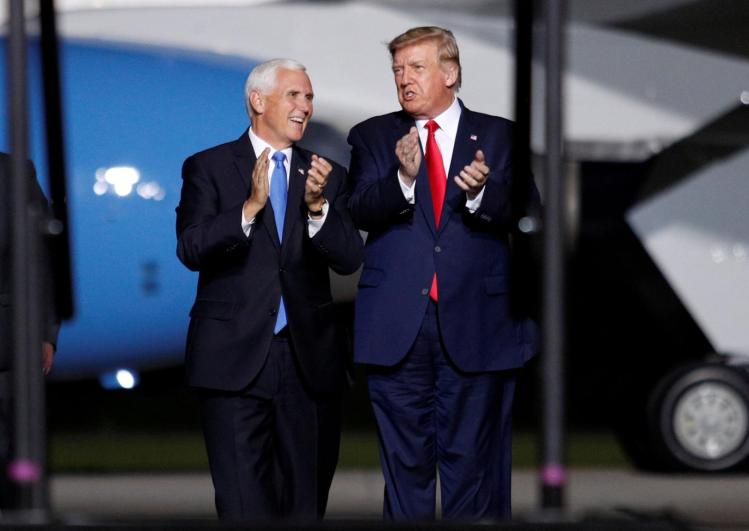
On January 6, 2021, a group of Donald Trump’s staunchest supporters set up a makeshift gallows beneath a cold gray sky just outside the United States Capitol. Those would-be hangmen later joined the rioters who stormed its halls, where chants of “Hang Mike Pence” rose above the furious din. The vice president refused to help Trump overturn the election and had, in their estimation, committed treason. As the mob penetrated deeper into the building, Pence was sequestered into an underground loading dock where he hid for hours while Trump refused to call off his vengeful supporters.
An experience like that would leave quite the mark on just about anyone. One would think it would clarify the worst threats to order in this country. And yet, readers of Pence’s new book, What Conservatives Believe: Rediscovering the Conservative Conscience, will find no such intellectual or moral clarity. Instead, the book is a clarion call for a lost cause and a confused genealogy of American conservatism.
On the surface, What Conservatives Believe is a manifesto that calls on Americans to return to what Pence considers the roots of conservatism in order to combat both progressivism and right-wing populism, which he sees as mirror images of each other. “While conservatives must confront the socialist ambitions of progressives, we must also recognize the new threat of economic nationalism from right-wing populists,” he writes. “The populist agenda of economic nationalism is socialism by another name.” Pence claims that only a movement grounded in conservative principles can serve as a bulwark against these twin forces. He presents his book as a statement of these principles—to “say what conservatives believe.”
Beneath the surface, though, there is also an attempt by Pence to absolve himself and the conservative movement of complicity in the disaster of Trumpism by creating distance between the two. Indeed, to the extent Pence is willing to criticize his former boss—only occasionally and only very gently—it is because he thinks Trump 2.0 has betrayed the principles that made Trump 1.0 a good and successful project.
According to Pence, the roots of modern conservatism are found in the ground broken by Barry Goldwater, the Arizona senator who became the Republican Party’s nominee for president in 1964 and lost in a landslide to Lyndon B. Johnson. That election has become a founding myth among many conservatives, who imagine Goldwater as lighting a torch that Ronald Reagan victoriously carried all the way to the White House. Reagan’s victory supposedly vindicated the “timeless principles of conservatism” Goldwater articulated in his book The Conscience of a Conservative—timeless, yet still “grounded in its time,” Pence writes. The longest chapter in that book, Pence notes, is about the threat of the long-gone Soviet Union. And so, he carefully extracts the essence of the Goldwater formula and updates it for application to the challenges of our own day. He begins by offering a list of ingredients for a conservative renaissance—for example: “Conservatives believe in character, civility, and statesmanship”—before expounding on each of these in subsequent chapters.
Of course, it would be much easier to believe all that if Trump did not exist and had not so thoroughly captured the conservative movement despite his incivility, unstatesmanlike conduct, and obvious lack of character. Hence Pence’s vain attempt to differentiate between the man he served under for four years and the man in the White House today. “Campaigning for a second term, Trump became fully uprooted,” he writes. As evidence, he furnishes the following quote from Trump as he campaigned for reelection in 2024: “You know, people say, ‘You’re a conservative.’ I’m not conservative. You know what I am? I’m a man of common sense.” Pence treats this as a damning admission of guilt, and once this supposed point of divergence has been established, he occasionally alternates between praising Trump 1.0 for adhering to conservative principles and lightly jabbing Trump 2.0 for embracing “right-wing populists” and grievance politics.
You might like: Dorothy Fortenberry on the many conversions of J. D. Vance
But this distinction is finally nothing more than a self-soothing lie. Its only purpose is to relieve the conservative conscience of guilt for the current state of affairs. It’s certainly personal for Pence—and not just because his life was threatened in the end. He was selected as Trump’s running mate primarily to reassure social conservatives who might be wary of getting into bed with a serial adulterer, inveterate liar, and con artist. By offering his own conservative bona fides as security, Pence helped quell those concerns and made Trump an easier pill to swallow. It is difficult, then, to take seriously the notion that Trump underwent a fundamental transformation in his politics or character. Trump has never been a paragon of Christian virtue; nor have his politics ever been anything more than an expression of self-interest, which occasionally aligns with conservative goals.
Pence warns conservatives against “modern-day nativists” who stir up “discord and division,” but he served under a man who made exploiting discord and division both a campaign and governing strategy from the start. Trump’s history of conspiratorial, grievance-fueled, and often bigoted rhetoric toward a whole gallery of enemies was not a secret when Pence first signed on as his running mate. That history reached its catastrophic crescendo on January 6, but it did not begin that day. Pence remains bafflingly incapable of confronting the realities of that episode. Readers hoping for a furious inside account of the attempted coup will be disappointed and perhaps puzzled.
“In the closing days of Trump’s first term,” he writes, “following our defeat in the 2020 election, the president and his most passionate allies sought to set aside the clear language of the Constitution regarding the vice president’s role in counting the votes of the Electoral College.” “Passionate allies” is a strange way for a man to describe people who constructed a gallows from which they hoped to hang him. Pence’s real venom is inexplicably reserved for Joe Biden and his progressive supporters. After praising Trump for aborting his own coup and finally acquiescing to the transition of power, Pence writes: “Tragically, President Joe Biden grabbed that power and Americans who hoped for a renewed constitutionalism were badly disappointed.” The reader is asked to believe that Biden and his allies posed a far greater threat to the political order than Trump because they proposed such radical things as the cancellation of student-loan debt. “It took the election of 2024, ousting Democrats from the White House, to restore constitutional order,” Pence concludes.
Rousseau once asked his readers to forgive his contradictions, for “one must make them when one reflects.” With Pence, there are plenty of glaring, untenable contradictions but no reflection whatsoever. It’s a shame, because a more reflective man with the same experiences could have written a useful book exploring why the conservative movement was so susceptible to being seduced and corrupted by a demagogue.
One of the few consistent things about the right is how frequently it has changed, often after periods of intense in-fighting and purges. If Goldwater represented a crucial turning point for the character of conservatism, it was because his presidential campaign marked the postwar right’s formal entry into mass politics. That is the argument historian Paul Gottfried makes in The Conservative Movement. “The Goldwater campaign,” Gottfried writes, “hurt the older conservatism in two ways: by equating its social philosophy almost entirely with free enterprise; and contributing to a conservative movement more concerned with electoral victories than unifying principles.” From that point on, conservatives prioritized activism and building political machinery over ideas, principally organizing themselves as an oppositional force. By attempting to rally his supporters against the specter of “godless communists” ahead of this year’s midterms, Trump is continuing the conservative tradition of defining itself chiefly by what it is against, even if that means conjuring an imaginary villain.
Far from marking a deviation, as Pence suggests, Trump is arguably the logical conclusion of a movement that has long prioritized imposing its will by any means necessary. Nor can Pence claim that Trump has completely failed in that regard. Kevin Roberts, president of right-wing think tank The Heritage Foundation, recently boasted that Trump has implemented 1,055 of the 1,913 recommendations in its ultraconservative Project 2025 program. Of course, Trump has also exploded the national debt, swelled government spending, trampled the Constitution, and presided over the most corrupt administration in American history. The more honest partisans on the right have simply called this the cost of doing business with a “winner.” The Republican Party and virtually the entirety of conservative media look at it that way.
The irony is that Barry Goldwater himself would never have suffered such delusions. Goldwater ceased to be a Goldwater conservative in the years after his defeat. He advocated for environmentalist restrictions and green energy, supported antidiscrimination legislation, and vehemently denounced attempts by conservatives to impose organized religion in public schools. Goldwater even endorsed a Democrat, Karan English, for Congress over a self-proclaimed “Goldwater Republican” in 1992. For all this and more, he was denounced as a traitor to the movement he helped launch. “The hero of America’s conservative movement is starting to sound like he’s lost it,” said one prominent Republican activist at the time.
In reality, Goldwater had a conscience and kept it. When asked if there had been some radical shift in his politics, he would scoff. “A lot of so-called conservatives today don’t know what the word means,” he told the Chicago Tribune in 1994. Nothing about him had changed; every position he struck was consistent with his view of individual rights as inviolable, and he couldn’t care less whether that offended his peers. Would Pence endorse a Democrat against a MAGA Republican who represents everything he claims to abhor? Not likely, for there is no greater transgression in his eyes than to be outside the GOP. And that is the key difference between Goldwater and Pence. One man would prove to be governed by principles; the other is still driven by pure partisanship. That is the irony at the heart of Pence’s book, with its constant celebration of principle and its unwitting testimony to failed opportunism. Even his halfhearted lamentation is opportunistic. Pence is like a man pulling the fire alarm after a blaze he helped set has already run its destructive course and left only cinders in its wake.
Now more than ever, America needs men and women of conscience who are willing to rise above party lines for the sake of the country and each other. Pence is right that we are living through perilous times. But he mistakes the source and nature of the peril, even though it almost killed him. Samuel Johnson famously wrote that “when a man knows he is to be hanged in a fortnight, it concentrates his mind wonderfully.” The memory of almost being hanged doesn’t appear to have concentrated Pence’s mind. It has merely tipped him back into the same partisan rut that led him to that fateful day.
We welcome your comments about this article. Please send your response to [email protected].