“This is your priest on drugs,” proclaimed the headline of a New Yorker article by Michael Pollan last year. Pollan’s 2018 book How to Change Your Mind both chronicled and turbocharged the so-called “psychedelic renaissance.” Proliferating clinical trials had already demonstrated psychedelics’ ability to mitigate psychiatric conditions like PTSD and treatment-resistant depression, and over the following years, psilocybin treatments were legalized, under some conditions, in three states. Celebrity podcasts and think pieces fueled the growing hype about those substances’ medicinal powers, and in April, President Trump signed an executive order to fast-track psychedelic research—largely on the recommendation of Joe Rogan.
For many psychonauts, however, psychedelics are not just pharmacological treatments but inherently sacred molecules. While both critics and defenders of Western medicine point out how hard it is to quantify mystical experiences, the scientific community is increasingly aware that the spiritual dimension of psychedelic trips can be their primary pathway for transformation. It was only a matter of time, then, before psychedelic researchers turned their attention to clergy.
Pollan’s article reports on an NYU/Johns Hopkins study ten years in the making. Twenty-nine mostly Jewish and Christian religious leaders (including one Catholic priest) agreed to consume psilocybin, the psychoactive ingredient in “magic mushrooms.” As in many psilocybin studies, most of the participants’ journeys had a mystical dimension. But what is really extraordinary is that 96 percent of those clergy—“people whose job it is to create and curate spiritual experiences,” Rabbi Jay Michaelson marvels—considered their psychedelic journey among the most significant moments in their lives.
This may be just as fascinating for religion scholars as for psychedelic researchers, although Pollan’s article glosses over the survey data that carry the broadest implications for mainstream congregational life. For instance, not only did most of the participating clergy emerge with a greater investment in interreligious dialogue; they also showed a deepened commitment to their specific traditions, making more time for their own “devotional life” and embracing the “veracity” of religious dogmas like “nirvana, heaven, hell, karma.”
Pollan relates the example of an Eastern Orthodox priest who saw himself entombed with Jesus, where he merged so fully with the indestructible power of divine love that he wet his bed at the moment of surrender. This account is certainly earthy, but so were some medieval mystics’ bridal unions with Christ, religious phenomena with a home in the Catholic theological tradition. Notably, like other clergy in the study, the priest felt cured of professional burnout and returned to his parish with a renewed enthusiasm for celebrating the liturgy and pastoring.
Three other participants were so impacted that they founded organizations dedicated to psychedelic-informed practice precisely within their own traditions. One can well understand why some researchers—instead of “psychedelic,” meaning “mind-manifesting”—prefer the term “entheogenic”: “engendering the God within.”
For its part, the Catholic Church has a slim but growing history of public engagement with psychedelic substances. The Catechism doesn’t mention them specifically but condemns drugs in general for “inflict[ing] very grave damage on human health and life…. Their use, except on strictly therapeutic grounds, is a grave offense.”
Some have claimed that psychedelics deserve the therapeutic exception. Jesuit priest and bioethicist Joe Lorenz carefully rehearses the argument for considering psychedelics “not just another drug, but a medicine”; indeed, they often transform, and in some cases may save, people’s lives. In a similar vein, the traditionalist priest and exorcist Chad Ripperger recently likened psychedelics to other drugs that are licitly prescribed for medical reasons: “God put these things here for a reason, and that means we have to figure out: What is that reason?… [If a psychedelic is] used properly and would correct certain things, then it can be legitimately used.”
The key word here is “properly,” but even when every due caution is taken, psychedelic journeys can be deeply unsettling. For example, Rev. Rita Powell, Harvard’s Episcopal chaplain and another participant in the NYU/Hopkins trial, came face to face with a joyless abyss that took her to “the furthest limit of human capacity.” The legendary psychedelic evangelist Terence McKenna, who had taken psilocybin for decades, had a viciously destabilizing trip near the end of his life and never used mushrooms again. Challenging experiences like those are not uncommon, and research suggests they are underreported. Jules Evans, who directs a center for the exploration of postpsychedelic difficulties, estimates that between 5 and 25 percent of psychedelic users suffer adverse effects from their trips. These include anxiety, depression, sleep disturbances, social disconnection, visual distortions, existential confusion, and feelings that the world isn’t real.
In rare cases, such symptoms can linger for years, but they needn’t last that long to inflict profound damage. In a widely reported incident in 2023, an Alaska Airlines pilot joined the cockpit of a plane a couple days after taking psilocybin. Still in the throes of derealization, he tried to crash the aircraft in order to wake from what he thought was a nightmare; the copilots had to wrestle him to the ground.
Those disturbing episodes seem worlds removed from traditional religious practice, but some scholars on the academic fringe argue that Christian entheogenic use is as old as the Church itself. Traces of ergot (a fungus from which LSD is synthesized) have been found on chalices used in the Eleusinian mystery cults of ancient Greece. On the supposition that those ecstatic rituals influenced early celebrations of the Eucharist, Brian Muraresku wonders if the Christian liturgy once involved psychedelics, too. Other researchers, knowing that magic mushrooms grew in Christian Europe for millennia, speculate that women like Hildegard von Bingen, an herbalist, mystic, and nun, may have consumed them. In one version of this account, the institutional Church needed a scapegoat after the bubonic plague, and the “witches” they chose to persecute were medicine women like Hildegard who kept the knowledge of psychedelic plants.
More recently, the heyday of psychedelic exploration in the 1960s touched the postconciliar Church, which had signaled its openness to the world in Gaudium et spes. At that time, the ecospiritual “geologian” Thomas Berry, a Passionist priest, became a mentor to Ralph Metzner, who with Timothy Leary and Richard Alpert researched psilocybin at Harvard. LSD evangelist Al Hubbard also persuaded the cathedral of the Catholic Archdiocese of Vancouver to release a statement urging the faithful “to discover whatever attributes [psychedelics] possess” that might give them “their proper place in the Divine Economy.” (The statement commends such research to the intercession of Mary.) Other prominent Catholics who experimented with LSD during this time include the famed Jesuit theologian John Courtney Murray and the public intellectual and politician Clare Booth Luce.
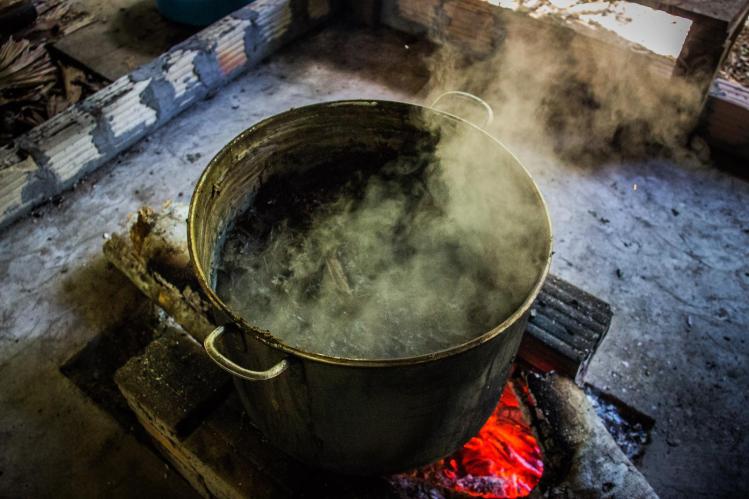
But the most sustained engagement between psychedelics and Christianity has taken place in Latin America. In Brazil, several churches—notably in the Santo Daime and União do Vegetal traditions founded by twentieth-century Indigenous rubber tappers—express a syncretic Christian faith through ritual consumption of the psychedelic ayahuasca. Those churches aren’t in communion with Rome, but many curanderos in the Upper Amazon—village healers who count entheogenic plants among their arsenal of medicines—are baptized members of the institutional Catholic Church and face no ecclesiastical opposition to their practices.
I met some of the curanderos last summer on a research trip to Peru. Geometric designs inspired by ayahuasca visions in the artistic culture of the Shipibo appear in some Amazonian Catholic cathedrals and adorn the stoles and chasubles of some diocesan priests. Might this imply a dialogue, I wondered, between Catholicism and the Upper Amazonian cosmovision?
Local clergy told me that the presence of Shipibo artwork signifies the Church’s goodwill towards local Indigenous communities and a desire to repair historic wounds of colonialism; it is not an endorsement of ayahuasca. I did, however, meet Indigenous curanderos who had given ayahuasca to religious sisters, and I spoke to Catholic priests who had tried it themselves. I’ve heard of one who was so transformed that he sought and received permission from his bishop to work at an ayahuasca healing center.
Most notably, I met Manuel, the lay animator of a remote forest community where he leads Sunday services when there isn’t a priest. He’s been a curandero for most of his eighty years. For Manuel, there is no contradiction between his identity as a devout Catholic and his use of medicinal plants, including ayahuasca. “God created everything,” he told me. “So if the Lord has placed a powerful medicine in the plants, who are we to reject it? I simply say my prayers and ask the Lord for help when I begin the ceremony, and then I heal.”
Manuel is deferential to clergy and believes that priests, who celebrate the sacraments, are far more powerful than he is. His community accepts his ministry and people often seek him out for physical as much as spiritual cures. His only real antagonists are the town’s Evangelicals, who believe that plant medicine amounts to witchcraft. (Manuel’s assistant, an only slightly younger man sitting off to the side at our meeting, would shake his head and spit on the ground when the topic of Evangelicals arose.)
The Church’s attitude toward mind-expanding substances, then, is relevant to its practice of interreligious and intercultural dialogue. As Sr. Susan Smith insists, comparative theology cannot be confined to “the great world religions, with their ancient literary traditions,” but must include the “oral traditions [which have been] dismissed as something less worthy of consideration.” Dialogue with Indigenous spiritual traditions will often mean encountering entheogenic plants like peyote, ibogaine, and ayahuasca.
At the same time, the Church cannot ignore significant differences between its traditional metaphysics and certain Amazonian beliefs. As simple as the relationship between ayahuasca and Catholicism is for Manuel, people in the Global North inhabit a different cosmology from that which is prominent in the Peruvian jungle. “When you get to Latin America, you enter into this whole different paradigm,” writes Jules Evans, “where spirits are real, where taking on people’s energies is a thing, time no longer really seems to exist, all these shamanic concepts. You can experience a degree of ontological shock trying to integrate these experiences into your life.”
Such issues affect psychedelic users even outside of the Amazon. Approximately 40 percent of people who use ayahuasca, but also 14 percent of people who use LSD, describe encountering beings from another dimension of reality: fairies, elves, spirits of the dead, demons, aliens. A strain of mushrooms in China consistently provokes visions of xiao ren ren, “little people” like the Lilliputians of Gulliver’s Travels.
Psychedelic researchers call these beings “entities.” While many encounters with them are benign, others are quite harrowing. In an indicative example of what Evans calls “the entity problem,” he cites a young woman who’d tripped on LSD with her romantic partner:
They both had a metaphysical “telepathic” experience of aliens visiting them to send them an urgent message. She describes feeling the intense weight of responsibility that they had been asked to deliver an indecipherable message, which left her distressed…. She was obsessing about the meaning of the experience, trying to find a framework to make sense of it…. She became paranoid and afraid of being stuck in a state of insanity.
Some Christian thinkers have grown particularly concerned about the entity problem. Rod Dreher, an Orthodox writer and commentator, has admitted that LSD turned him on to Christianity as a younger man, but he now believes that psychedelics open portals to the occult that should never be opened. Ross Douthat and Tucker Carlson seem to agree. The Catechism also warns believers against “the invocation of evil powers” (2117) that can occur in esoteric spiritual settings, particularly those involving “divination.”
This may look like conservative religious pearl-clutching, but every curandero I’ve met in the Shipibo tradition describes a life hounded by spiritual attacks from envious or malevolent rivals. They believe that dark energies known as shitana dwell even in plants used for healing, and unscrupulous practitioners draw on those energies to execute mercenary killings or vengeful curses.
I would disavow the superior moral attitude that these dynamics can engender among critics of contemporary psychedelic use and traditional Indigenous cultures. The psychological problems that bedevil some shamanic practitioners, and with which the “psychedelic renaissance” of the Global North is also rife—grandiose narcissism, sexual and financial abuse, lack of regulation, and so on—also exist in their own form in the Catholic Church. Toxic dynamics will show up in any spiritual community in which the drama of contact with the divine magnifies the shadow material of unfulfilled human longings and attachments. Still, the sheer power of psychedelic substances does heighten the stakes, and psychedelic boosters are often breezily silent about the spiritual warfare that can occur in their spaces.
Are these entities actual beings? Hallucinations? The psyche’s attempts to symbolize the pain of intergenerational trauma for which it has no other language? Similar questions have been asked about the Church’s concept of demons. Our spiritual traditions may find common ground not in our answers to these questions but in how seriously we take them.
On the one hand, the trickster quality of many plant spirits in traditional Amazonian belief systems is far removed from the Catholic concept of the benevolent saints who guide us through life. In fact, pilgrims from the Global North who have journeyed through ayahuasca curanderismo sometimes end up converting to Christianity, shaken by the Manichaean universe of the jungle and finding solace in the unconditional love and moral clarity of Jesus. On the other hand, even those who oppose psychedelics for their apparent adjacency to sinister powers might admit that they echo supernatural imagery in the Christian tradition that is itself often dismissed as superstitious: Jesus’ confrontations with Satan, St. Anthony battling demons in the desert, the prayer-appeal to St. Michael the Archangel. A rigorous comparative mysticism must acknowledge a broad spectrum of uncanny spiritual phenomena reported across historical contexts of belief. Neither all psychedelics nor all Christian mysticism simply produces blissful feelings of an airy nonduality. Whether one appreciates or rejects the spirit-haunted view of the cosmos that can arise under the influence of those substances, sheer indifference on the part of the Church is harder to defend.
At the very least, Catholic clergy, chaplains, and spiritual directors would benefit from learning about psychedelic experiences so that they can provide sensitive and nonjudgmental pastoral care to people experiencing post-psychedelic difficulties. There is precedent for this in the history of Catholicism’s engagement with substance use. Avant-garde artists in postwar Paris often discovered the embrace of the Church as a haven from their opium addictions. The Catholic theologian Jacques Maritain, for instance, befriended the poet and filmmaker Jean Cocteau after opium contributed to the death of Raymond Radiguet, Cocteau’s lover. Maritain, with deep respect for Cocteau as an artist and human being, persuaded him to enter a sanatorium for treatment for his grief and addiction. Cocteau eventually returned to the Catholic faith of his childhood.
But there is also room for more substantive engagement. As I have written elsewhere, many Westerners turn to psychedelic medicine out of frustration with contemporary society’s disenchanted vision of the cosmos. They seek spiritual communities that can appreciate their psychedelic journeys and help them process their newfound state of wonder or connection to the divine. After all, the desire to consecrate one’s life to sacred truths can quickly be thwarted by our everyday dreary materialism; many, though not all, psychedelic users emerge with renewed interest in the communal and symbolic life of the world’s religions.
“Psychedelics can potentially act as praeparationes evangelicae,’” Colin Pugh, the founder of the Brooklyn Psychedelic Society and a practicing Catholic, told me in a conversation this year, alluding to the Church Fathers’ respect for pre-Christian practices that “prepared an openness” to the Gospels. Yet if the Church is indifferent to the holy desires at the heart of these pursuits, it will punt on opportunities to accompany contemporary seekers who may be surprisingly open to the theological vision that the Church, at its best, has to offer. A post-psychedelic seeker may look elsewhere if her religious community isn’t open enough to help her integrate her personal experiences into the Church’s sacramental life. Take a Catholic who encounters the divine feminine on LSD. Marian devotions, like making a pilgrimage to the womb-like grotto of Lourdes, may come alive with surprising new meaning for her, yet she may feel alienated if her community’s theological imagination cannot reach beyond patriarchal images of God.
It’s worth pointing out that mysticism unaided by psychedelics has often been met with similar skepticism. Mystics are tolerated, even admired, when their insights are confined to canonically approved volumes of “spiritual classics”; but in their lifetimes, as the Jesuit philosopher Michel de Certeau observes, they are often “displaced towards the area of ‘the fable.’” There, their unnerving visions put them in solidarity with “the child, the woman, the illiterate…social categories which [are] in socio-economic recession, disadvantaged by change, marginalized by progress, or destroyed by war.”
This is essentially Michael Pollan’s take on the clergy psilocybin trial. He claims that it recapitulates “the entire history of world religions in a nutshell: orthodoxy and authority in tension with the direct spiritual experience of the individual.” In urging the Church to be sensitive to psychedelic users, however, I emphatically wish to question—not echo—that reductive critique. For one thing, the qualitative data from that study do not demonstrate that the clergy felt alienated from their traditions after taking psilocybin; quite the contrary. Furthermore, the Church is a body, so a dynamic tension between personal experience and collective belonging is both inevitable and healthy. An atomized spirituality that overemphasizes the solipsism of headstrong individuals can become just as chauvinistic as one that demands conformity to rigid thinking—and it isn’t ecclesial.
A nuanced appreciation of the place of non-ordinary states of consciousness in the lives of Christian believers might begin with the recognition that they span the theological, ecclesial, and ideological spectrum. While particular religious devotions are often politically coded, virtually all forms of prayer have the ability to expand human consciousness. Those who revere the otherworldly, “transcendent” atmosphere of the Latin Mass are experimenting with a kind of liturgical neuromodulation. So are charismatic Catholics. Retreats like the Spiritual Exercises of St. Ignatius are intended to produce visionary states; fasting can do this, too, and so, for the occasional few, does reception of the Eucharist. A “bipartisan” appreciation for the variety of non-ordinary prayer experiences—as indeed, secular views of psychedelics are largely bipartisan—could refute Pollan’s assumption that mystics will find no shelter in our communion.
Clearly, not everyone should, or needs to, take psychedelics. The saints have seen the world bathed in the light of God without psychedelic assistance; so have innumerable ordinary people who forgo grandiose quests for peak experiences in their quiet lives of love and faith.
Sixties-era Christian thinkers like Thomas Merton and Jacques Ellul—who were well aware that religious dogma could become a barrier to personal growth—had their own concerns about psychedelics: that they could enable a crass consumer mindset for people seeking an ersatz enlightenment on demand. In the words of Erik Davis, chemical shortcuts to mystical heights would not constitute “a spiritual resistance to the dominant society, but a complete capitulation to it.” The reigning cosmology of the Global North is techno-capitalism, and in settings like Silicon Valley, where psychedelics are de rigueur, many users are less interested in God than in channeling lucrative ideas for their startups. That psychedelic use is not intrinsically prosocial is evident in several public examples: ketamine user Elon Musk hastened hundreds of thousands of deaths by destroying USAID, and DMT smoker Robert F. Kennedy Jr.’s fantastic views of human health seem bathed in the afterglow of a perpetual psychedelic flight from reality.
Whether or not it accepts psychedelic use for its members, the Church must evaluate the impact of psychedelics on society in light of Catholic social teaching and the spiritual vision of the Gospels. At times, I suspect, this will involve challenging the excesses and abuses of psychedelia, including its spiritual immaturity and grandiose claims. At other times, the Church may find alliances with psychedelic users over reverence for the spiritual dimension of existence, opposition to technocratic hegemony, and ecological ethics.
Ecological concerns, in particular, may prove an important point of contact. The watershed papal encyclical Laudato si’ expands the Church’s moral call to include healing the wounds that our extractive, materialistic paradigms have inflicted on our relationship with the earth—a common theme in many psychedelic users’ experience. The encyclical—part of the Church’s magisterium—gestures towards Christian ecospirituality as a natural means of expanding one’s consciousness. It praises John of the Cross’s pan-animist awareness that “all things are God” (234) and invites us “to embrace the world on a different plane” (235). Just as psychedelics can increase nature-relatedness and soften anthropocentric views, Laudato si’ also asserts that “the ultimate purpose of other creatures is not to be found in us. Rather, all creatures are moving forward with us and through us towards a common point of arrival, which is God” (83).
That such insights have arisen through prayerful contemplation and not through entheogenic use reminds us that the natural world itself has psychedelic (mind-manifesting) powers that can be accessed through nonpharmacological spiritual practices. Think of long hikes or camping trips you’ve taken. As the anthropologist David Abram suggests in his work on shamans’ relationship to their environment, we may feel clearer-headed, more intuitive, and more connected to the web of life simply by removing ourselves from the city and immersing ourselves in places where more of the surrounding biomass is nonhuman than human. Living for a time in the Peruvian jungle, I learned that dreams are often referred to as “jungle TV,” because the unconscious comes vibrantly alive outside of the constructed human world. I experienced this personally: my dreams were often exceedingly vivid, even visionary, in the forest, but on evenings when I spent time on my phone before sleep, nothing came to me overnight.
Indeed, for millennia before urban modernity, it was ordinary for our religious ancestors—Biblical figures like Abraham, Jacob, Joseph, Samuel, Solomon, Daniel, and Joseph, father of Jesus—to consult their dreams. Many Celtic saints were legendary dreamers, too. And it is worth underlining that for centuries before the Roman invasion, rural Irish Catholicism known for its nature mysticism celebrated a valid Eucharist and produced canonized saints, just like the Church in the Amazon for whom the Vatican is currently discerning a unique liturgical rite.
Far more important than psychedelics themselves, then, are the fruits of an expanded spiritual awareness. I do not remotely advocate for the Catholic Church to become anything like a “psychedelic church.” But nor do I dismiss the phenomenology of powerful psychedelic experiences that can echo, support, and highlight themes in the Catholic mystical tradition. Amid the destruction arising from the materialist worldview, every opportunity for consciousness to peek beyond the veil is worthy of careful consideration.
We welcome your comments about this article. Please send your response to [email protected].