Toward the end of Gabriele Tergit’s 1951 novel Effingers, Erwin and Lotte Effinger travel to Landro in South Tyrol, where they intend to spend a belated honeymoon at a “particularly elegant hotel” in the mountains. The year is 1926. When Lotte gets off the train, she is surprised to find “nothing except for a graveyard full of white crosses for fallen soldiers…young men, men of her generation, born between 1890 and 1900, who had died in the spring without knowing how sweet the summer could be.” Standing by the station with her Baedeker—nineteenth-century optimism in pocketbook form—she looks in vain for the hotel she was expecting to find:
The impressive landscape remained: There was Monte Cristallo with its glacier, the Piz Popena, and the Cristallino. But the human habitations, that elegant hotel by the glacier with electric light and column radiators and wonderful upholstered furniture, had been destroyed, and the people who had wanted to dance and dine there had been made residents for eternity.
It is an eerie moment, grimly foreshadowing the fate that history has in store for the world Erwin and Lotte come from, the world of Berlin’s wealthy Jewish bourgeoisie. Like the destroyed hotel, this novel’s human habitations—those elegant houses by the Tiergarten with their flushing toilets and wonderful upholstered furniture—will in time be reduced to rubble, and the families who danced and dined there will have fled, or disappeared, or died.
And yet, as the translator notes in her afterword, Tergit does not present German Jewry’s destruction as inevitable. On the contrary, it is one of the melancholy pleasures of reading Effingers that we experience history with the characters, that events in this novel have the coarse texture of the present, with all its hopes and fears. In fact, Effingers identifies as one of the central experiences of modernity a deliberative anxiety about the future. Its characters are forever at turning points, lamenting one era’s passing or another’s dawn. “We are witnessing progress!” one of them says. “When I think about how people used to see operas by candlelight, and now we have gas lamps.”
Spanning more than eight hundred pages, Effingers paints a vast and amiably peopled panorama of German-Jewish life around the turn of the century. It opens in 1878 when the young Paul Effinger leaves his fictional hometown of Kragsheim to join his brother Karl in the rapidly industrializing Berlin, which in the second half of the nineteenth century was transformed from “a dingy city in a marsh” to “the German Chicago,” as Mark Twain put it. (Between 1877 and 1897, Berlin’s population grew by almost a million.) “Everywhere one looked, things were being built and torn down, the ground excavated, pipes laid for water and gas,” Tergit writes. “A new era was being born.”
Eager to make their fortune in industry, Paul and Karl initially build a screw-making factory that, over the course of the novel, grows into a pioneering manufacturer of German automobiles. While still determined young entrepreneurs, they marry into a family of elite financiers, the Oppner-Goldschmidts, whose “cheerful bon vivant” of a patriarch, Emmanuel Oppner, is the first of the novel’s characters to buy a home in the Tiergarten neighborhood of Berlin. This neighborhood, where most of Effingers is set, is described by one character as the “Via Sacra of Christian and Jewish wealth.”
By charting multiple generations of German family life, Effingers automatically calls to mind Thomas Mann’s Buddenbrooks, but the similarities more or less end there, because Tergit simply reads nothing like Mann. A court reporter for the Berliner Tageblatt in the 1920s, her prose has a journalist’s snap and flash; the sentences generally keep up a brisk pace, carried along by the chatty and winsome cast of characters, a far cry from Mann’s solemn merchants. The result is that Effingers has a nineteenth-century novel’s engine but a coat of New Objectivity prose. The achievement of Tergit’s translator, Sophie Duvernoy, cannot be overstated: she has as fine an ear for the precision and humor of the original as can be imagined.
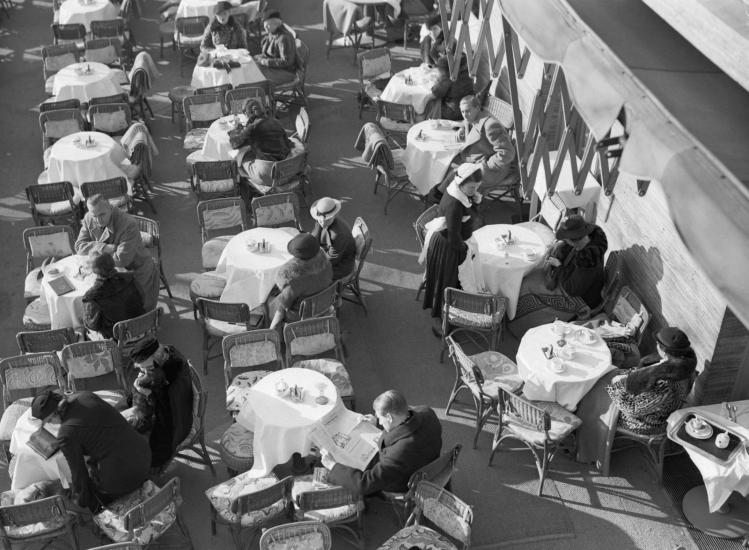
The contrast between Tergit’s prose and the clutter and bourgeois bric-à-brac of her characters is striking. And yet it is precisely by writing so clearly about such a rich and multifaceted world that Effingers distinguishes itself. The material and domestic life of the families is vividly evoked, Tergit registering the changing tastes in fashion, décor, food, art, and literature. There are memorable descriptions of advances in ordinary household appliances, from the telephone to plumbing. “God’s gone, but we’ve got flushing toilets instead. That’s the modern way, I suppose,” as one character laconically puts it. Of even greater significance is the upheaval in sexual mores and standards the characters live through, from a time of arranged marriages to masked orgies in darkened bars.
The characters themselves are mostly seen at intervals, months or even years passing between one appearance and the next. Among the most memorable are Waldemar Goldschmidt, the novel’s liberal-humanist conscience; Sophie Effinger, a painter and femme du monde turned eccentric spinster; and the idealistic Lotte, Tergit’s surrogate. For the most part, they are characters we only ever know socially, as it were, either in dialogue or by their consumption of goods. Yet by fixing the narrative in their various households and domestic concerns, Tergit’s novel rebels against the remorseless one-way traffic of history. Here, banal instances of private life jostle against political turning points. Tergit’s novel rescues those moments that history would not only fail to record but would obliterate the memory of.
The mere existence of Effingers is a literary miracle. Not only does it portray German-Jewish life in the decades leading up to its annihilation; it was written by a German Jew while she was fleeing from that same annihilation.
Born Elise Hirschmann in Berlin in 1894, Gabriele Tergit came from a world similar to that of the Effingers and Oppner-Goldschmidts. Her father was the founder of the Deutsche Kabelwerke, “one of the most important cable-manufacturing companies in the German Empire,” Duvernoy writes. In 1906, the family relocated to the Tiergarten neighborhood. As a young woman, Tergit enrolled in the Soziale Frauenschule (Social Women’s School) before going on to study history in Munich and Heidelberg. She returned to Berlin and earned her PhD in 1925. The newspaper contributions she’d begun writing as a student eventually led to her staff-writer position with Berliner Tageblatt, which inspired her 1931 smash-hit literary debut, the Weimar Republic satire Käsebier Takes Berlin.
Encouraged by the novel’s success, Tergit’s publisher suggested that she write a Jewish family story. But Tergit barely had time to accept the proposal before finding herself in Prague, where she fled in March 1933 after the Nazis seized power and began arresting political opponents. It was in the Czech capital that she began writing the novel she wouldn’t complete until 1948. In the intervening years, Tergit joined her architect husband in Palestine before eventually settling in London in 1938. “To create this grand portrait of German Jewish life,” Duvernoy notes, “Tergit drew upon her memories, articles, and family stories.” Yet even in 1938, she was reconstructing a world that no longer existed: as part of Hitler’s redesign of Berlin, Jewish-owned houses in the Tiergarten neighborhood were seized by the state and razed in March of that year. Those that survived the redesign were later destroyed during the war.
Published in Germany 1951 after being turned down by numerous publishers, Effingers was as good as doomed to fail. Most of the German Jews who might have recognized their family histories in the novel had been exterminated, while the existing postwar German readership either would not or could not peer into the looking glass of its pages. Consequently, the novel got a cold reception. Duvernoy cites Tergit’s biographer Nicole Henneberg: “Publishers and journalists found the book morally awkward in light of the Shoah, Jewish readers felt there were too many assimilated, extravagant bourgeois characters, and German readers thought there were too many Jews.” When Tergit later found success with a series of nonfiction books about flowers, she bitterly commented, “It seems that flowers are more popular than Jews.”
Naturally, it is difficult to read Effingers without also reading the Holocaust back into its pages, yet the novel frustrates this response by the sheer abundance of life it evokes. Tergit, writing to a publisher in 1949, was adamant that what she had written was “not the novel of Jewish fate.” If that’s all it was, it might be of only historical interest, yet who among its twenty-first century readers could fail to find its account of a liberal, cosmopolitan culture’s downfall distressingly resonant?
In her afterword, Duvernoy cleverly observes that “the force of [Tergit’s] Jewish perspective lies in her proximity to her own material, and in the eye she casts on each individual fate and choice, showing how life could have been otherwise.” One way in which Tergit shows that is by planting a seed of ambiguity in Paul Effinger. Even as he wishes to participate in “the great economic upturn sweeping the country,” Paul at the same time longs for “the pious, devout, simple” life of his native Kragsheim. As the years pass and the Effinger business flourishes, he worries about the moral cost of their success. “These people no longer believed in hard times,” he thinks when he sees how his brother Karl and his wife spend their money. “Paul felt this whole business went against everything his ancestors had taught him.” When he and his wife, Klärchen, eventually move out of their working-class apartment and into a house in the Tiergarten opposite Klärchen’s wealthy parents, Paul tells her, “People are losing their roots; in the old days people were born and died in the same house.”
And yet the search for roots can lead to a dead end. “Germany is our home,” Paul insists early on to his brother Benno, who at the novel’s beginning has already decamped for London. But what does home mean in a world where “all growth, all work on earth was transformed into goods valued by the pound,” and those goods are moved “across the world on ships, trains, and trucks piled high”? Or in a country where you are gradually made to feel unwelcome, despite having lived there for generations? For the Effingers, Zionism is not a viable response to rising antisemitism either. “I think it’s very dangerous to emphasize blood kinship and reject one’s environment,” Erwin Effinger says during a discussion with a friend. “Palestine isn’t my homeland.” But neither, it becomes clear, is the new Germany. At the end of the 1920s, with the Nazi political threat increasing, Erwin tells his family, “We must stop lying to ourselves and admit that we love a Germany that no longer exists.”
Written before the postwar reckoning with the roots and causes of the Shoah, Effingers presents historical events “in undigested form, replete with ambiguities and contradictions,” as Duvernoy notes. It is this sense of taking place before reality has been fully metabolized that gives the novel its powerful resonance. No doubt many people reading it today will feel a bit like Waldemar Goldschmidt in 1888, after hearing of the death of the liberal Emperor Frederick III. “My era has died,” Waldemar tells Paul Effinger. “I don’t know what lies ahead. But I sense trouble.”
Effingers
Gabriele Tergit
Translated by Sophie Duvernoy
New York Review Books
$29.95 | 864 pp.
We welcome your comments about this article. Please send your response to [email protected].