This past season in the English Premier League, the farthest a fan could travel to see their team play away from home was 348 miles, the distance between Newcastle and Bournemouth. In the Bundesliga, the German top flight, five hundred miles separated Freiburg and Hamburg, and in Ligue 1, the French top division, the distance between Brest in the northeast corner of the country and Monaco on the French Riviera was 654 miles. Though the first divisions in Spain and Italy both featured island-based teams, the average travel length in both leagues sat between two hundred and three hundred miles.
Outside of the United States, the “away day” is a ritualized part of sporting culture. Some supporters make it a point to attend their team’s most grueling away fixture. The difficulty and the hours spent traveling serve as proof of their fandom. Like modern pilgrims, these fans embark on journeys characterized by camaraderie, a sense of optimism, plenty of food and drink, and, of course, the intense bouts of chanting people have come to associate with European football. On their travels, football fans buy memorabilia like pins and scarves to display their devotion and slap symbolic stickers on local urinals and lampposts.
Every couple of years, for the Copa America and European Championships, or—most meaningfully—for the World Cup, the same fans who travel hundreds of miles during the football season to shout nasty things at their fellow countrymen are united according to their respective nations. Together, they embark on the Camino de Santiago of away days: the month-long international tournament. Since these tournaments feature competing national teams, countries’ different religious, political, and social values inevitably inflame many of the same cultural tensions that would have worried a pilgrim a millennium ago. And this summer’s World Cup, which is hosted by the United States, Mexico, and Canada, is nothing if not fraught with cultural and political tension.
World Cup 2026 is, geographically, the largest in history. Matches are taking place in cities across North America, from Boston to Mexico City and Vancouver, so fans hoping to follow their teams through the tournament face staggering travel distances. Bosnia and Herzegovina, for instance, played their first match against Canada in Toronto and their second against Switzerland in Los Angeles—a 2,175 mile trip for any fan with the means to make it. Comparing the scale of this year’s World Cup in relation to previous tournaments, or the typical “away day” in Europe, a classic American sporting idiom comes to mind: it’s not even in the same ballpark.
While the cost of transportation will add up to a hefty sum, fans eager to attend matches will also have to shell out tens of thousands of dollars for tickets. In the tournament’s opening group stage the cheapest tickets to attend host country Mexico’s matches cost $2,000. (These are, ostensibly, the lowest-stakes matches of the tournament.) The price of attending every game, assuming a fan’s team makes it all the way to the finals, could be as much as a down payment on a home—and will undoubtedly require more than 10 percent of the average American’s annual income. Depending on one’s perspective, it’s either a form of sports tithing or a modern version of indulgences. Big business, either way.
This World Cup also presents fans, players, and officials with rigorous and inconsistent customs processes. A Somalian referee was denied entry to the United States because of “vetting concerns,” despite receiving a valid visa from the Department of State. When the Iraq national team arrived at Chicago’s O’Hare Airport, their star striker, Aymen Hussein, was detained and questioned for seven hours. The team’s photographer was denied entry entirely. Journalists from the Middle East and Africa have regularly been denied the visas they need to cover the tournament. Iran’s national team, which is training in Tijuana, is required by the Trump administration to leave and enter the United States on the same day. “They didn’t even give us time to recover,” head coach Amir Ghalenoei said after the team’s opening match against New Zealand.
The World Cup is supposed to be the ultimate celebration of the beautiful game, bringing nations together in their shared love of the sport. Historically, during the month-long tournament, patriotism is festive, instead of divisive. Regrettably, FIFA and the U.S. government have been chipping away at this spirit through targeted sanctions, unreasonable travel restrictions, and shameless price gouging.
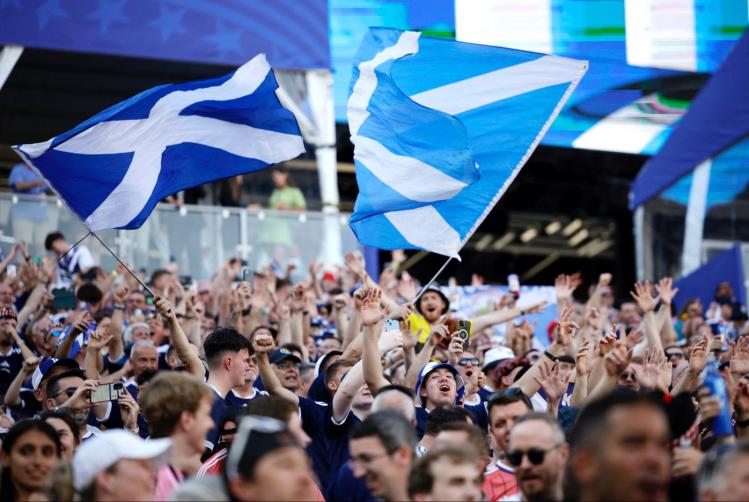
Fortunately, it seems those obstacles have been powerless to prevent fans from enjoying the World Cup. Since the tournament kicked off on June 11, supporters of Scotland’s national football team, the “Tartan Army,” have dominated the news cycle with their antics throughout New England. Stories of enthusiastic Scots celebrating in bars around Boston spread across media platforms, and Americans quickly became familiar with their chant, “No Scotland, no party.” One account recalled how a group of kilt-wearing fans drank a pub dry for the first time in half a century. The first viral sensation featured a group of Scots, who had adorned their airbnb with Scottish flags, playing bagpipes at 6 a.m. Another viral video showing Scots singing and chanting during a Red Sox game at Fenway Park also received substantial attention online. Viewers commented on the “unmatched” culture of European fans, while pointing out that Fenway hasn’t seen an atmosphere like that in decades. Teary-eyed interviews from Scottish fans expressing just how excited they were to be at the tournament also helped them win over the American media. Before Scotland’s opening fixture against Haiti in Gillette Stadium—its first World Cup match since 1990—Scottish fans sang their country’s national anthem with such force their voices registered a level of 125 decibels, the loudest ever recorded at a World Cup.
Another great story to emerge this month is Cape Verde, which is playing in its first World Cup. In its opening match, the team held heavily favored Spain to a 0-0 draw, thanks in large part to an awe-inspiring performance from Vozinha, their forty-year-old goalkeeper. Still, surrounding all of the excitement was a stark reminder of the political tensions that threaten to mark this year’s tournament. In a postgame interview, Vozinha lamented that his mother wasn’t able to attend the match because of issues with her visa.“My mum could not be here either for a visa issue, and the money we had to pay for it,” he said. “We did not manage to do this in time.” Because Vozinha’s heroics on the pitch caught the attention of World Cup viewers worldwide (he gained fifteen million Instagram followers practically overnight), his mother’s visa application was expedited. She was able to attend Cape Verde’s second game, a 2-2 draw against Uruguay, another major upset. After three matches, the nation of only five hundred thousand people defied all the odds by making it through to the Round of 32. This moment is symbolic of the tournament’s duality. For every brilliant display on the field and joyous celebration off of it, a diehard supporter, relative, journalist, or referee has been denied sharing in the experience.
How, then, should we view this tournament? At the last World Cup, which was hosted by Qatar, workers died building the stadiums, earning condemnation from human-rights campaigns across the globe. But what football fans most remember about that tournament is its enthralling 3-3 final between Argentina and France, which was decided on penalties. So, do politics and corruption actually take away from the spirit of the World Cup? Or does football, and its devoted pilgrims worldwide, outshine even the institutional depravities around it?
For anyone who’s not a fan of the sport, watching this World Cup from anywhere other than the TV at home or in a local pub would seem irrational and impractical. Yet, early predictions estimate that up to ten million international fans will make the trip to North America. That would make it the largest sporting event in history. Now, as always, there is no sense of practicality for the pilgrim. Fanciful inklings of “what could be” and the promise of transcendental fulfillment can be stirring motivators. For the pinnacle of the world’s game this summer, pilgrims are driven by unshakable faith to follow the football: overcoming any and every obstacle to be in proximity of a sporting stage where the spectacular borders on miraculous, and athletes can, if only for a moment, take on the role of the divine.
We welcome your comments about this article. Please send your response to [email protected].