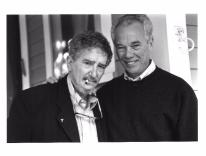
The writer Jay Neugeboren recalls that as a boy growing up in postwar Brooklyn, “the two great passions of my life were playing ball and reading novels.” Based on his new collection of essays, I can imagine that if he’d succeeded in making a career of sports, he’d have been a “ballplayer’s ballplayer,” a player other players respect for hard work, unflagging professionalism, a steadily high level of competence, and even brilliance. He got no further in athletics than the Columbia University football team in a league for players weighing no more than 155 pounds. Fortunately for readers, he brought the same qualities that make for a ballplayer’s ballplayer to the literary world. He’s a writer’s writer, continuing to publish books at the age of eighty-eight.
Neugeboren’s publications include twelve novels, four story collections, short stories reprinted in more than fifty anthologies, nine nonfiction books, and many essays. Stories flow from him, and, as we see in many of this collection’s nineteen essays, he is compelled to tell them almost as a matter of self-preservation.
The titular essay, “Dickens in Brooklyn,” explains why. At first glance, it’s about the mail-order Complete Works of Charles Dickens set that his parents ordered when he was a child. In the cramped Brooklyn apartment where he grew up, it dominated the breakfront that displayed his parents’ prized possessions—Jewish ritual objects, wine glasses, gold-rimmed demitasse cups and saucers. But more to the point, the essay is about the family dysfunction that drove him to write. His childhood world was “distinctly Dickensian,” he reports: “Determined by difficult economic circumstances, inhabited by eccentric larger-than-life characters, rooted in family feuds about inheritances and money, and steeped in scenes of intense, high drama.”
Writing was his refuge from the madness of his feuding, chronically unhappy parents, from his cancer at the age of nineteen, from his talented younger brother’s mental illness. It sustained him after his parents moved to Florida and left him as the sole family member to care for his institutionalized brother and, later, when his wife left him and their three children. When he wrote, he was “transported to a world that no matter how terrifying, mad, strange or cruel, was not the world I actually lived in, and therefore was without the power to hurt me, to drive me mad, or to take away what was precious to me.”
And so he wrote. After pounding out seven unpublished novels and tallying nearly three thousand rejection notes, Neugeboren published his first novel at the age of twenty-seven.
The essays in this book appeared initially in such venues as The New York Review of Books, The American Scholar, The New York Times, and Commonweal. They are the work of a gifted storyteller: yarns with vivid characters, Dickensian plot twists, a gently ironic first-person voice, and hints at deeper truths. With the small exception of two comparatively flat essays that delve into Neugeboren’s political activity—one about opposition to a new shopping mall, the other about his days as a campus radical—I found them captivating.
“My Cousin Manya, Survivor of Auschwitz” tells the story of a relative he discovered fifty-nine years after the end of World War II. Although it seemed a long shot, she contacted Neugeboren upon seeing an article of his in the Times. She’d once heard about a family member who married a Neugeboren, a name that, as far as the author knows, is unique to a Polish shtetl called Rimanov and thereabouts. He and Manya met and discovered that Neugeboren’s great aunt and Manya’s grandfather were siblings, meaning he and Manya were cousins.
As Neugeboren learns, Manya’s parents and her eight siblings died in the Nazi camps. He tells the story of her improbable survival, and how she somehow managed it without falling into bitterness. As Manya explains how that is possible, she takes her cousin’s hand, smiles, and says, “And also, sometimes, like you and me, something happens, and it’s a miracle.” Neugeboren responds with a rabbinic saying that becomes the essay’s closing line: “A person who does not believe in miracles is not a realist.”
As a seasoned short-story writer, Neugeboren has a knack for the evocative parting word. I found myself looking forward to the conclusion of each essay to see if he could continue to pull off these elusive moments of epiphany within a work of nonfiction. He often succeeds.
In the best of the essays, Neugeboren takes the reader along on some quest of his and, after sifting out his story, digs deeper for larger truths. He does this with the saga of a high-school basketball phenom who went off the radar, “Whatever Happened to Frankie King?”
Neugeboren starts unspooling the yarn with a conversation he had at the Friars Club with another guy who came of age in 1950s Brooklyn. They drift into sports nostalgia, recalling the great players who had risen up from local playgrounds. James Madison High School’s legendary Frankie King was the best high-school basketball player they’d ever seen, they agree. Famed coach Frank McGuire recruited him to play for the University of North Carolina, the country’s top college team at the time. Within days of arriving, King drifted away from the school, to be heard of only in rumor. But Neugeboren’s acquaintance had seen a death notice for King in the Times a few weeks before, and he broke the news to Neugeboren: King had become a novelist, writing more than forty books, mostly mysteries, under the pseudonym Lydia Adamson.
Neugeboren researched King’s life, reading his novels, calling old friends, driven by the thought that “my dreams would seem to have come true in his life—that by being a great athlete and a prolific novelist, King would seem to have had it all.”
Of course, he didn’t have it all. Neugeboren discovered that King had struggled with mental illness, and that King’s brother had cared for him, much as Neugeboren cared for his brother Robert throughout his life. Several weeks after Robert’s death, Neugeboren managed to connect with King’s brother Steve, and the rest of the remarkable story unwinds. (Neugeboren has also published this as a graphic memoir illustrated by his son, Eli.)
This hunt for the true story of Frankie King would be interesting enough on its own, but Neugeboren takes it to another level by reflecting on something he noticed in King’s mysteries about a cat-loving actress: his interest in Sophocles’ play Philoctetes, in which, as Edmund Wilson wrote, the long-suffering main character shows how “genius and disease, like strength and mutilation, may be inextricably bound up together.” It makes for a haunting reflection.
Neugeboren told his brother’s story in his well-regarded 1997 memoir Imagining Robert: My Brother, Madness, and Survival, and references to their relationship appear in many of these essays. In particular, one essay recounts Robert’s acquaintance with chess champion Bobby Fischer when both attended Brooklyn’s Erasmus Hall High School starting in 1957. Fischer, too, faced mental-health challenges.
Fifty years ago, I was a student in Neugeboren’s creative-writing course at the University of Massachusetts Amherst, where he was writer-in-residence for thirty years. He was in his thirties then, and I remember him as a calm, cheerful man with a bit of edginess and mischief peeking through. I was surprised to read in his essay “Couch” that, at the time, he was seeing a psychiatrist three times a week after being frightened by some destructive thoughts he’d experienced.
I don’t recall a lot, but I do remember well a class held in the lovely Pioneer Valley farmhouse where he lived with his family. He brought in a guest, Martha Foley, long-time editor of The Best American Short Stories, who lived in nearby Northampton. At that point, she was a peppy, white-haired woman in her “anec-dotage,” as she called it, writing her memoir and brimming with tales dating back to when she founded Story magazine in 1931. All told, she’d published early stories by a who’s who of twentieth-century writers. “She was full of marvelous tales about Ernest Hemingway, James Joyce, Greta Garbo, Charlie Chaplin, William Shirer, Dorothy Thompson, William Saroyan, Ray Bradbury, and others,” Neugeboren writes.
A happy scene, it was, but Neugeboren came to know that she was a lonely woman living alone in a small apartment, depressed over the drug-overdose death of her son David Burnett, financially stressed, without friends. This is where the complications multiply: “While Martha knew but was in denial about David’s addictions and the cause of his death, what she never knew about David was that he had fathered two daughters”—her granddaughters.
After Foley died in 1977, Neugeboren helped sort out her affairs, completed work on her memoir, and wrote its introduction. And by and by, over the decades, her two granddaughters find him—and each other: another miracle, too strange to be fiction.
Dickens in Brooklyn
Essays on Family, Writing, & Madness
Jay Neugeboren
EastOver Press
$18.63 | 265 pp.
We welcome your comments about this article. Please send your response to [email protected].