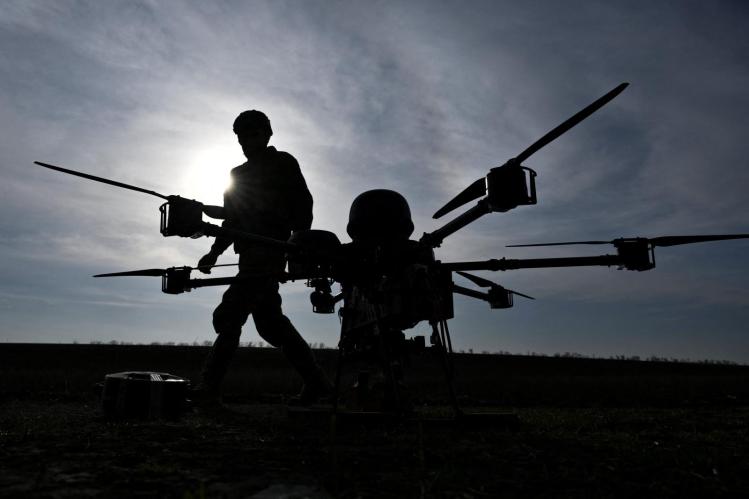
A few years ago, I overheard a conversation among some of my colleagues at the CIA, many of whom were military veterans. They were discussing drone operations on the Ukrainian frontlines, and the conversation turned to whether drone operators qualify as aces. Ace is a title that suggests courage, evoking the image of daring airmen of the world wars. Calling drone operators aces, my colleagues concluded, felt cheap; their kills were too remote, their position too safe. There was hardly honor in maneuvering a joystick far from the battlefield’s thrill and danger.
To many, this de-risking of warfare for the soldier is a feature, not a bug. Weapons are generally designed to achieve some combination of four objectives: maximum lethality per pound, fastest deployment, safest distance, and greatest precision. In assessing just-war criteria, the Church has paid a lot of attention to the first two, less to the latter two. Still, precision weaponry that widens the gap between soldier and enemy carries its own moral risks. Disembodied warfare is spiritually vacuous; it abstracts the horrors of war from the people who fight it and the society they’re fighting for. Valor and guilt don’t disappear, but deprived of the physicality of war, they are transfigured into something more synthetic. My colleagues thought that drone operators’ characters suffered because of their distance from killing. Their discomfort reveals a deeper truth: the way we conduct war today wounds those who fight it because they are kept from reckoning with the consequences of their actions.
On the eve of Armistice Day in 1932, British Prime Minister Stanley Baldwin delivered an address to Parliament where he reasoned that the distance afforded to soldiers by the use of bomber planes would normalize civilian casualties. “It is well,” he warned, “for the man in the street to realize that there is no power on earth that can protect him from being bombed, whatever people may tell him.” He feared this reality would translate to less restrained offensives, such that “you have to kill more women and children more quickly than the enemy if you want to save yourselves.”
As with physical distance, the precision of modern weaponry contributes to the abstraction of warfare. Precision encourages us to view civilian death as a rounding error, a negligible and tolerable result. Conservative estimates of President Barack Obama’s “surgical” air strikes place the civilian death toll in the hundreds—unsurprising given that his administration dropped more than twenty-six thousand bombs in 2016 alone. Even a sharp knife misses the cut sometimes. Now, though, the promise of precision encourages far more chops at the block. When civilians do die, soldiers need not grapple with the destruction they’ve caused; they can justify civilian casualties as acceptable collateral damage of a more legitimate target. The soldier has not engaged in some heinous act of total war. He is probably not even officially at war.
As Magnifica humanitas argues, artificial intelligence dehumanizes our warfighting even further by removing the last strands of accountability and witness. If war is ever just—and Pope Leo concedes that there are such wars—then it must honor our personhood even as it results in death. Commanders must be the ones to choose targets and atone when they choose poorly. Soldiers must be the ones to carry out the attack and see the faces of those they kill. This is not to say war should be more barbaric. It is merely to recognize that war is barbaric, and the spiritual cost of that barbarism must be reckoned with.
Distance from the enemy is nothing new in war. Catapults and javelins have enabled warriors to be deadly at a safe distance for millennia. But the farther technology allows soldiers to stay from violence, the lower the barrier to war becomes, and the less just the war is likely to be. When we believe our weapons are surgical and our targets are perfectly optimized to our objectives, there is no need to weigh the violence we commit against the instigating injustice. When “winning” is either undefined or limited to a single operation, we can dispense with the just-war prerequisite of having a serious hope of victory. We have not outgrown just-war doctrine because we have progressed beyond war, we have logicked our way out of evaluating the justice of the ones we wage.
Our technology is one dimension of a larger moral failing—that we are a people constantly at war and yet rarely in the crosshairs. We have offloaded the moral weight of war to the handful of people who must deal with it directly. More than a quarter of all U.S. military interventions have taken place since the Cold War’s close, even as the number of troops has significantly declined during the same period. War remains in the air, just not the air most of us breathe.
Phil Klay, an Iraq veteran and contributor to these pages, has written extensively about the cost of this disconnect. The Founding Fathers, he points out, did not so much envision a professional military as volunteers responding to a particular call to arms. Standing armies are the stuff of empires; free nations only fight when citizens are moved to drop their plowshares and learn how to wield swords. A country should only go to war if it can rally its people to fight.
But Americans’ distance from the battlefield is convenient for our political narratives. In the absence of genuine participation in the war effort, we project what we wish war was in place of what it actually is. To the right, war has become a bloody video game, epitomized by obscene social-media posts in which soldiers are based American avengers, superheroes who kill by console. To the left, armed conflict is an exercise in sterile, technocratic efficiency, a necessary and permanent fixture of our national interests and humanitarian obligations.
The distance we have created from war even affects the way we support or oppose conflicts. The hawkish among us can take pride in America being the greatest purveyor of violence in the world, as measured by weapons sales, without being able to name the capital cities of the countries we’ve bombed in the past decade. The doves among us can oppose our military presence without being thrown in jail for draft-dodging and without quitting their job at a company supporting the war effort. Our wars, whether detested or righteous, short-lived or long-lasting, are always and everywhere halfhearted. We have created a world where both protestor and proponent can, as the Soviet-American poet Ilya Kaminsky writes, “live happily during the war.”
We may, for a brief moment, convince ourselves that despite this, our national spiritual sickness can be relieved by “staying informed,” the catch-all solution suggested for all modern political ailments. We can hide under the penumbra of conviction that in a democracy, the best swords are pens, or posts, or signs above freeways. But the comfort is superficial. In Regarding the Pain of Others, Susan Sontag reminds us that the constant bombardment of graphic images and warzone news is less a means of fostering genuine moral concern and more a manifestation of sadistic voyeurism. Our sympathy for the victims of far-off violence “proclaims our innocence,” she says, “as well as our impotence.” The weight of war must be felt viscerally and physically by those in whose name it is being fought, or it is not felt at all. If our children are not commissioned, our work not altered, our gardens not enlisted to achieve victory, then in earnest, we can neither support the troops nor oppose the war. Our distance relegates our conviction to the theoretical.
So it is that we have relieved soldiers of the burden of killing while improving their death efficiency, and absolved ourselves from war without making any peace. Before launching an attack, not a single Congressman needs to be swayed, not a single company convinced to repurpose production, and often not a single soldier must set foot in enemy territory. Soon, not even a single commander must direct an attack. And for this, there is no peace in our ceasefire, nor justice in our war.
We welcome your comments about this article. Please send your response to [email protected].