Ryan Burge is a political scientist, statistician, and the go-to expert for religion data in the United States. A professor of practice at the John C. Danforth Center on Religion and Politics at Washington University in St. Louis, he also analyzes religion data twice a week at his blog, Graphs about Religion. He is the author of six books and regularly comments in the media. Burge served as a pastor in the American Baptist denomination until his church closed in 2024. His wife, Jacqueline, is Catholic, and they are raising their two sons in the Catholic Church. Senior Correspondent Heidi Schlumpf interviewed Burge about his recent book The Vanishing Church: How the Hollowing Out of Moderate Congregations Is Hurting Democracy, Faith, and Us (Brazos Press). The interview has been edited for length and clarity.
Heidi Schlumpf: Your book details a number of trends in U.S. religion: the rise of Evangelicals and the nones, the decline of mainline Protestantism, and increasing polarization. You say homogeneity is the source of all of this. How did this happen, and why does it concern you?
Ryan Burge: Homogeneity is just a social-science term for a group having the same composition, whether it be gender, race, age, or politics. The data is very clear on this: white Christianity is becoming more and more politically homogeneous with every passing year. And it’s not just a white Evangelical phenomenon; white Catholics are going in the same direction. About 80 percent of white Evangelicals are Republican. I don’t know if white Catholics will get that high, but I wouldn’t be surprised if they get to 70 percent identifying as Republican.
The only white Christian tradition that has rejected that trend is mainline Protestants, but it was at their peril. One of the reasons for their decline was that they didn’t choose a side in the culture war. People want to know what team you’re playing for, whether they’ll hear liberal or conservative sermons if they show up to your church. Meanwhile, Evangelicalism has become a brand. If you’re a Republican or conservative, you know to go that direction.
The hollowing out of moderate congregations doesn’t mean that everyone in those churches was a moderate. It meant liberals, conservatives, and moderates all sitting side-by-side on Sunday mornings in politically diverse churches. We don’t have that anymore, and that’s a real problem not just for American religion, but for American society and democracy. Everyone will be impacted by this in one way or another, in ways they may not perceive right now.
HS: What is the threat to the broader society and democracy?
RB: It’s an issue of atrophy—we don’t exercise our compromise muscles enough or dialogue with difference. Those are learned skills that you acquire subconsciously by having conversations with people who are different from you but who you like and come into regular contact with. You still want to be in community with them after you have a conversation about politics or abortion. If we don’t practice that skill, we lose it.
And if we don’t actually know anyone on the other side of an issue, we don’t fully understand our own position, either. You find your blind spots in an academic setting from peer reviews, and from a human perspective through dialogue and discussion. When we don’t know a person from the other side of the aisle, we create a caricature of them, when in reality they’re not that different from us in values and philosophy. We’ve created strawmen in our minds.
HS: You call this “the great sort”—people sorting themselves into the categories of conservative white churchgoers or nonreligious liberals. Which happened first: Did churches become conservative, and then liberals left? Or did the churches become conservative because so many liberals left? Or were both things happening at the same time?
RB: Causality is really hard to figure out because often people leave for reasons they can’t fully articulate. But I do think Americans have intuited that today, to be a Democrat is to be nonreligious and to be a Republican is to be religious, especially if you’re white. It just feels like “my values are their values.” But the Republican Party went out of its way, beginning in the 1970s, to court religious voters, especially white Evangelicals, who turned out and helped them win elections. But it also pushed out a lot of moderate religious people. Then the Democratic Party realized they had a base of support among the “nones,” so started catering to them more. It became a self-reinforcing cycle of sorting.
Around the same time, you have the decline of mainline Protestantism. Protestants went from 31 percent to 19 percent of Americans in just fifteen years. Some of those who left became Evangelical, but many also became nones. I think the late 1980s and the early ’90s were the most transformational era in modern religion and politics. What we’re living in today is a direct corollary of what happened then.
HS: The shift in Catholicism seems to have come later. Is white Catholicism following the trend of white Evangelicalism? What does that mean for the Catholic Church?
RB: There’s no doubt it’s a later movement. The white Catholic vote was about 50–50 for George W. Bush in 2000 and 2004, but slowly started edging toward being majority Republican with McCain in 2008. Then we’ve seen a huge acceleration in the last elections. More than 60 percent of white Catholics voted for Donald Trump in 2024. I don’t think they’re going to end up where white Evangelicals are, because there is a guardrail in Catholicism in which the leadership tries to keep people away from too much xenophobia and racism. In Evangelicalism, there is no magisterium to hold people back from their worst impulses.
Some of the most compelling data in the book [The Vanishing Church] is about how conservative young Catholic priests are. Whenever I do a presentation about the book, that graph always gets gasps from the audience. About 5 percent of priests are liberal now, and 80 percent are conservative. There is just no way you can look at that data and think the Catholic Church is going to be moderate in the future.
Going to church is a voluntary decision. Are Catholics going to go to a parish where they keep hearing conservative messaging, theologically and politically, over and over again? The majority of Catholics in the United States favor abortion access and have used contraception, so they’re clearly opposed to some of what the Church is teaching. I think this is going to create a larger divide between very devout and engaged Republican Catholics and all the other Catholics, who are more liberal. The liberals are going to reject the Church, not by losing their Catholicism as an identity, but by not going to Mass because they don’t want to be subjected to messaging they disagree with.
HS: The Church also has a “liberal” body of social teaching, which the pope keeps talking about and which is officially part of Church teaching. So even if people choose to ignore it, is Catholic social teaching another one of those “guardrails”?
RB: To me, Catholic theology doesn’t fit well with modern politics and has never laid on the political landscape that well. Catholics are known as much for being pro-immigration and anti–death penalty as they are about being anti-abortion and anti–gay marriage. It’s a coherent worldview that makes sense from top to bottom. You’re not bolting pieces on to match the current political climate. If I was going to advise the Catholic Church, I would say, “lean into that fact.” The U.S. Conference of Catholic Bishops was no fan of Joe Biden and constantly made it known how awful they thought his policies were, so it’s nice to see them be anti-Trump a little bit, especially toward what his administration is doing on immigration.
HS: Is there a future for Catholic liberals, given some of the data about young people—both the liberal ones who have left and the very conservative ones who stay in the Church? In another generation or two, I wonder, will there still be liberal Catholics maintaining their Catholic identity?
RB: The branding of American religion—that to be white and Christian is to be Republican—means you’re going to attract people like that to your congregation. Many converts to Catholicism are theologically and politically conservative. I worry that the “trad Catholic” view is what’s drawing a lot of people into Catholicism, and then they become the public face of the Church and attract more of their own kind. Vice President J. D. Vance is an example of that. Meanwhile, many cradle Catholics are biting their tongue when Catholic converts become the face of the U.S. Church. If the Church wants to grow, it has to grow through conversion, but the Catholic Church is actually awful at conversion. Historically speaking, they convert at a very small rate. Ninety-five percent of Catholics were born Catholic. But if conservative converts become the loudest voices in your parish, how do you keep both groups happy at the same time? I’ve always been in awe of the Catholic Church, which keeps 60 million people under one umbrella. Protestants sneeze twice and start a new denomination, but Catholics don’t do that. I think that’s a really interesting social phenomenon, but it raises the question about how to maintain cohesion with all this disunity.
HS: You write that religion has become a tribal marker and that it has been co-opted into tribalism. What happens if religion becomes more of a tribal marker than an expression of actual faith and discipleship in Jesus Christ? For example, has it been a good thing for Evangelicalism to be so associated with the Republican Party? It’s growing, right?
RB: Well, for every action, there’s an equal and opposite reaction. Some people join the movement because they like what it stands for, but you also hear about “exvangelicals,” too. Evangelicalism is actually the same size today as it was fifty years ago. If those inflows and outflows match each other, it’s complicated. Religion becoming a tribal marker has been good for Evangelicalism in some ways, as odd as it sounds. It’s good for a church to be politically homogenous, but it’s bad for all the rest of us. As a pastor, it would make my life easier if the people in my church believed the same, voted the same, had the same theology and the same understanding of worship. But it would make my community worse, and our democracy worse. So you have to steer against the easy thing and seek out diversity, which is not natural in a lot of these communities. If you try to intentionally become diverse, you’re probably going to fail and turn a lot of people off. So I don’t have an answer on how to fix this.
HS: Could the Catholic Church be in a unique position because we do have racial and ethnic diversity, even though white Catholics are becoming more homogeneous politically? In previous generations, we used to have ethnic churches, and then within a generation or two there was assimilation.
RB: In the Catholic Church, the most polarizing question you can ask today is if the parish has a Spanish Mass. It can create two churches under one roof, one for the Spanish speakers and one for the English speakers. You’re creating division, though maybe for a good reason. But, increasingly, the Church is going to have to struggle with the question of how to deal with diversity, with increasingly conservative white Catholics and nonwhite Catholics, who tend to be moderate on many issues. How to keep those two groups under one roof is a hard question.
Unless a lot of young Catholics really commit to the faith, the future of the Catholic Church is a very open question, especially when the Boomer generation passes. By then, the Catholic Church will be 40 percent Hispanic. The questions raised by its ethnic, political, and regional diversity are hard to answer, especially in a Church of 60 million people. I’m glad I’m not a bishop or cardinal! People often wish I were more prescriptive, but I don’t have the solutions. But I do believe things always change from the bottom up, not the top down. Change happens when people go to a church they might not love and become part of that community as a way to represent more facets of American society. But there’s a you-go-first problem. No one wants to be the first one to jump in the pool, but if we all jump together and become part of that community, it would have a real impact on those houses of worship.
HS: Is there a lesson that Catholics can learn from mainline Protestant denominations in the United States?
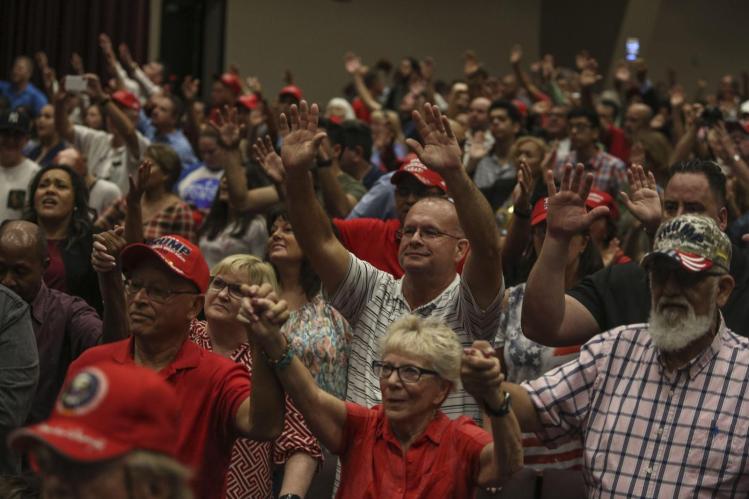
RB: The solution to the increasing conservatism of white Evangelicalism and the white Catholic Church is not the increasing liberalism of the mainline denominations. The mainline clergy are very left of the average mainline laity. You see all these churches with rainbow flags and Black Lives Matter signs. Do you really think that to counter the MAGA hat you can wear a BLM stole? That is not the solution to the problem. Instead, you need to reinforce that we’re left, right, and center, especially when the average mainline Protestant is a white, retired schoolteacher living in rural Minnesota. It’s a fallacy that mainline Protestants are a bunch of Bernie Sanders voters. A majority of mainline Protestants voted for Donald Trump in 2024. The mainline is actually a lot of old, relatively rich, well-educated white people—a Republican constituency.
HS: Are there any other common misconceptions about American religion? I often see you on social media pushing back on people who claim there is a resurgence of religiosity among young people.
RB: There is no Gen Z religious revival. There is just nothing in the data that points to that. I’ve even looked at data after Charlie Kirk’s assassination, and I see no increase in church attendance. The other misconception is that young men are returning to church. They’re actually leaving church more slowly than young women, but the numbers are not going up. There is this idea that piety is surging in conservative religious communities, which are seen as strong compared to their weak, liberal counterparts. But there is no evidence of that. The Southern Baptist Convention, which has become more conservative over the last twenty years, is absolutely collapsing, numerically speaking.
What’s really happening is that denominationalism is in decline, almost universally. Denominations are struggling, and not just “liberal” mainline denominations. The Southern Baptists, the Lutheran Church–Missouri Synod, which is fairly conservative—they’re all struggling, no matter what: left, right, or center. It’s part of a more general anti-institutionalism in the culture, which is the future of America. It’s why nondenominational churches are taking off. They’re deinstitutional, bottom up, not top down. The rise of the nones is the biggest story in American religion, but the rise of nondenominational churches is the second biggest one, because without that, American religion would be in absolute collapse.
But how does that work for an institutional church like the Catholic Church? It doesn’t, in many ways. I keep telling people that if you’re a denomination, good luck, man, because we’re just anti-institutional people. I think that’s actually one of the reasons the Catholic Church has struggled so much—it’s seen as so hierarchical and institutional. It might swing back, but right now, the trend in U.S. religion is definitely not in favor of big institutions.
We welcome your comments about this article. Please send your response to [email protected].


