Why read? For readers of this essay, as for me, the question probably carries a whiff of unreality. Our lives are so tightly braided with the written word that we cannot imagine them apart from it and can’t place our minds at a sufficient distance from ourselves to really ask the question.
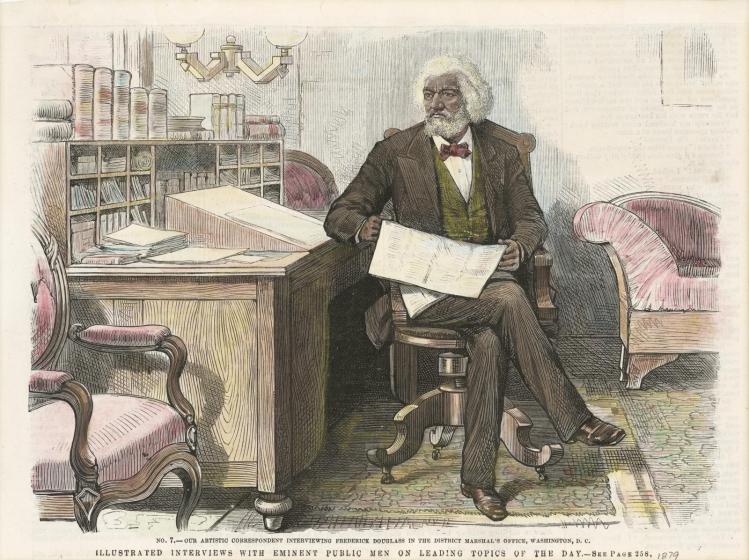
Most of us can scarcely remember a time when we could not read. We can’t conceive of a psyche that is shut out from the alphabetically mediated universe in which we enact virtually every aspect of our social lives. Reviewing the experience of someone who did very much remember a time when he was a stranger to the kingdom of letters can give us an entry point into the question of “why read?” Here’s Frederick Douglass writing in 1845, at age twenty-seven, about his introduction to reading at about the age of eight. It’s one of my favorite passages in American literature.
Very soon after I went to live with Mr. and Mrs. Auld, she very kindly commenced to teach me the ABC’s. After I had learned this, she assisted me in learning to spell words of three or four letters. Just at this point of my progress, Mr. Auld found out what was going on, and at once forbade Mrs. Auld to instruct me further, telling her, among other things, that it was unlawful, as well as unsafe, to teach a slave to read. To use his own words, further, he said, “If you give a nigger an inch, he will take an ell. A nigger should know nothing but to obey his master—to do as he is told to do. Learning would spoil the best nigger in the world. Now” said he “if you teach that nigger (speaking of myself) how to read, there would be no keeping him. It would forever unfit him to be a slave. He would at once become unmanageable, and of no value to his master…” These words sank deep into my heart…. From that moment, I understood the pathway from slavery to freedom. It was just what I wanted, and I got it at a time when I least expected it. Whilst I was saddened by the thought of losing the aid of my kind mistress, I was gladdened by the invaluable instruction which, by the merest accident, I had gained from my master. Though conscious of the difficulty of learning without a teacher, I set out with high hope, and a fixed purpose, at whatever cost of trouble, to learn to read.
Douglass learned well. My deluxe literary education notwithstanding, whenever I see my own droopy prose next to his, I am struck anew by the directness, clarity, and force of his writing. But that’s not the reason that I love this passage. I am most drawn to it because of how starkly it brings home the liberatory power of literacy. “From that moment”—the moment he heard the warning about what learning to read would do to a slave—“I understood the pathway from slavery to freedom.”
Reading isn’t just a skill; it’s not the mechanical capacity of translating marks on a page into meaningful phonemes. Reading is an animistic power. While writing entails encoding thoughts in symbols—arresting their life and putting them into a kind of suspended animation—reading entails their reincarnation in a subjective consciousness; it is, in effect, resurrecting them into the world of conscious life and agency. Reading involves the transmigration of meaning from one consciousness to another. My text-to-speech app does not read—it sounds out. To read is to make the word flesh again. When you read, you cathect your selfhood, your humanity, your autonomy, what philosophers call your “ipseity,” into inert marks and turn them into living things. When you read, you don’t decode—you incarnate.
In Mr. Auld’s warning about the consequences of literacy, Douglass grasped the power of reading to give you access to a broader world, to enlarge the frame through which you look, to liberate you from the confines of your mental universe. So one straightforward answer to the question “Why read?” is that reading expands your horizons—that it gives you powers of vision, powers of experience, that you could not get without reading.
Today there are many signs that reading is in real trouble. People are reading less, especially for pleasure, and especially in long-form. Even for someone like me who makes a living reading and writing, the marathon reading sessions that formed the core of my education have become rarer and rarer. We hear from almost every quarter that students are not reading as much as they once did, that they are unable to complete long reading assignments, and that they are arriving at even elite colleges with alarmingly inadequate reading habits.
The bank robber famously said he robbed banks because that’s where the money was. If reading is simply an efficient means of getting information, then we could say that we read texts because that’s where the information we need is. We could say it’s the information that matters, not how it’s conveyed. But there’s a large body of scholarship and historical experience that challenges this view. We have come to understand that, in the long run, the means by which information is conveyed shapes its content, reception, and, ultimately, the minds engaged in the communication.
If reading were only a neutral vehicle for the transmission of information, we wouldn’t need to be worried about its fate. In the sense of extracting information from a text, people today are reading more than ever. The increase in the amount of information consumed through text over the past twenty-five years is probably greater than the increase in the first hundred years of the printing press. But what worries us—at least some of us—is not the decline of reading per se, but the rapid decline of a certain kind of reading. Specifically, the decline in reading long texts with intensity and intent, also known as “deep reading.” The developments in communication technology of the past few decades, and the resulting erosion of our reading habits, have us asking with some urgency about the cognitive and social effects of deep reading. What might be lost, for individuals and for society, if the robust forms of sustained attention that such reading cultivates are systematically undermined?
As the titans of the tech world have long understood, attention is our most precious resource. We know that our attention is being systematically exploited and vandalized—some of our sharpest social critics have referred to this assault on our attention as “human fracking.” The most powerful corporations of today, like those of an earlier era, are capital-intensive extractive industries, but instead of precious materials from the earth, the natural resource they extract is a highly distilled form of our very humanity.
Reading is a form of disciplining our attention, of expanding its reach and concentrating its powers of penetration. We all know from experience that when you hold your attention on the same object for a long time, you see things that you cannot see otherwise. If you can get past the initial impulse to switch your attention elsewhere and hold your interest on the plant in front of you, or the chair, or the sleeping face of your child, you will soon find yourself in a vast and absorbing world. Just as there are sounds you can’t hear unless they’re enveloped in thick silence—like certain noises in your house at two in the morning—and just as there are things you can’t see unless it’s very dark—like the chalky smudge of the milky way—there are states of consciousness that can be reached only after extended periods of sustained attention. What do we miss if those states of sustained attention become increasingly inaccessible? What forms of human perception, what depths of human experience, and what kinds of social engagements are degraded by our chronically fractured attention?
Reading is probably the most widespread and effective technology ever devised for extending the human attention span. Perhaps the practice of meditation is its only rival, but meditation has always been a niche practice, at least in the West. And even in the West, reading took a long time to reach the masses.
Here’s a thought experiment. Imagine you live in Europe in the year 1400. And imagine you’re in the three-to-five percent of the population that can read. That means you’re probably male and reasonably well-off. Say that you’re intellectually inclined and manage to attend one of the great European universities—Oxford, the Sorbonne, Padua, Salamanca. Your university library would have maybe three hundred books. As a student, you might not be allowed near them. They are fragile and expensive. Your access to them is probably limited to hearing them read in a lecture hall (“lecture” is from the Latin word for reading). You would probably write down everything you could about the book and create a private library of quotations. Reading and writing were esoteric practices conducted by a tiny intellectual elite.
It took the invention of the Gutenberg printing press around 1440, the growth of a text-based religion, and the spread of mass education to bring reading to the general public. A large reading public changed everything. In the few centuries we have lived under the dominance of print, we have experienced a succession of technological (and social and economic) accelerations, from the Scientific Revolution, to the political upheavals of the Enlightenment, to capitalism, to the Industrial Revolution, to the digital revolution. The widespread adoption of print and the information practices it fosters produced fundamental changes in our social organization, our forms of perception, and the structure of our cognition.
In his book Amusing Ourselves to Death, the media theorist Neil Postman describes what he calls “the typographic mind.” This is the mind that is shaped by print. In his view, print’s ability to freeze language—to hold it still—allowed for analysis, interpretation, and reasoned argumentation in a way that was impossible with oral communication. “The typographic mind,” he writes, displays “the strongest possible bias towards…a sophisticated ability to think conceptually, deductively, and sequentially; a high valuation for reason and order; an abhorrence of contradiction; a large capacity for detachment and objectivity; and a tolerance for a delayed response.”
Reading the list of attributes Postman associates with print culture, one can’t help noticing that they are precisely those features of public discourse that seem lately to have gone missing from our politics. According to Postman, these features of public discourse were made possible by the dominance of print and began to be progressively weakened toward the end of the nineteenth century. Extending Postman’s narrative of decline, some thinkers have argued that we have already moved beyond the historical dominance of print and have, in effect, entered a “postliterate” age. Video, images, emojis, and microforms of alphabetic writing now seem to be the actual language of public discourse. This is how Donald Trump won. It’s also how Zohran Mamdani won.
We have good reasons to worry about the fate of reading. For one thing, in losing or weakening the social pervasiveness of deep reading, we may be placing explosives in the structural foundation of our liberal political order. The postliterate society may also be a postliberal one.
These are highly speculative propositions and, coming from a professional practitioner and teacher of deep reading, they are also self-serving. Even so, they may be correct. And even if they are incorrect in detail, there is little doubt that the profound changes in how we read and circulate information in the digital age are rearranging our social world and reshaping our cognitive capacities.
There are many dimensions to the question of reading today, but one presses on my mind with particular force: the liberatory power that the enslaved boy Frederick Bailey heard described by his master in the 1820s. The rise of mass literacy, made possible by print technology, was also the rise of liberal democracy. That political order is built on a set of nearly miraculous historical achievements. They have been costly, and behind each of them lies a long and difficult history struggle. Think of what it took to get kings to give up absolute power. Think of what it took to force the ruling aristocracies to give up their privileges and accept democratic rule. Think of what it has taken to establish the independence of the judiciary. Think of what it has taken to establish the idea that the law applies equally to the powerful and to the weak. Think about what it has taken to establish civilian rule over the military. Think of what it has taken, historically, to secure freedom of speech, freedom of religion, freedom of assembly, freedom to criticize the ruling authorities, freedom to vote them out of office.
All of these freedoms are under threat today in a way they have not been in the lifetime of any one of us. These are all pillars of our free way of life. They all seem less secure, less understood, less valued now than they did only a few decades ago. Why read? There are a lot of good reasons. The one that feels most pressing to me now is that it may be necessary for maintaining a free society.
We welcome your comments about this article. Please send your response to [email protected].