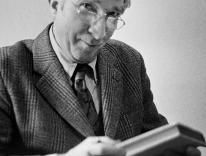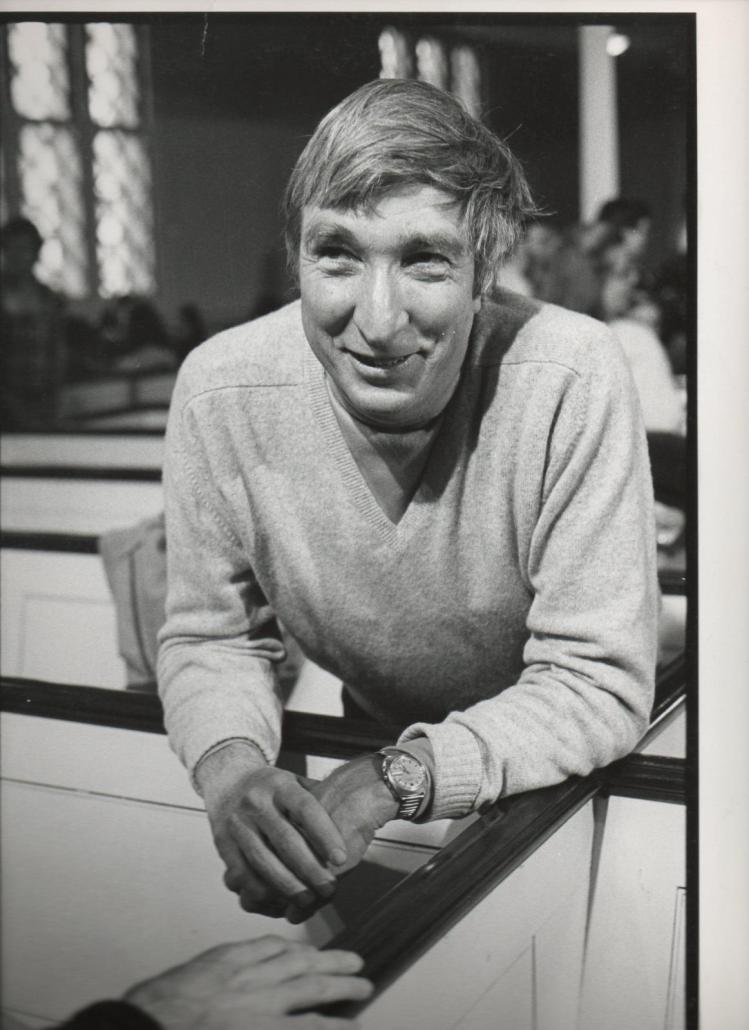
“I used to love to hear him talk,” a female friend said to me when I told her I was reviewing the Selected Letters of John Updike. Anyone who has had a long exposure to Updike (my own goes back to the paperback copy of Pigeon Feathers I bought in the mid-1960s) will know what she meant. Updike’s voice, whether on the page or heard orally, was enormously soothing, so much so that it comes as no surprise to learn, in the Letters, that he was once seriously considered for the hosting job on Masterpiece Theater. The comfort of that voice can be traced back to the early stories like “Snowing in Greenwich Village,” with its delicate layerings of class consciousness, the weight of impending adulthood, and the still only mildly threatening hint of adultery. Revisiting them, it’s easy to imagine young readers of The New Yorker, where most of the stories first appeared, feeling themselves flattered by Updike’s view of them: here we are, starting out, well-educated, lucky (most of us), seeing our domestic lives play out, elegantly, in print.
But Updike, even early on, was doing something else as well: imposing, in stories like “Packed Dirt, Churchgoing, a Dying Cat, a Traded Car,” the presence of God. A deity hung over the young lives Updike was writing about. A benign one, to be sure, but one whose presence endowed such lives with a thickness, an exaltedness that must have flattered them even further. “Only in church and at the polls are we actually given our supposed value,” the narrator of “Packed Dirt” intones. It’s possible, immersing oneself in the early, and even some of the later Updike, to think of him as the James Taylor of American literature, a writer bringing his readers peace, not a sword.
Yet for longtime readers of Updike—those of us who have gotten enough distance to imagine ourselves as seeing behind the man’s mask—there’s always been an intriguing question: How much was the writer onto his own schtick? There’s a sense of anticipation in approaching this new volume. How much, in these seventy years (and 822 pages) worth of letters to parents, editors, wives, mistresses, fellow writers, and to his own children, will Updike’s self-presentation actually reveal about “the man himself”?
He notes, early on, how “life has been suspiciously easy for [him].” Indeed it was. First published in The New Yorker at the age of twenty-two, he was held in the magazine’s embrace (with a few negligible partings) until his death fifty-five years later. Married with four children by the time he was thirty, he kept up a rigorous work life, and saw even his early books become bestsellers and prizewinners. There is the sense, evidenced in these letters, that no one ever managed to say no to John Updike. The affirmation went on—famously—when Updike moved his young family from New York to “the playpen” of Ipswich, Massachusetts, where it seemed every available housewife fell for his charms. A huge swath of the Letters (nearly two hundred pages, by my count) is devoted to ones written to various of his mistresses, encomiums to the “yummy cunt” of the woman who would become his second wife, declarations that his own “prick” “deludes [him]…into feeling immortal.”
Two hundred pages of Updike-as-horndog becomes a bit hard to take. But it has to be admitted that even during this period—the heady years of the 1960s and early ’70s—he maintained some sense of the larger dimensions of what was happening to him, and to others of his generation. All those earnest young couples (like the ones in “Snowing in Greenwich Village”), veterans of “the pallid 50s” who had married and started families early, and who had thought they “could save [themselves] with diligence and a lot of smiling,” had discovered a new, and seemingly irresistible, sexual unboundedness in the suburban culture most of them had graduated into. He once described the environment Nathaniel Hawthorne wrote about as “the brutally new world.” Those words could easily be applied to the one Updike found himself in. The fictional result of Updike’s absorption in the brutally new world of swinging Ipswich was Couples (1968), a novel most readers of Updike will not be eager to return to. The more successful fictional grappling with his own erotic conflicts (if conflicts they were) had happened earlier, and would go on happening, in Updike’s lifelong obsession with Harry “Rabbit” Angstrom.
What’s telling about that obsession, as he references it in his letters, is how deliberate was his attempt to break away from the “nice, polite New Yorker writer” he had up to that point been. (Updike bristled at Alfred Kazin’s disparaging assessment of the typical New Yorker contributor as “that safe citizen of our time.”) He wanted badly to free up the “obscenity-spouting novelist” in himself. But where his colleague and occasional correspondent Philip Roth was content—in his birthing of Alexander Portnoy and Mickey Sabbath—to let the libidinal urge stand for nothing but itself, Updike kept insisting that the highly libidinal Rabbit stood for something more. Rabbit was the instrument with which Updike attempted to take a big swing at “America.” The language of the Rabbit novels is heavily weighted with that ambition. In a typical passage, when Harry Angstrom watches his father waiting for a bus near the opening of Rabbit Redux, he sees the old man as “whittled by the American glare.” A reader might reasonably ask: What exactly makes this glare “American”? The adjective feels like a too-conscious attempt at heft, a way to make the moment feel significant. To use a phrase I’m growing overly fond of, it’s as though it were profound.
But Updike had even more in mind for his hero. Rabbit was, again according to the letters, a “Christian hero,” a “rigorous Protestant,” an embodiment of “a certain innerness…an innerness which Christianity, in its official, practicing version at least, has sternly subordinated to social and moral ideals.” But as with the heavy swath of “American” significance, the Christianity in the Rabbit novels, and elsewhere, often feels imposed. Where the complex religious life of Patrick White infuses every aspect of that writer’s prose, Updike’s self-described “battered and vestigial but unsurrendered Christianity” feels, in his writing, like a kind of lacquer applied to give a surface shine. In a strange way, that impression is confirmed by these letters, where very little self-examination goes on and absolution reigns. (In a late letter to his older daughter, who had chided him for his lapses as a father, he wrote, “My own experience of family life fitted me for the role of child, and a child I have remained.”) The sense, in the prose, of a glow imposed from without helps explain something else I have always felt. Having read, over a lifetime, more than a dozen of Updike’s novels and story collections, it’s always astonishing to me that I find it so hard to actually remember anything about them. The shiny surfaces give way, in the memory, to a kind of blankness.
Which is sad, because revisiting the stories, and even the Rabbit novels (exactly what reading the letters ultimately asks one to do) is to rediscover how much pleasure is to be found there. The man had an undeniable brilliance. At his best, particularly when he’s not trying so hard to load a character like Rabbit with significance, he also has a stunning, almost offhand precision. (His description of the “laughable, military haircuts” of 1950s men, “the pea-brained look,” seems to me Updike at his most unpretentious and spot-on.) There are moments, particularly in an early story like “The Witnesses” (about a man desperate to find a witness to his life’s one instance of pure happiness), where he seems capable of rising out of his own customary solipsism to fully take in another man. But too often, the solipsism reigns.
For me, Updike’s most characteristic work might be the story “Wildlife,” published in Esquire in 1987 after The New Yorker rejected it. Updike often worked close to the bone; as with many writers, a number of his stories adhered to the actual events of his life. “Wildlife” feels like one of those stories. A divorced father is returning to the house in a seaside town (one very like Ipswich) that he had abandoned after the end of his marriage, and where his adult son is now living. At a certain point, the son reveals that he has a suspect rash on his upper thigh: Would the father take a look at it? There’s a homoerotic frisson on the part of the father—not as uncharacteristic in Updike as you might suspect—before the son lowers his pants. Sure enough, it’s a serious-looking tick bite, indicative of Lyme disease. And the father’s response? Does he rush his son to the doctor? No. What Updike has the father saying to himself, in reaction, is: “He tried to suppress the happy thought that he had got out just in time.”
I read that story when it was first published, nearly forty years ago, in the first flush of my own new fatherhood, and it’s one of the few Updike stories I actually do remember, in large part because of my strong reaction to it. Did Updike really mean to be so callous? Over the years, I’ve wondered: Did I get that story right? Was there more to it than I’d given it credit for?
I’ve since reread it, and I can now attest to the fact that there isn’t. I thought of “Wildlife” a great deal as I was reading these letters, particularly the ones Updike wrote in the last twenty years of his life, when his stated ambitions—whatever the pose of modesty he often assumed—grew oversized. In his memoir, Self-Consciousness, he writes of the title of his 1996 novel, In the Beauty of the Lilies—a title lifted from the lyrics of “Battle Hymn of the Republic”:
[It] seemed to me…to summarize what I had to say about America, to offer itself as the title of a continental magnum opus of which all my books…would be mere installments, mere starts at the hymning of this great roughly rectangular country severed from Christ by the breadth of the sea.
That’s a large claim to make—the “hymning” especially—for a man so simultaneously intent on “getting out.” Rereading both the fiction and the letters, I was often tempted to ask what might have happened to Updike’s work if he’d had to struggle more, had to endure a few more “no’s.” But asking that would be like asking more of the midcentury American audience that fell in love with him early—that so loved his reflection of them—and remained faithful to the end (some of them, anyway). Maybe the ambition he declared to his mother, in a letter from Harvard written when he was nineteen, offered the most honest assessment of the writer he would eventually become: “We need not a man of great courage, willing to accept the scorn of society for his art…but a man who will consciously and undeviatingly strive for the approval of his age, and, by so doing, not define or criticize his age, but fulfill it.” In being true to that early promise to himself, it can at least be said, John Updike succeeded brilliantly.
We welcome your comments about this article. Please send your response to [email protected].