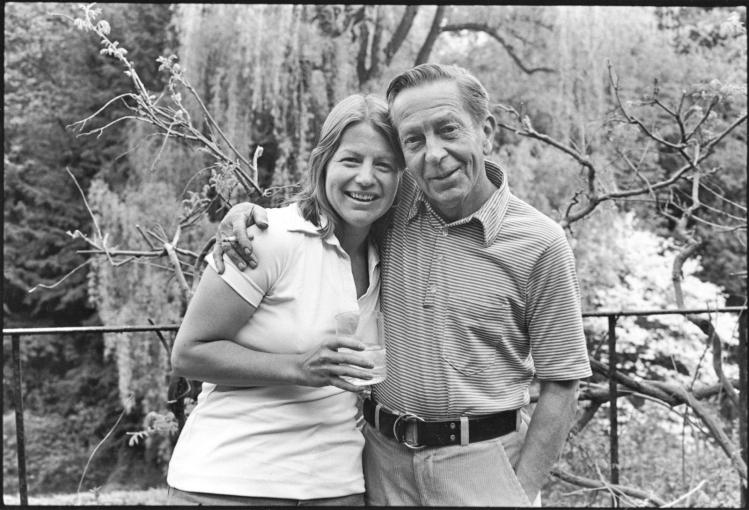
In thinking about John Cheever, it’s worth remembering that he was never an actual contemporary of the two writers he’s most identified with, John Updike and Richard Yates. Born in 1912, Cheever was actually closer in age to Ernest Hemingway, and older than Saul Bellow and Arthur Miller by three years. This makes it all the more astonishing that over time, more than any of those, he has come to seem like our contemporary.
This might have something to do with the revelations contained in 1991’s The Journals of John Cheever, published about a decade after his death, revealing the closeted gay man living under the guise of the heterosexual country squire. Cheever’s revealed (some might say overrevealed ) “doubleness” has made him seem a very modern man. But sexual revelations can’t account fully for Cheever’s continuing hold on us. I think it has a lot more to do with the confluence of this writer’s particular sensibility with the place he chose to live.
He was warned against moving to the suburbs by his early mentor Malcolm Cowley, Susan Cheever tells us in her new quasi memoir, When All the Men Wore Hats. “The suburbs were not the place for a serious writer,” she quotes Cowley. What Cowley couldn’t see was how much the suburbs were to become the great setting for exploring the postwar world in the 1950s and ’60s. What he also missed was the way Cheever’s imagination would become inflamed there. “When the word ‘mythic’ was suggested to him as a designation of his work,” Susan Cheever writes, “my father would snort with distaste.” But it was precisely the myth that Cheever created out of the bare bones of the commuter’s life—the trains and the train stations, the weekend cocktail parties, the swimming pools—that continues to hold us spellbound.
The work itself was not, of course, the only myth Cheever created. Susan Cheever has made a kind of cottage industry of debunking her father’s carefully maintained image. This is her second book about him, her third about her family. But I’ve called this a “quasi memoir” for a reason. The implicit promise of When All the Men Wore Hats (the book’s subtitle is Susan Cheever on the Stories of John Cheever) is that she’s going to concentrate more on the fiction, less on the life. And the promise is a delicious one. What is Cheever’s daughter going to be able to tell us, from her presumably charmed perspective, about the rough magic her father employed to turn prosaic Westchester into “the bewildering and stupendous dream” he made of it in his fiction?
“I can see how much my father leaned on real life details, and how much he transcended them,” she says near the beginning of this book, setting a hopeful note for what’s to come. But too often it’s not the transcendence but the “real-life details” that compel her, and Cheever’s use of those details leads to the charge—baldly made here—that the writer “exploited” his family. About “The Sorrows of Gin,” a story of a little girl who pours bottles of her hard-drinking father’s liquor down the sink (and blames it on her babysitters), she writes: “My father pulled a perfectly formed story out of my imagination.” About “The Country Husband,” in which a man survives a near-fatal plane landing that subsequently transforms his vision of the world: “I am proud to have had the crooked teeth that inspired it.” “The little girls in his stories weren’t me, he insisted.” But Susan Cheever isn’t buying that. Her father “sacrificed his family’s private lives to his art.”
There’s an argument to be made here, certainly, but when that argument reduces a story’s meaning—when “crooked teeth” are given an outsized importance in a story as far-ranging as “The Country Husband”—it ceases to be convincing. It also leads to a troubling exclusivity. “People read his work and they think he is actually writing to them. They forget that he was actually probably writing to some other real people—his own family. Us! Me!” Okay, but where does that leave the rest of us?
I’m guessing this was tricky material for Susan Cheever to handle. It’s also tricky to review, especially for a fiction writer who has endured his own share of criticism from his family for the use of intimate details. The argument one always gives is the same one John Cheever gave Susan: Of course the little girl in the stories isn’t you; it’s just borrowing a couple of details from you, then using them to lift off into another space—the great trick Cheever always managed of “extricating [himself] from ordinary realism,” to quote William Maxwell, his editor at The New Yorker. But for a daughter, particularly one who has chewed over the Cheever legacy for decades, the pain of having her life invaded and held out for the world to view is real, and such highfalutin explanations are never going to do. Cheever may well owe his daughter a belated apology. But admitting that doesn’t do much for those of us coming to this book hoping for new insights.
Susan Cheever clearly has a large and intimate knowledge of her father, but she seems uninterested here in using that knowledge to explore the underground streams in his work. “My father…was living a lie as a gay man leading the fictional life of a nonfictional straight man and writing fiction about straight men.” As factually true as that might be, it leaves unexplored the question of how much the “lie” might have fueled the extraordinary detours Cheever took in his work. Perhaps Susan Cheever is no longer interested in that question, but the resultant failure of imagination leads to the largest missed opportunity in the new book.
John Cheever apparently had a fear of bridges. One day, he and the teenage Susan were driving over the Tappan Zee Bridge when Cheever suddenly got shaky and began driving erratically. He asked his daughter to talk to him, and she did, easing him through his phobia until they arrived safely on the other side. Not long after, Cheever turned that incident into a story called “The Angel of the Bridge,” in which the narrator, driving over the George Washington Bridge, is attacked by a seizure. He picks up a hitchhiker, a young girl carrying a small harp, who sings, through his panic attack, the exact song Susan Cheever had learned to play on her guitar at school.
“The Angel of the Bridge” would seem to provide Susan Cheever with one of her best opportunities to explore the intimate link between life and art. Knowing this, she devotes an entire chapter to the story. What did she see in her father that day on the bridge that he brought to his fictional version of the event?
Based on her reading of the Journals, Susan imputes the cause of her father’s mid-bridge seizure to the aftereffects of a messy relationship he’d had with a male writer in Los Angeles. Fair enough, as far as it goes. But art isn’t always so cause-and-effect. Relying too heavily on it causes Susan Cheever to miss, here and elsewhere, what was richest, and most mysterious, in her father’s work. Though she claims “The Sorrows of Gin” came “fully formed” out of her imagination, the story really only comes to life toward the end, when the father, having picked up his runaway daughter, notes that “a shower of leaves on the wind crossed the beam of his headlights, liberating him for a second at the most from the literal symbols of his life.” It’s a scene repeated almost verbatim—the leaves across the headlights—in the novel Bullet Park, after a father has rescued his troubled son. The repeated image seems to me a key to the inner life that motivated some of his best writing.
A deeper key may lie, though barely hidden, in the image I find most commonly used by Cheever, that of a “thread” binding his characters to the world. It’s there in what I think of as Cheever’s most characteristic sentence, at the end of “The Country Husband”: “The village hung, morally and economically, by a thread, but it hung by its thread in the evening light.” He uses the image for similar effect elsewhere, including his Journals. But he uses it most powerfully in Bullet Park, when his antagonist, Paul Hammer, helps a father on a beach untangle a kite string, in order to avoid the blandishments of an approaching “faggot”: “The filament of kite line in my fingers, both tough and fine, that had quite succinctly declared my intention to the faggot seemed for a moment to possess some extraordinary moral force, as if the world I had declared to live in was bound together by just such a length of string.”
Cheever’s brilliance lay in slicing himself open (he never did it better than in Bullet Park), allowing us to see what Susan calls his “confusions between light and dark”: both “the profoundness of [his] yearning for a more vivid, simple and peaceable world” and the tenuousness of the thing that bound him to that world. But a thread, or a length of kite string, can have a surprising strength, and Cheever knew that. When one of his least appealing male protagonists—“a cad named Blake,” as Susan puts it, in the story “The Five-Forty-Eight”—is being marched at gunpoint by an avenging woman, he still manages a Cheeveresque eulogy for the world he believes he’s about to be permanently exiled from: “It was time to go home, time for a drink, time for love, time for supper, and he could see the lights on the hill—lights by which children were being bathed, meat cooked, dishes washed—shining in the rain.”
In her earlier memoir, Home Before Dark, published forty years ago, Susan Cheever tells a story that seems to say as much about her father as anything I’ve read. His young son Federico was coming home from playing with friends when he ran into his father’s arms, saying “I want to go home, Daddy.” “Of course he was home,” Susan wrote in that earlier book. “But that didn’t make any difference, as my father well understood. We all want to go home.” I wish that there was more of that sort of insight brought to bear on the stories discussed here. But then, we all see in Cheever what we see. There are times when I think of him as the supreme breadcrumb artist. He was a writer who allowed his characters to range far and become deeply lost, but he was always dropping crumbs that pointed the way home. His greatest fear may have been that even when following them, he, and they, might discover, as Neddy Merrill famously does in “The Swimmer,” that “home” was no longer there.
When All the Men Wore Hats
Susan Cheever on the Stories of John Cheever
Susan Cheever
Farrar, Straus and Giroux
$30 | 400 pp.