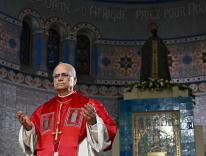
On November 30, 2025, Pope Leo began a three-day visit to Lebanon. A papal visit had been long in the planning. Pope Francis had wanted to go to Lebanon but was prevented from doing so—first for security concerns and then because of failing health. When Pope Leo arrived in Beirut, he was greeted like a rock star. Jubilant crowds braved torrential rains to welcome him. It was exceptional, even by Lebanese standards.
After meeting with government officials and Christian and Muslim religious leaders, Leo turned his attention to the real purpose of his visit: to affirm his solidarity with the people of Lebanon who faced unspeakable hardships for reasons that were out of their control. He encouraged them to stay the course. He urged them not to yield to the temptation to emigrate but to return Lebanon to the vibrant country it once was.
Especially moving were prayers the pope led at Martyrs’ Square in Beirut and a vigil he attended at the site of the 2020 Beirut port explosion, which killed 250 people, injured more than seven thousand, and left three hundred thousand homeless. Again, the message was one of hope, resilience, and encouragement.
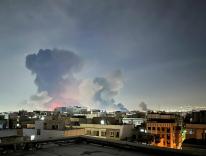
On March 2, less than four months after Leo prayed with and for the people of Lebanon, Israel unleashed what it called “Operation Eternal Darkness.” The first bombs fell less than a mile from where Leo had stood. Before day’s end, Israeli fighter jets would drop 160 bombs on targets across Lebanon. Israeli Defense Forces said the operation was in retaliation for Hezbollah missiles fired into Israel during the joint U.S.-Israeli war on Iran.
A second, even more lethal bombing raid began just hours after a two-week ceasefire had been agreed to by the United States, Israel, and Iran. Israeli prime minister Benjamin Netanyahu announced after the fact that the ceasefire did not apply to Lebanon. In a video address broadcast throughout Lebanon in October 2024, Netanyahu had warned the Lebanese to “save Lebanon before it plunges into the abyss of a long war that will lead to destruction and suffering like we see in Gaza.”
An early casualty in the war was Fr. Pierre al-Rahi, pastor of St. George Maronite Church in the southern Lebanese city of Qlayaa. He was killed on March 9 while attempting to rescue wounded parishioners. Fr. Rahi had previously told Israeli officials that the people of Qlayaa would not evacuate their village as they had been ordered to. He told the Israelis that the village was entirely Christian, that there were no Hezbollah operatives, and that the people were unarmed. Pope Leo called Fr. Rahi “a true shepherd and martyr who refused to leave his people despite the danger.”
The current wave of violence that has engulfed Lebanon began when Hezbollah forces started shelling Israel in retaliation for the death of Iran’s Supreme Leader Ayatollah Ali Khamenei during joint U.S.-Israeli strikes on Tehran. Hezbollah first gained a foothold in Lebanon after the 1982 Israeli invasion, which aimed to expel the Palestine Liberation Organization. Today, Hezbollah constitutes a state within a state that has destabilized and undermined Lebanon’s precarious political and religious balance. The Lebanese don’t need to be told that their country will not regain territorial integrity as long as Hezbollah continues to operate within its borders; they know it well enough. But they also know that past Israeli assaults have only strengthened Hezbollah’s resolve.
Israeli finance minister Bezalel Smotrich recently threatened to turn Beirut into another Gaza Strip. On March 6, the former Israeli prime minister Yair Lapid went considerably further. In a televised address to the Israeli public, he remarked that “it might be unaesthetic perhaps, or unpleasant, to scrape away two or three Lebanese villages, but they brought it on themselves, it is their problem, not ours. No one told them to become the host state of a terrorist organization.” This appallingly cynical language overlooks Israel’s role in the creation of Hezbollah. Another former Israeli prime minister, Ehud Barak, came closer to the truth when he famously admitted that “it was our presence there that created Hezbollah.”
On April 7, the United States and Israel agreed to a two-week ceasefire with Iran, which immediately began unravelling because of a dispute over its scope. While both the United States and Israel initially claimed victory, the truce was tested by continued Israeli air strikes in Lebanon as well as mounting tensions in the Strait of Hormuz.
Iran’s speaker of parliament, Mohammad Bagher Ghalibaf, posted on X that ongoing Israeli attacks in Lebanon violated the ceasefire framework that President Trump and Prime Minister Netanyahu had both agreed to. Trump dismissed the claim, asserting that Lebanon was “a separate skirmish” and not part of the truce agreement. This was one of many instances of mixed messages from the White House. Trump posted on Truth Social that if a permanent “REAL AGREEMENT” is not reached during the upcoming two-week pause, the “Shootin’ Starts again.”
Before Trump began invoking images of the Wild West, his secretary of defense, Pete Hegseth, had led a prayer service at the Pentagon in which he used a “Deus Vult” Bible to justify devastating military action against Iran. He presented the conflict as a divinely sanctioned struggle and encouraged those present “to pray for overwhelming violence of action against those who deserve no mercy.” On Palm Sunday, Pope Leo pushed back. He emphasized that “Jesus is the King of Peace, who rejects war, whom no one can use to justify war.”
The war on Iran has now engulfed the entire Middle East and threatens the global economy. It is a war that Trump has improvised, a war with no clear objectives. The lack of focus and planning are not exceptional when it comes to Donald Trump. But in this case, there is perhaps another reason for the astounding level of incoherence coming from the White House. Could it be that this was not Trump’s war in the first place, but Netanyahu’s? A 2025 Defense Intelligence Agency Report concluded that Iran posed no imminent threat to the United States. So how did we get here?
Yes, such a war was bound to appeal to Hegseth’s evangelical messianism and to Trump’s need to project an image of total dominance. But there is more. Netanyahu boasts about having wanted a war with Iran for forty years. Donald Trump’s father, Fred Trump, was a close friend of Netanyahu all the way back in the 1980s, when Netanyahu was the Israeli ambassador to the United Nations in New York. Jared Kushner, Trump’s son-in-law, also has a longstanding family relationship with Netanyahu. Netanyahu has been a close friend and political associate of Jared’s father, Charles Kushner, and reportedly even stayed at the Kushner family home in New Jersey. This is the same Netanyahu who threatened to turn Lebanon into another Gaza and has done his best to make good on that threat.
On April 16, a ten-day ceasefire went into effect in Lebanon. The pause in hostilities and the opening of face-to-face negotiations between Israel and Lebanon were a welcome development. However, no sooner was the ceasefire announced than Netanyahu stated that Israeli troops would remain in the “security zone” they had reduced to a devastated landscape, an area of 568 square miles that stretches from the Israeli border to the Litani River twenty miles north. The next day, Trump posted that Israel was now “prohibited” from bombing Lebanon, but prohibited by whom? Trump’s words shocked Netanyahu and his team. The ceasefire agreement published by the U.S. State Department explicitly states that Israel reserves the right to act in self-defense against planned or imminent attacks by Hezbollah. The occupation of southern Lebanon, which, ceasefire notwithstanding, has no end in sight, fulfills a long-cherished goal of Netanyahu, one that he has no intention of forfeiting. In fact, the ceasefire effectively locks in Israel’s occupation of Lebanon.
The ceasefire also has some benefits for Trump. The war with Iran failed to do what he said it would: it did not inspire Iranians to rise up against their government, and it did not bring about regime change. The Iranian leaders the United States killed have been replaced by even more brutal successors. Things are not looking good for Trump at home, either. Attacking the pope, posting images of himself as Jesus, denying the record prices at the gas pump and grocery store—these are all taking their toll, even among the MAGA base. Trump needs a win. On April 16, the same day that the ceasefire went into effect, Trump invited Benjamin Netanyahu and Lebanese president Joseph Aoun to the White House to conduct what he called “the first meaningful talks between the two nations since 1983.” It would be another chance for Trump to present himself as a peacemaker. Netanyahu had previously told his advisors, “When Israel’s greatest friend, President Trump, is acting alongside us in close coordination, Israel cooperates with him. When the president calls, we come.” Netanyahu immediately accepted Trump’s invitation.
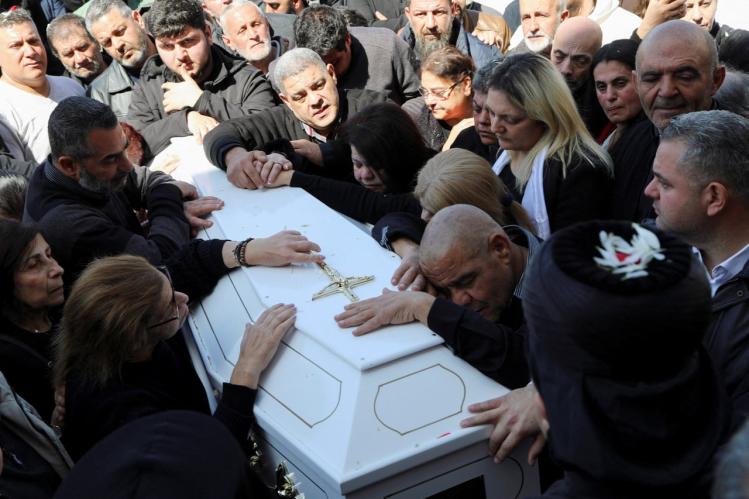
For its part, Lebanon faces enormous challenges. It lacks the capacity to disarm or dismantle Hezbollah, and this ensures the ongoing presence of the Israeli army, which the Lebanese government calls “a new occupation.” The Lebanese have endured unspeakable suffering since Israel invaded their country on March 2. The Lebanese Ministry of Health reports that there have been 2,294 civilian deaths, including 432 women and children. Another 7,100 civilians have been seriously wounded, and more than a million have been displaced. Those who were driven from their homes have no homes to return to. Under international law, the Israeli military’s targeted destruction of civilian infrastructure may qualify as a war crime.
When Israeli bombers struck apartment buildings in the southern port city of Tyre, thirty-six-year-old Hassan Abu Khalil lost all thirteen members of his family. He had just returned from the United Kingdom, where he was working and sending money home to support them. Bombs killed them all late in the night on Thursday, April 16, minutes before the ceasefire was to take effect. “There is nothing left,” he said. “My life is over.” Israeli shelling has continued since the ceasefire was announced. So the situation is, as they say, fluid. Is the ceasefire as good for Lebanon as it is for Israel and the United States? It may be a long time before we know. In the meantime, the Lebanese have their dead to bury.
Editors’ Note: This piece was originally published online April 15, 2026. It has since been updated to reflect recent diplomatic developments.
We welcome your comments about this article. Please send your response to [email protected].