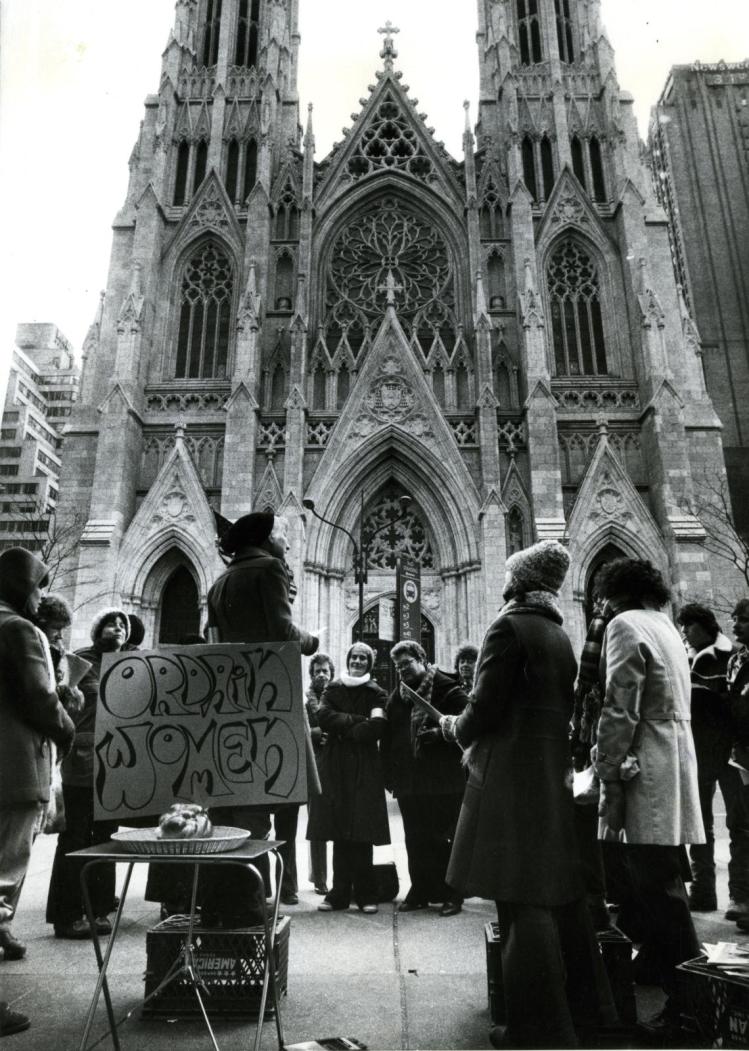
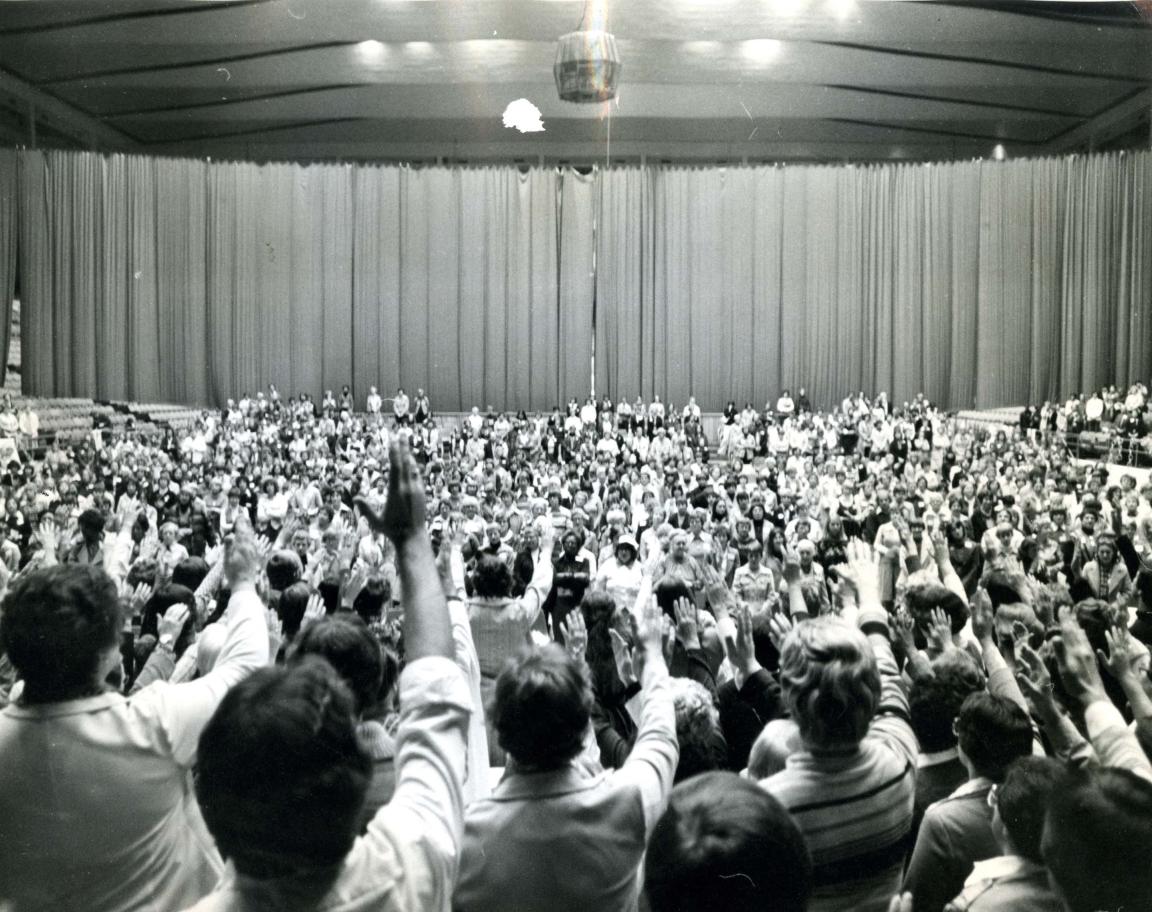
Carol Crowley was a twenty-one-year-old student at Michigan State University when a parish staff member invited her to a Thanksgiving-weekend conference in Detroit on women and Catholic priesthood. Crowley had already discerned, with the help of priests at the student parish, that she was called to ordination, so when women with a calling were asked to stand at the conference, she was one of three hundred who rose to their feet. It was the first time she realized she was not alone.
The mood at the 1975 conference was electric and hopeful as more than 1,200 participants gathered to hear from feminist theologians such as Elisabeth Schüssler Fiorenza, Margaret Farley, and Anne Carr, and to network and strategize about how to challenge the patriarchal structures that prevented women’s inclusion in all ministries in the Church. (Five hundred people were turned away at the door for lack of space.) Many Protestant denominations had already ordained women to the priesthood, including the Episcopal Church the year before. The Detroit event was the brainchild of Mary B. Lynch, an Indianapolis resident who had begun seminary studies for the degree needed for ordination, the master of divinity, in 1971. She had queried people on her Christmas-card list about their interest in a national meeting on the topic and gotten a positive response.
Forty-nine men’s and women’s religious congregations publicly endorsed the conference, and many of the attendees were religious sisters. Mary McGlone had entered the Sisters of St. Joseph of Carondelet three years earlier and been open about her call to ordination. The expectation was that priesthood would soon be opened to women, and many orders were already planning how to accommodate women priests within their communities. McGlone, then twenty-six, remembers listening wide-eyed to her heroes at the conference and feeling energized by being with others who really believed women’s ordination in the Catholic Church could happen. “I don’t think anyone doubted that it should, but they were thinking that it could,” she recalled.
The event gave birth to the Women’s Ordination Conference (WOC), an organization that has been advocating for women’s ordination for five decades, a journey that its current executive director, Kate McElwee, describes as a mixture of grief and hope. Today, not only is the possibility of women’s ordination to priesthood remote, but movement on other avenues, such as ordination to the permanent diaconate, seems mired in endless “study.” During the fifty years since that first conference, the movement has seen ups and downs, disagreed over strategies, and sometimes struggled with institutional acceptance. But it’s still going strong and continuing the fight, reinvigorated by younger women. This May, WOC will mark its anniversary with a conference back in Detroit, and Crowley and McGlone, both in their seventies, plan to be there. They acknowledge that institutional approval of their priestly vocations will not come in their lifetimes, but both women have found ways to minister without ordination.
You might like: Mollie Wilson O’Reilly on Pope Leo and women
It’s clear from Scripture that women were influential and in some cases leaders in Jesus’ movement and early Christianity, despite the culture’s opposition to women in authority. The New Testament references women deacons, an analysis of ancient Roman burial art reveals images of women as preachers and teachers, and some archaeological evidence points to women serving as presbyters and even bishops in the decentralized Church of the first centuries after Christ. Throughout history, however, Church officials have offered several arguments against women’s ordination, most notably that women cannot image Christ and serve in persona Christi because of their gender. Others cite the twelve male apostles, although whether Jesus officially ordained them is debatable. Women’s lack of equality under patriarchy has been a reality inside and outside the Church (although women have obtained substantial power as heads of women’s religious communities).
In modern times, advocacy for women’s equality in the Church paralleled similar movements in broader society. The first recorded Catholic organization calling for women’s ordination was the St. Joan’s International Alliance, founded in 1911 in London to work for women’s suffrage. By the mid-twentieth century, women began studying theology at the graduate level, and the Second Vatican Council stirred hope that women’s roles in the Church could expand and include ordination. A number of progressive advocacy organizations flourished in the United States after Vatican II, including several that also backed women’s ordination. One group, Priests for Equality, revealed that at least some clergy were open to women priests. A year after the first women’s ordination conference, the U.S. bishops would hold their own gathering in Detroit to mark the country’s bicentennial and chart the Church’s future. Among the nearly two hundred resolutions from the “Call to Action” event were ones calling for opening the priesthood to married men and to women.
I have reported on women’s ordination advocacy for more than three decades, and for a time was involved in one of WOC’s Young Feminist Network groups in Chicago. Some of my reporting on the issue for U.S. Catholic even earned me a slap on the wrist from the Congregation for the Doctrine of the Faith under then-cardinal Joseph Ratzinger. But younger women today give me hope. If, as it’s said, the Church thinks in centuries, the fifty-year-old women’s ordination advocacy movement is already halfway there.
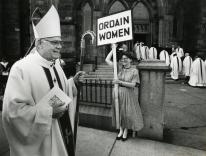
“Knock, knock. Who’s there? More than half the Church!” About twenty WOC members were peacefully protesting in St. Peter’s Square in 2018, urging bishops and cardinals entering the opening session of the Synod on Young People to allow women to be voting members at the assembly. Already, nonordained men—two religious brothers—had been given voting rights, but women, including sisters, were excluded, making clear the reason was not ordination but sexism. But the protest erupted in chaos when Italian police swept in to break it up, violently grabbing McElwee’s arm. It wasn’t the only time WOC protesters have faced possible arrest.
Five years later, after numerous “Votes for Catholic women” actions, Pope Francis changed synod rules to allow nonbishops, including women, to vote at the Synod on Synodality. Fifty-four women voted at the two Rome synod meetings in 2023 and 2024, the first time women held official decision-making power for the global Church. In its statement, WOC called the decision “a significant crack in the stained-glass ceiling, and the result of sustained advocacy [and] activism.” The Synod on Synodality was also the occasion for another major victory: WOC’s inclusion in the consultative process as a convener of listening sessions whose results were forwarded and included in the synod preparatory document. WOC was also listed on the synod’s webpage as a resource.
Inclusion on a Vatican website seems small, but it’s significant. Just a decade earlier, the topic of women’s ordination was so taboo that few Catholic organizations, schools, or publications would touch it. The fear came from Pope John Paul II’s 1994 apostolic letter Ordinatio sacerdotalis (“On Reserving Priestly Ordination to Men Alone”), which declared that “the Church has no authority whatsoever to confer priestly ordination on women and that this judgment is to be definitively held by all the Church’s faithful.” Some mistakenly interpreted this as a declaration of papal infallibility, which discouraged advocacy or even discussion of the topic. Invitations dried up for pro–women’s ordination speakers, Catholic publications no longer covered it, and “feminist” became a dirty word in the Church.
In a matter of two short decades, the Church had moved from preparing for what seemed like an inevitable change to shutting the door on the possibility of female priests. Overall, the quarter-century term of John Paul’s papacy, which had begun in 1978, signalled a time of growing conservatism in the global and U.S. Church. His “Theology of the Body” that emphasized complementarity, not equality, between the sexes was out of step with the views of most U.S. Catholic women. Despite his popular personal style, he ruled the Church with an iron fist, and his head of the powerful Congregation for the Doctrine of the Faith, Cardinal Ratzinger, demanded doctrinal orthodoxy. Ratzinger would succeed John Paul when he became Pope Benedict in 2005.
It’s hard to imagine now, but many bishops had subscribed to the WOC newsletter in the early years, and the organization partnered with a number of other Catholic institutions. The pope’s apostolic letter “created a chilling effect on those relationships,” McElwee said. “It was a real roadblock for the movement.” But that wasn’t the only signal of growing conservatism about gender in the Church.
In the mid-1980s and early ’90s, the U.S. bishops’ conference attempted to write a pastoral letter about women, and the process epitomized the widening chasm between the Church and progressive Catholic women. After two years of listening sessions that included some seventy-five thousand women, a first draft highlighted women’s voices and included criticisms of the Church and calls for ordination. But the bishops’ committee, in part in response to interference from Rome, rewrote the document, replacing the women’s words with papal quotes, critiquing “radical feminism,” and reaffirming Church teaching against artificial contraception and women’s ordination. The Vatican intervened again, and more changes were added to third and fourth drafts. It was a public-relations disaster and became the first pastoral letter to fail to pass in an open vote. Progressive groups saw stopping passage of the watered-down document as a victory, but it also illustrated how the episcopate had shifted. Even among bishops who opposed the letter, few supported women’s ordination. The issue had already become too toxic.
The decade-long debacle of the women’s pastoral and the issuance of Ordinatio sacerdotalis two years later led to spirited debate within the women’s-ordination movement about whether their efforts were best aimed within or outside of the institutional Church. Ruth Fitzpatrick, a Virginia woman who served in WOC leadership throughout the ’80s and early ’90s, remained committed to working for change within the Church, even as she was open to the women-church movement that created alternative, inclusive spiritual spaces. But other women were losing patience.
In 2002, seven Catholic women boarded a cruise ship on the Danube River, where they would be in international waters and thus not under the jurisdiction of any local bishop. In front of two hundred friends, family, and supporters, they were ordained as priests in a ceremony led by two male bishops who claimed apostolic succession, though they were not in communion with Rome. A third bishop had previously ordained the women as deacons, after each had completed a three-year period of study and preparation. The “Danube Seven”—four Germans, two Austrians, and one American (a former first lady of Ohio)—insisted that since their call came from God, not the Vatican, the ordinations were valid.
The Vatican disagreed and threatened excommunication unless the women rejected their claims and asked for forgiveness. None did. Three would eventually go on to be ordained bishops in what is now called the Roman Catholic Womanpriests movement, which currently boasts hundreds of female priests in its “renewed priestly ministry” in thirty-four states and in Canada, Europe, South and Central America, South Africa, the Philippines, and Taiwan.
Equally controversial, though more likely valid, was the ordination of Ludmila Javorová, a woman involved in the underground Catholic Church during the time of Communist rule in Czechoslovakia when the country was under Russian occupation. The underground bishop Felix Maria Davídek secretly ordained Javorová in 1970, and she served as his vicar general. Another four women, who have not come forward publicly, were also said to have been ordained, primarily to serve imprisoned women.
Hundreds, if not thousands, of women have left Catholicism to pursue ordination as priests or deacons in Protestant denominations, such as the Episcopal Church or the Evangelical Lutheran Church in America. Others have been ordained through splinter groups such as the Old Catholic Church, which also claims apostolic succession through its bishops, although it is not recognized by the Vatican. A year before the Danube Seven, Mary Ramerman—a lay pastor who had gotten in trouble with the Diocese of Rochester, New York, for participating on the altar during the Eucharistic prayer at Corpus Christi Parish—was ordained by an Old Catholic Church bishop for a breakaway community called Spiritus Christi. After serving as pastor for two decades, she was succeeded by a Roman Catholic Womanpriest, the Rev. Myra Brown.
In Long Beach, California, Jennifer O’Malley had worked in campus and youth ministry, earned a degree in pastoral studies, and took turns leading a liturgy at a small faith community. Members of the community told her she was “good at it,” but she didn’t consider ordination until she met another Roman Catholic Womanpriest. “I had always been searching,” she said. “But I didn’t even know ordination was a possibility.”
After her ordination in 2012, O’Malley pastored that small faith community until it disbanded and currently works to promote rights for hospitality workers and undocumented migrants. Now fifty-four, O’Malley accepts that some may choose to work for change within the institutional Church, but she has made peace with her path. “I feel if I were to just sit on a call to ordination, it’s a disobedience to God,” she said. “There’s no choice, if I want to be who God created me to be.”
Crowley and McGlone both chose to do ministry without official ordination, Crowley as a hospital chaplain for three decades and McGlone as a seminary professor and Scripture columnist. McGlone believes in “upsetting the set-up” from within and challenging the clericalism of the current way the Church views priesthood. “Maybe what we’re doing is creating the new priesthood, instead of getting into this structure that has done all kinds of damage,” she said.
Crowley got involved in a “covenanted community” of women called to ordination called RAPPORT (Renewing and Priestly People Ordination Reconsidered Today), which formed after the third WOC conference in 1985 in St. Louis. While they appreciated WOC’s long-term vision, these women wanted more immediate results. The group initially focused on meeting with bishops during their annual gathering—some two dozen over the years, she said—to share their stories and ask for help. Although they promised the bishops confidentiality while they were alive, Crowley named the late Auxiliary Bishop Frank Murphy of Baltimore as an organizer. Others included the late Bishop Raymond Lucker of New Ulm, Minnesota; Auxiliary Bishop Thomas Gumbleton of Detroit; and Bishop Michael Kenny of Juneau, Alaska. Today, RAPPORT has shifted from strategy to support, and operates under the umbrella of WOC.
Despite occasional differences of opinion about strategy, WOC’s current executive director sees the organization as a “mothership to hold all these tensions together.” “It’s going to take all these strategies to dismantle this system of patriarchy,” McElwee said. “Our mission is clear: to work for women’s ordination in the Catholic Church.”
Much of the debate about women’s ordination today centers on restoring women to the diaconate. It was a topic of conversation during the Synod on Synodality, where the synod’s final document stopped short of moving on the issue but left it “open.” The main advocacy group in the United States, Discerning Deacons, sees the issue of the permanent diaconate as separate from priestly ordination. But WOC sees them as connected; in fact, Lynch, considered the founder of the organization, felt called to be a deacon, not a priest. Among advocates for women’s ordination, some see focusing on only the diaconate as a piecemeal approach and would consider Vatican acceptance of women deacons, but not priests, as incomplete.
Hannah Coley is involved in both WOC and Discerning Deacons and believes both vocations are “a call of the heart.” She became aware of her own call to ordination while working in Belize and at the Pine Ridge Reservation in South Dakota, where women leaders took on liturgical roles because of a lack of priests. Yet Coley finds it hard to imagine herself as ordained while the Church does not recognize women’s vocations. At thirty-two, she is grateful for previous generations who opened these conversations and is hopeful that her generation will continue the fight.
“I see all calls as a necessary gift from God and what our Church needs in this moment, especially in places like Detroit and across the country where churches are closing,” she said. “We need more priests and deacons. It’s not from a lack of call but a lack of receptivity.”
More than two-thirds of U.S. Catholics favor opening ordination to women, a percentage that has remained constant for at least two decades. Support is even higher among younger Catholics. A recent poll found majorities in Latin American countries also approve of the ordination of women. Meanwhile, the Church is experiencing a severe shortage of priests, especially in the United States. The number of U.S. priests has dropped 40 percent since 1970; globally, the number of clergy is stable, but the Catholic population has doubled, according to the Center for Applied Research in the Apostolate at Georgetown University. The number of parishes without a priest has skyrocketed—even excluding parishes that have closed or merged due to lack of priests.
Ordaining women would not only address these shortages, it would energize the Church and right a terrible injustice, advocates say. As WOC begins its sixth decade, it is focusing on creating a playbook that addresses how change happens (not “protesting just to protest”) and is taking an increasingly global perspective to dispel the myth that the issue only interests Western women. McElwee, who has served as executive director for fifteen years, lives and works in Rome, although the organization maintains an office in Washington D.C. While she does not feel called to ordination herself, McElwee says that frees her to do the work of advocacy.
While some Church-reform groups that emerged after Vatican II have declined in membership or influence, WOC has not only survived but continues to grow, infused with energy from younger and more diverse members and leaders. In 1995, WOC formed the Young Feminist Network to nurture members and leaders from younger generations. Today the network has four hundred members in its database. Many young women have learned about WOC from creative social-media campaigns, such as their “pink smoke” demonstrations during conclaves.
In 2019, WOC launched the “Escuchando a las Mujeres” program to connect with Latina women. Then-staffer Lilian Medina Romero recalls that many Latina women expressed a desire for women priests—especially in the confessional or when dealing with issues that could be best understood by another woman, such as relationships, domestic violence, or sexuality. At the time, few had considered ordination. “Some of them said, ‘Well, I never thought about it,’” she said. “But they did share the feeling of not being recognized or not feeling they were in the full image of God growing up in the Church.”
McElwee said part of WOC’s mission is to accompany women as they navigate their relationship to their faith and to the institutional Church. “Come with all your questions,” she said. “This is a place to explore and hold one another as we try to figure out what our faith means in this world.”
WOC’s last national conference was held in 2015 in Philadelphia to coincide with Pope Francis’s visit. The fiftieth-anniversary meeting in Detroit will be not just about looking back at a trailblazing movement but about pushing forward, reenergized and with prophetic courage, to continue the work. McElwee senses a shift, as people feel more emboldened to speak about women’s leadership, and some Church leaders are more open to listening. “This is no longer a marginalized issue,” she said. “It’s a mainstream conversation.”