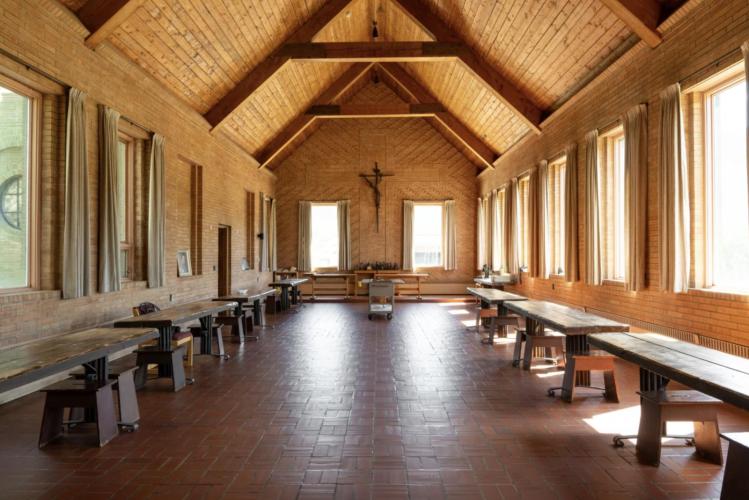
In summer, wildflowers broke out along the stony ridges of the mountains, and for most of winter the valley would be hushed with snow the color of cotton paper. The Trappist monks of St. Benedict’s Monastery were lovers and stewards of the place and called it their “sacred valley.” They came from Brooklyn or Boston, had once served in the Air Force or as missionaries abroad. One brother had fought in the Battle of the Bulge, and when he died, I helped carry his body on a plain wooden bier to the hilltop cemetery where he would rest with his brothers.
Now the place will be the newest residence of Alex Karp who, as The Wall Street Journal recently reported, paid $120 million for the 3,700-acre property twenty minutes’ drive from Aspen, Colorado. CEO and cofounder—along with his Stanford pal Peter Thiel—of Palantir Technologies, Karp has made billions guiding the development of data-analysis software for top-tier intelligence and defense organizations, including the FBI, ICE, and the Israeli and Ukrainian militaries. In-Q-Tel, the venture-capital arm of the CIA, was an early investor in Palantir. Karp’s Promethean sense of self-importance—“I am running the most important tech company in the world”—will be right at home in Aspen, which has in recent years become a playground for the super-rich.
You might like: ‘Pope Leo vs. Palantir’
In 2016, I took an Amtrak west from my native Chicagoland and stepped off the train twenty-four hours later with the Colorado River rushing behind me. At twenty-seven, I entered St. Benedict’s in Snowmass, Colorado, inspired by St. John of the Cross and Thomas Merton. I expected that a few months of the monastic life would flush out the vague spiritual yearnings that had been gnawing at me, but as God would have it, I stayed three years. A career-minded relative had inquired if there was any chance of upward advancement at a monastery. When I later shared this with one of the monks, he chuckled and said, “Tell them that when you make it to the top, you get to wash the feet of the brothers”—a reference to the tradition of the abbot washing the community’s feet on Holy Thursday. In a similar vein, the same monk would tell me, “Learn to love humiliations.” As I was often reminded during my time at St. Benedict’s, humiliation and humility share the same root. Of course, learning to love humiliations is easier said than done. No matter the context, failure of personal effort is painful, and it’s why one develops humility gradually and often uncomfortably. It’s also why, in our prevailing zeitgeist of self-assertion and celebrity, humility is seen less as a virtue than as a social or political liability.
Alex Karp’s success teaches a very different lesson. He preaches a counter-gospel of self-aggrandizement, for nations as well as people, arguing in The Technological Republic that the United States should immediately launch “a new Manhattan project”—an AI-driven race to dominate “the targeting systems and swarms of drones and eventually robots that will become the most powerful weapons of this century.” Beneath his public-facing persona as AI prophet and Palantir tycoon (the company’s name is a reference to the seeing-eye stones in The Lord of the Rings), the evolution of Karp’s personal philosophy is as puzzling as it is ominous. Once a self-described progressive who supported Biden and Harris and said, in 2019, that his “biggest fear is fascism,” he has since joined Team Trump, donating $1 million to the president’s latest inauguration, applauding the administration’s policies on immigration and its military buildup, and bemoaning the socially corrosive effects of wokeism and identity politics. Like many others in Big Tech, Karp seems to have been seduced by access to power.
Notwithstanding his stated aversion to identity politics, Karp seems to find his own complicated identity fascinating and empowering. In a recent interview, he quipped, “I’m a Jewish, racially ambiguous dyslexic, so I can say anything.” For example, he can say that “saving lives and on occasion taking lives is super interesting,” It’s the sort of thing you might expect a gamer amused by his kill count to say, the sort of thing you would hope one of the world’s most powerful people would not say.
Thomas Merton wrote, “In a world of noise, confusion, and conflict it is necessary that there be places of silence, inner discipline, and peace.” Hence the bitter irony of this former monastery being owned by a man whose financial and cultural capital springs from the world’s noise, confusion, and conflict. Perhaps Karp purchased the property of St. Benedict’s precisely for the atmosphere described by Merton, a world away from the kind of violence his company enables and capitalizes on.
Monastic orders have always depended on wealthy benefactors for support—dukes, barons, and bishops in the old days, billionaires now—so maybe it seems unfair to slam a tech billionaire for buying available real estate; it’s not as if he is responsible for the monastery’s decision to sell it. But if we treat the transaction as a sign of the times, it sounds a foreboding spiritual alarm: from the idyllic grounds of a dissolved monastery, Karp will continue to lobby for the expansion of an AI-driven military-technocratic complex. Karp’s whole project is a particularly egregious manifestation of what Pope Francis called the “technocratic paradigm.” When Pope Leo addressed a conference on AI ethics in June 2025, he could’ve had Palantir in mind as he expressed concern for “the possibility of [AI’s] misuse for selfish gain at the expense of others, or worse, to foment conflict and aggression.” More recently, the pope noted, “War is back in vogue and a zeal for war is spreading…. Peace is sought through weapons as a condition for asserting one’s own dominion.”
And for this we have people like Alex Karp to thank. If, as Randolph Bourne wrote, war is the health of the state, then Karp is one of America’s most diligent and prosperous physicians. His company fuels conflicts all over the world. The marketing copy for its Gotham line—software for militaries and intelligence services—reads like something from Call of Duty. “Your software is the weapons system.” “Orchestrate combat power.” “AI-driven combat superiority.” Karp justifies Palantir as the newest iteration of “peace through strength,” citing a history of American “‘superiority in applying organized violence.’” But as the historian Andrew Bacevich notes, “‘Peace through strength’ easily enough becomes ‘peace through war.’” The war may be conducted by drones or robots, but it is still violence against real human bodies that break and bleed and are mourned by those who loved them.
I left St. Benedict’s in 2019, for reasons that, like any breakup, are complicated. One was the disquieting distance I felt between my monastic prayers and the flesh-and-blood realities I was praying about every day. My prayers seemed like such pale and wispy things in the harsh light of the suffering of Syrian refugees or Central American migrants at the border increasingly vilified during Trump’s first term. More prosaically, I left because I wasn’t ready. I was thirty and terrified of commitment. My novitiate was coming to an end, and taking first vows felt like getting engaged to a girl I had only grown more uncertain of the more I knew her. Meanwhile, in the short time I was there, the community had shrunk through deaths and departures, and I was now the youngest by a decade. But if there was any resentment about my departure, I didn’t feel it. One of the brothers told me, “Monks come and go—most go.” Still, I left St. Benedict’s knowing that I would never again live in such a beautiful place.
A few of those close to the monastery say that its dissolution feels to them like a death. After sixty years, there will no longer be monks singing the Salve Regina as night closes in on the valley around St. Benedict’s. Prayers for peace will be replaced by schemes for war. Is this a sinister harbinger for the future, another reminder that World War III will be “fought piecemeal,” as Pope Francis warned? As Nazi banners fluttered along the boulevards of her native Paris, the exiled Simone Weil wrote in her journal, “You could not have been born at a better time, when everything has been lost.” Christian hope begins where the world sees it ending. St. Benedict himself taught his monks, “Keep death daily before your eyes.” If men like Karp have their way, it will be hard not to.
We welcome your comments about this article. Please send your response to [email protected].