In the summer of 1956, when I was fifteen years old, I worked as a staff member at a Boy Scout camp located in Wisconsin but serving Scouts from suburbs northwest of Chicago. I worked in the Nature Area, teaching kids how to identify poison ivy and poisonous snakes (we had plenty of the former, none of the latter) and to distinguish red oaks from white oaks and red pines from white pines. We organized early-morning bird-watching hikes, not very successfully in my case because birds, unlike the oaks and pines, would not stay still to be examined by the nearsighted. There were five of us on the Nature Area staff: an older director who was always missing on Sundays because he also happened to be the pastor of a nearby fundamentalist church; two other staff members slightly older than me; and a fourteen-year-old “trainee.”
Trainees were a summer-camp version of interns; they went unpaid in exchange for a summer at the camp and the prospect of becoming a paid staff member the next year. Which this trainee did. Each year, my brother and I painted the names of all the summer’s staff members on a canoe paddle that was hung in the dining hall, and when I visited the camp many years later, I saw his name, Harry Ford, painted on at least two paddles.
You might like: Antonio Spadaro on Pope Leo’s favorite movies
Was Harry short for Harold or perhaps, in the manner of British royalty, for Henry? That would make his proper name Henry Ford—ironic, I thought at the time, because this Harry was nothing like the man who perfected the assembly line and created the Model T. Instead, this Harry was rather lost, even something of a pain in the neck. His face usually wore a worried, hangdog look. His mind was elsewhere. He had to be reminded three times before he got started on ordinary tasks. He seemed to lack the energy, the focus, the determination, that might augur success beyond a summer job at a Scout camp. No doubt my reaction reflected some of the disdain a high-school sophomore feels toward a high-school freshman, but I recall this was also the view of my coworkers.
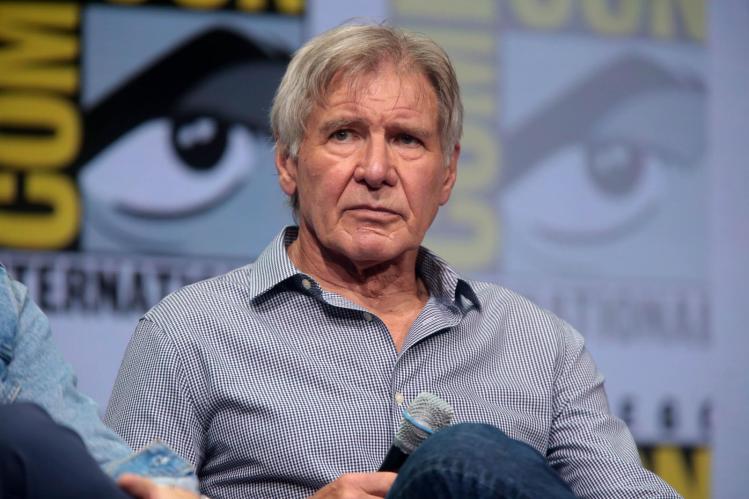
I couldn’t have been more wrong. Wrong, to begin with, about Harry’s first name, which turned out to be Harrison, and wrong about his future. If I can’t claim to have relished every movie in which that worried, hangdog face confronts danger after danger—as Han Solo and Indiana Jones and Jack Ryan and the protagonists of Witness and The Fugitive—it’s only because he’s made so many of them. I’ve also thought of that face when reading about the rescue missions Ford has carried out as a licensed pilot and collector of planes and about his painful survival of several crashes. (While a college student at Ripon College, Ford took his first flying lessons at the Wild Rose, Wisconsin, airport, forty miles from Ripon but only a few miles from that Scout camp.)
A year ago, The Wall Street Journal’s glossy “luxury magazine,” WSJ., featured a story on Harrison Ford. The article was flattering, the photos unsparing. That worried gaze, now reinforced with wrinkles and sags, as well as Harry’s now octogenarian body could be seen on the cover and inside pages. As in his early scenes in Indiana Jones and the Dial of Destiny, which reveal an aging, battered, and weary Indiana, Ford was breaking the mold of the ageless action hero.
The article also mentioned Ford’s zeal as a nature lover and environmentalist and his public pose as a curmudgeon, grump, and crank. I would like to think that some of the former might have some roots in that Nature Area experience; I’m not sure about the latter.
Certainly that persona was not on display when Ford recently accepted a Life Achievement Award from the Screen Actors Guild. His remarks could not have been more gracious, eloquent, and deeply personal, delivered with tears in his eyes to a rapt audience. As a flailing and “isolated” college student, “I found the company of people putting on plays,” he said, “people I once thought were misfits and geeks turned out to be my people. I found a calling, a life in storytelling, an identity.”
You might like: Rand Richards Cooper on Gene Hackman’s emotional intelligence
“As actors, we get to live many lives,” he continued. “We get to explore ideas that affirm and elevate our shared experience. The stories we tell have a unique capacity to create moments of emotional connection; they bring us together.… We share the privilege of working in the world of ideas, of empathy, of imagination.” The emphasis was on the shared nature of that work. “My career is built on…the work of writers, directors and every single cast member, every crew member I’ve ever been on a set with.” Much of what Ford said was particular to acting and moviemaking. But much, by extension, could be applied to any genuine calling, from physician to firefighter, from plumber to poet, from manager to medical aide.
Ford did quip that it was “a little weird” getting a Lifetime Achievement Award “at the half point of my career.” With a Jewish mother and an Irish Catholic father, he has occasionally been asked what religion he was raised in. His reply: “Democrat.” Asked by WSJ what “boils your blood, Ford replied, “Meanness. Lies, hatred, harm.” His blood must be boiling a lot these days, but he shows few signs of slowing down. Just last summer, he received his first Emmy nomination for his work in the TV series Shrinking. No better time, perhaps, for that worried, slightly hangdog look I first noticed seventy years ago. It’s serving him well—and the rest of us, too.
We welcome your comments about this article. Please send your response to [email protected].