Commonweal’s recent symposium on Christian democracy was both timely and fruitful. Sohrab Ahmari gave an excellent account of how Christian Democrats, rooted in the Leonine tradition of Catholic social teaching, were able to align with secular Social Democrats in building an economy based on the common good—achieved by regulating capitalism and elevating the countervailing power of workers. Ahmari is right to emphasize the primacy of politics over a laissez-faire approach to the economy, which ushered in the fabled thirty golden years after the Second World War—a period marked by high economic growth, low inequality, full employment, and the absence of financial crises.
Yet there is an element missing from Ahmari’s narrative: postwar Christian democracy diverged in important ways from Pope Leo XIII’s social teachings. One point of divergence has to do with the role of the state in economic life. Under Christian Democratic governments, the state’s role became more prominent than Leo and his successors thought it should be. Indeed, it was only in 1961 that Pope John XIII declared in his encyclical Mater et magistra, “As for the State, its whole raison d’être is the realization of the common good in the temporal order. It cannot, therefore, hold aloof from economic matters.” But that papal pronouncement did not arrive until halfway through the thirty golden years, by which time leading European countries had been governed by Christian Democrats for more than a decade.
The second point of divergence lies in Christian Democrats’ firm embrace of democracy and its associated civil and political rights, such as freedom of speech, association, and religion. It was not until the Second Vatican Council—two decades after the advent of postwar Christian democracy—that the Church finally made its peace with liberal democracy. The lay leaders of Christian democracy—people such as Konrad Adenauer, Robert Schuman, and Alcide De Gasperi—were trailblazers along this path, but it took the Vatican a while to catch up with them.
To fully understand postwar Christian democracy, we need to appreciate the political context in which it emerged: the immediate aftermath of the Second World War and the Holocaust. The political right came out of this maelstrom completely discredited, having embraced inhuman ideologies—sometimes only as lesser-evil alternatives to Socialism, but too often because these ideologies seemed fresh and exciting, a way to overcome the collective trauma of the First World War. This realignment swept up Catholics, too. In Italy, the Church regarded the fascists as better than the left and refused to allow the Catholic Popular Party to align with the Socialist Party in order to stop Mussolini from coming to power. For similar reasons, Catholics supported fascist regimes in Austria, Spain, Portugal, Vichy France—and, most notoriously, in Slovakia and Croatia, which were full partners of the Nazis in the Holocaust. For its part, the papacy kept a fairly low profile. Its main concern was guarding its own institutional prerogatives, which meant signing concordats with both Mussolini and Hitler, and failing to adequately speak out for human rights—especially concerning the Jews.
Catholic politicians needed to grapple with this moral failure at the end of the war. In this, they were guided by the “spirit of Dachau”—the witness of shared sacrifice and solidarity with Socialists and Communists, formed in the camps and solidified in the immediate aftermath of the war as the enormity of the moral horrors came to light. Jacques Maritain—the influential Catholic philosopher and intellectual godfather of Christian democracy—believed that Christians could have a fruitful engagement with socialism, but never with fascism. This would lead, as Ahmari has shown, to a significant alignment between Christian Democrats and Social Democrats in the decades ahead.
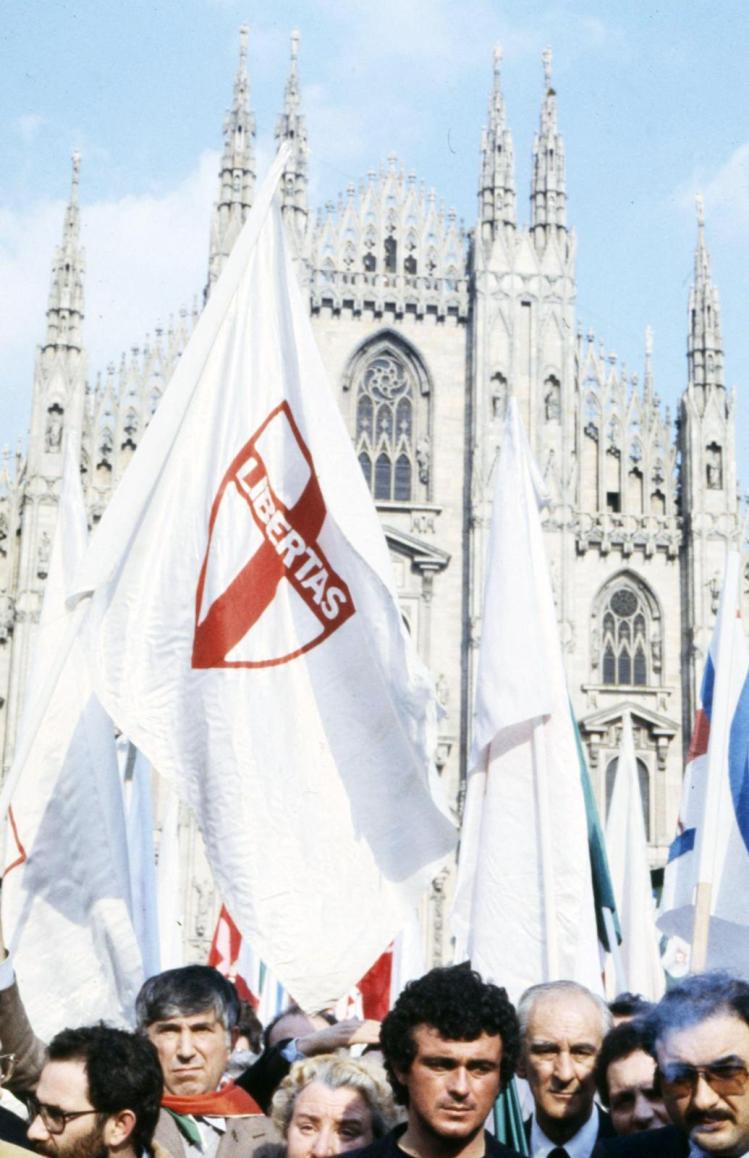
It was within this context that modern Christian democracy emerged, a movement that dominated postwar Europe for decades. In West Germany, the Christian Democratic Union was in power for thirty-six of the new state’s first fifty years. In Italy, the Christian Democrats were in power for forty-seven of the fifty years following the war. The same is true for Belgium and the Netherlands, where the Christian Democrats governed for forty-seven and forty-nine years respectively. In Austria, the Christian Democrats—the Austrian People’s Party—were in power through 1970, mostly in coalition with the Social Democrats. Likewise in the Netherlands, a “Roman-red” coalition was in government after the war. Only in France did Christian democracy fade away, eclipsed by Charles de Gaulle’s alternative right-wing patriotic movement.
Postwar Christian democracy was, as its name suggests, based on Christian values and principles. It was heavily influenced by Catholic social teaching but also willing to push beyond papal pronouncements—and to engage constructively with Protestants. Its foundation was a belief in the dignity of every person and in a common good that united all members of a political community. Christian democracy borrowed from Catholic social teaching an emphasis on cross-class collaboration. It affirmed the legitimacy of private property but also emphasized its social nature, thus adopting an intermediate position between liberal individualism and socialist collectivism—what Pope Pius XI had called the “twin rocks of shipwreck.” It developed what would become known in Germany as the “social market economy,” whereby market outcomes were balanced by concerns of justice, so that all citizens could participate in economic progress, attain security, and enjoy a decent standard of living.
The leading theorist of Christian democracy was the personalist Catholic philosopher Jacques Maritain. Maritain believed that democracy had its roots in the Christian conception of the human being—as a person made in the image of God and endowed with infinite dignity and inalienable rights. His personalism also emphasized the social nature of the human being, differing from the liberal individualism that had dominated economic thinking. Maritain argued that, since every person has a destiny she must fulfill in order to flourish, she has a right to the goods she needs to fulfill that destiny. Personalism gave rise to a particularly Catholic conception of human rights, which had a huge impact on the formulation of the Universal Declaration of Human Rights in 1948. In turn, the declaration would inspire a particularly Christian Democratic justification for the welfare state and worker power: to ensure freedom, security, and fulfillment for all. This conception of rights was also ahead of official Catholic social teaching. It was not until 1963—with Pope John XXIII’s encyclical Pacem in terris—that the Church first offered a robust framework of rights and duties.
We can see the role of personalism and Catholic social teaching in the postwar constitutions. The first article of the German constitution states: “Human dignity shall be inviolable. To respect and protect it shall be the duty of all state authority.” The second article says: “Every person shall have the right to free development of his personality.” The first article of the Italian constitution simply states that “Italy is a Democratic Republic founded on labor.” Its second article “acknowledges and guarantees the inviolable rights of man, both as an individual and within the social groups in which one’s personality is expressed.” Both constitutions recognize the social nature of property and permit expropriation in the service of the common good. Italian Christian democracy was also heavily influenced by the Code of Camaldoli, which was developed by a group of leading Catholic thinkers—including two future prime ministers, Aldo Moro and Giulio Andreotti—at a Benedictine monastery in 1943, while the war was still raging. The code affirmed an economy based on human dignity, equality, justice, solidarity, and the universal destination of goods.
As it developed after the war, Christian democracy took a firm stance against the laissez-faire market economy. The 1947 Ahlen Program of the German Christian Democratic Union declared: “The new structure of the German economy must start from the realization that the period of uncurtailed rule by private capitalism is over.” It called for a “socialist economic order” to “provide the German people with an economic and social framework that accords with the rights and dignity of the human person.” Two years later, the Düsseldorf Guidelines stated: “The capitalist economic system has not done justice to the vital interests of the German people.” In France, the Popular Republican Movement called in 1944 for a “revolution” to create an economy guided by a state “liberated from the power of those who possess wealth.” And in Italy, Alcide De Gasperi claimed a kinship between Jesus Christ and Karl Marx; both had a message of equality and universal brotherhood. Especially in the early years—before Cold War realities set in—Christian Democrats entered political alliances with Socialists and even Communists. This would have implications for how Christian Democrats would think about the economy—chiefly the welfare state, the need for worker power, and the socialization of the means of production. This went further than official Catholic social teaching at the time, which still ruled out even moderate forms of socialism.
Christian Democrats were pioneers of the welfare state in Europe, going faster and further than even the Scandinavian social democracies. This shouldn’t surprise us. After all, the first nascent welfare state was established in Germany in the late nineteenth century by the conservative Otto von Bismarck as a way of fending off socialism. By 1960—a date that marks the halfway point of the thirty golden years and the zenith of Christian democracy in Europe—the average ratio of public social spending to GDP was 14.3 percent across the Christian Democratic countries (Austria, Belgium, France, Germany, Italy, and the Netherlands) as opposed to 9.5 percent in the Nordic countries (Denmark, Finland, Norway, and Sweden) and 8.9 percent in the Anglo-American countries (Australia, Canada, Ireland, New Zealand, the United Kingdom, and the United States). Even today, social spending is higher in France, Germany, and Italy than in Denmark, Norway, and Sweden. This reflects the forgotten legacy of Christian democracy in those countries.
The Christian Democratic welfare state was predicated on the twin pillars of solidarity and subsidiarity, both concepts drawn from Catholic social teaching. Solidarity required that all citizens be protected from social risks and share in rising prosperity. Subsidiarity meant aiding the family as a vital social institution by providing financial resources to deal with unemployment, disability, poverty, or old age. The Christian Democratic welfare state relied more on cash benefits than on benefits in kind or active labor-market policies. This would distinguish it from the Scandinavian social democracies. It also relied more on social contributions—specific charges leveled on employers and workers—than on general taxation, meaning that benefits typically mirrored the status differentials generated by the market. Overall, the goal of the Christian Democrat welfare state was not to interfere with the market, but rather to support those who fall through the cracks of the economy through no fault of their own.
Christian democracy also tended to support strong and independent unions, allowing them to bargain collectively at either the sectoral or national level. As Ahmari explains, this has deep roots in Catholic social teaching, dating back to Rerum novarum in 1891. Because of this support, collective-bargaining coverage—defined as the share of workers whose wages and working conditions are determined by collective-bargaining agreements—tends to be high in Christian Democratic countries, typically on par with the social democracies. By the 1970s, collective-bargaining coverage had reached 85 percent in Germany (the same as in Sweden), 70 percent in France, and 100 percent in Italy. The state played a more limited role in Germany, where unions and employers’ associations tended to act independently. It played a stronger role in France, where collective-bargaining agreements were often extended by government decree, and in Italy, where extensions came through the labor courts.
Christian democracy also emphasized codetermination—the sharing of workers in the management of enterprises, both on corporate boards and in enterprise-level works councils. This is especially pronounced in Germany, where firms with more than two thousand employees are obliged to allocate 50 percent of board seats to workers, and firms with between fifty and two thousand employees must allocate a third. Germany also has enterprise-level works councils, which grant workers a voice on issues like hours and working conditions. Codetermination arrived earlier and still reaches farther in Germany than in countries like Sweden. It can be seen as another reflection of subsidiarity—in this case, empowering workers and affirming their agency and decision-making authority in the workplace. Reflecting its emphasis on cross-class harmony, Catholic social teaching has long stressed the importance of workers having a share in the ownership and management of companies.
Postwar Christian Democrats also adopted the quintessential mixed economy, with a vibrant private sector balanced against state ownership of vital industries. Again, this differs from the Nordic social democracies, which relied less on state-owned enterprises. After the war, France nationalized about a fifth of the country’s industrial output—including air transport, banks, insurance companies, utilities, mines, munitions industries, and aircraft and car manufacturing. The Italian state also ended up controlling between 20 and 30 percent of industry, especially through a large holding company called the Istituto per la Ricostruzione Industriale. This company enjoyed preferential access to credit and had control over firms in iron, steel, gas production, shipbuilding, transportation, broadcasting, telephones, and banking. Germany’s economy remained more market-oriented, relying on codetermination rather than state control to “socialize” the means of production. According to data from Thomas Piketty, the share of public capital in total capital was between 20 and 30 percent among the advanced economies in the 1970s.
In addition to public ownership, France also resorted to economic planning to support, promote, and direct key economic sectors. Immediately after the war, it set up the General Planning Commission led by the technocrat Jean Monnet. The plan targeted coal, steel, electricity, cement, agricultural machinery, and transport for expansion. The planning process involved close collaboration between government, business, and unions. This planning was only “indicative”—it set targets for each sector but did not impose the kind of production quotas associated with Communist central planning. But the French government was able to channel resources to the sectors that, in its view, needed them most. In particular, the government used its control of the banking industry to direct credit to favored industries.
European integration was also a quintessential Christian Democratic project. Indeed, Konrad Adenauer of Germany, Robert Schuman of France, and Alcide De Gasperi of Italy are often regarded as the founding fathers of the European Union. The 1957 Treaty of Rome—which founded the European Economic Community, the forerunner to the European Union—was signed by six Christian Democratic leaders. Once again, this reflects the principle of subsidiarity, which works upward as well as downward, because many problems cannot be adequately addressed at the level of the nation state. It also reflects Christian universalism, the notion that all human beings are connected to one another in a spirit of fraternity. This is why the Catholic Church has always supported the United Nations and multilateral institutions, and it’s why Jacques Maritain believed in some form of world government to promote peace and global cooperation. Robert Schuman always believed that European integration would be a precursor to greater global integration.
In these different ways—a robust welfare state, strong unions, multilateralism, codetermination in Germany, economic planning in France, and state control in Italy—postwar Christian Democrats grappled with how best to achieve the common good in a liberal democracy. This experiment was deeply rooted in Catholic social teaching but was also willing to move beyond it. Indeed, just as Soviet Communism was once referred to as “really existing socialism,” it makes sense to call postwar Christian democracy “really existing Catholic social teaching.”
Yet the heyday of Christian democracy eventually came to an end. It was eclipsed in France by the Gaullist right. In Italy, it collapsed in a major corruption scandal in the early 1990s. And in Germany and other countries, it morphed into a center-right neoliberal party with a weakened attachment to the social market economy. Neoliberalism rolled back many of the institutions of both Christian democracy and social democracy, ending the thirty golden years. After 1980, growth slowed, inequality rose, unemployment shot up, and the economy became more unstable. These trends culminated in the global financial crisis, which hit Europe hard and precipitated the rise of the nationalist far right. This was very similar to how the Great Depression had affected politics in interwar Europe—as early Christian Democrats remembered all too well.
Political dysfunction went even further in the United States, which never really had a Christian Democratic movement, even though the New Deal mirrored some aspects of it—with a modest welfare state, modest union power, and modest checks on corporate power. But because the roots of the postwar order were shallower in the United States, neoliberalism did more damage there. It hit working-class men especially hard as their real wages fell in the decades after 1980 and they became increasingly detached from the labor force. With fewer good manufacturing jobs and no unions to protect them, their only option was often precarious low-wage service-sector work that offered little autonomy and even less dignity. In too many cases, this led to what Anne Case and Angus Deaton dubbed “deaths of despair”: working-class men began to die in large numbers from suicides, drug overdoses, and alcohol poisonings. Adding insult to injury, the global financial crisis saw millions of working-class Americans lose their jobs and homes while the financiers that caused it were bailed out on the most lenient terms.
All this lies behind the rise of Donald Trump. Trump fed off the anger of those who felt left behind by the economy, but his policies have done nothing for the working class; on the contrary, they have doubled down on neoliberalism. He is, in the words of the Financial Times columnist Martin Wolf, a “pluto-populist.” In both his first and second terms, his signature policy has been a massive tax cut for corporations and the wealthy, coupled with massive cuts to the social safety net, including health care for the poor. He has also deregulated aggressively, to the benefit of fossil-fuel companies and the shadier corners of finance. His erratic tariffs, meanwhile, have ended up hurting, not helping, manufacturing.
Worst of all, Trump has launched a full-scale assault on liberal democracy. After he lost the 2020 election by seven million votes, he attempted a putsch to stay in power, which culminated in a violent and bloody assault on the Capitol. And in his second term, he has pardoned the insurrectionists, weaponized the judicial system against his political opponents, cracked down on independent media, and deployed a federal paramilitary force to terrorize communities that did not vote for him, which has resulted in the murder of citizens in the streets—with the promise of full immunity for the ICE agents responsible.
This is an eerie echo of the 1930s, a period in which too many Catholics failed to meet the moral demands of the moment, either through complicity or silence. And today, Trump’s biggest enabler is his Catholic vice president, J. D. Vance. Identifying himself as a postliberal, Vance is scornful of the values of liberal democracy. He is an acolyte of technology oligarch Peter Thiel, who opposes democracy on the grounds that it interferes with property rights. Vance has defended Trump’s putsch, embraced blood-and-soil nationalism, attacked the European Union, vilified vulnerable immigrants, insisted on a right to tell lies for political purposes, called for civil servants to be fired en masse and replaced with regime loyalists, endorsed a book calling his political opponents “unhumans,” excused white-nationalist and even Nazi rhetoric, and attacked those murdered by federal agents as domestic terrorists responsible for their own deaths. This is all diametrically opposed to the values that animated postwar Christian democracy—values such as human dignity, social solidarity, and multilateralism. Vance is a throwback to the past, embodying everything repudiated by that defining generation of lay Catholics.
I don’t mean to suggest that the United States in 2026 is just like fascist Italy or Nazi Germany. It isn’t—at least not yet. But it does look a lot like France in the 1930s. Then as now, there was enormous polarization between the right and left in the context of large-scale economic instability—a polarization that frequently erupted in street violence. In 1934, far-right paramilitaries attempted a coup by storming parliament. That was followed two years later by Léon Blum’s left-wing government, which was soon felled by economic challenges and strident attacks from the right. All of this ended in the collaborationist Vichy regime with the active complicity of many Catholic leaders. Léon Blum himself ended up in a concentration camp.
We face a perilous moment. If Christian democracy can be referred to as “really existing Catholic social teaching,” then the Trump regime might be legitimately dubbed “really existing postliberalism.” It marks the kind of “regime change” demanded by postliberal political theorist Patrick Deneen. Just as in the 1940s, Catholics committed to Catholic social teaching—to solidarity and subsidiarity, but also to truth, justice, and decency—need to oppose this by reasserting control over their own tradition. They need to refound Christian democracy, updating it to reflect the political and economic challenges that face us today. But with some notable exceptions, most American Church leaders have not met the moment with the moral clarity it demands. Just as in the 1940s, this task will likely fall to lay people. It is worth remembering that the Christian Democratic parties were born out of catastrophe. It might need to get darker yet before the dawn breaks.