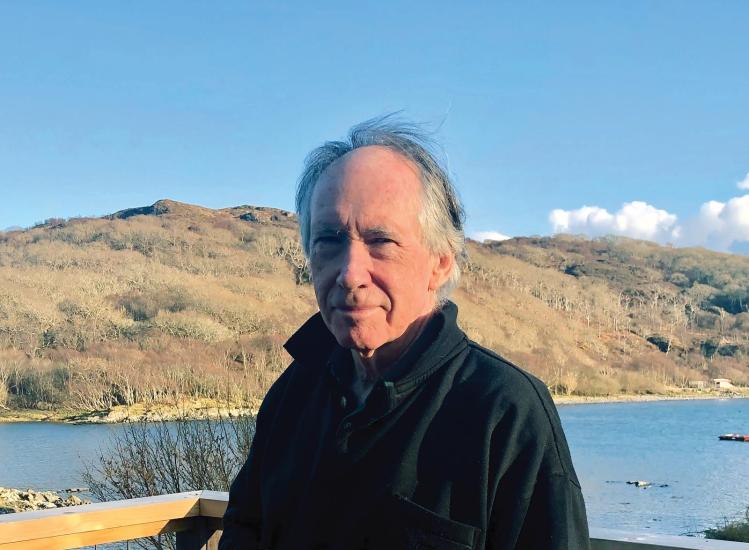
In offering some commentary on a novelist as highly regarded as the prolific Ian McEwan, it may be useful to note the example of a writer of comparable achievement, John Updike, who died at seventy-seven, McEwan’s present age. The two novelists admired each other’s work (McEwan visited Updike not long before he died) and testified in letters to that admiration. One of the words Updike used about McEwan’s work—“duplicitous”—was provoked especially by McEwan’s 2001 novel, Atonement. “Duplicitous” could signal mistrust and disdain instead of admiration, but it was clear that Updike had been impressed by the English writer. Updike died before the publication of Lessons, McEwan’s 2022 novel. There was enough duplicity in that long book (512 pages) to keep any reader busy with its back-and-forth account of the protagonist’s life into middle age and beyond. Because the account alternates with reportorial pages about British life and politics in the late twentieth century, the narrative of Lessons is seldom smooth, but no one could deny the energy and wit animating the book’s most memorable sections.
The mainly realistic narrative of Lessons had followed hard upon two very different and inferior books, neither of them qualifying as realistic: the brief Cockroach, a not very amusing exercise in the Kafka-Metamorphic mode, and Machines Like Me, a labored account of AI-driven high jinks. I was eager to see what McEwan had in store after Lessons but was frustrated by his American publisher’s inability to get the new book into my hands while the early reviews piled up—including one by Dwight Garner, a critic to be trusted. The headline of Garner’s review in the New York Times announced that What We Can Know was the best book written by McEwan in ages. It was “a piece of late-career showmanship…from an old master” whose “melodramatic, storm-tossed stuff” included “murder…revenge plots, buried treasure, literary arson” and more. Garner was aware this might come off as over-enthusiastic (“this can sound like a bit much, and perhaps it is”), but he assured us that the new book’s ambitions were large, nothing less than “the nature of history” and that it most resembled McEwan’s “stately 2001 classic, Atonement.”
My own admiration for Atonement is strong; it holds up after more than one rereading. What makes the novel so good has less to do with the tricky game McEwan plays by revealing, near the end of the book, that the main character, Briony, is in fact the book’s author than with more old-fashioned, familiar matters of character, dialogue, and action. It is these “realist” standbys that animate the later parts of the novel: the agonizing retreat of the British to Dunkirk in World War II and its aftermath in a South London hospital where Briony is employed. That so much critical attention has been given to the novel’s surprising narrative disclosures at the expense of its realistic solidity is in keeping with McEwan’s general reputation for cunning. A similar thing has happened with the reception of my favorite McEwan novel, Saturday. Some critics have objected to the climactic scene in Saturday, in which a brain surgeon’s daughter deters a thug from terrorizing her family by charming him with a recitation of Matthew Arnold’s poem “Dover Beach.” Yet the care and precision with which the novel follows the surgeon’s varied activities over the course of one day grip the reader (this one anyway) and make the resolution, however improbable, compelling and satisfying.
That brings us to 2025’s What We Can Know. The overwhelming narrative complexity of what Garner calls “a piece of late-career showmanship” has distracted most reviewers from the task of making any judgment about the book’s overall success or failure. I say this on the basis of six reviews, all of them plausible and intelligent but mostly concerned with mapping out the novel’s various intricacies so that readers can make sense of its resolution.
The voice in the novel that gives us most help is that of Tom Metcalfe, a humanities professor at the University of the South Downs who speaks to us from 2119 after a momentous climate upheaval. Metcalfe has devoted his career to exploring exactly what happened on a memorable evening in 2014 when a group of friends gathered to hear the distinguished English poet Francis Blundy read an extremely ambitious, difficult poem composed for the celebration of his wife Vivien’s birthday. The varied responses of the twelve guests are explored in a scene that is a highlight of the novel. Tom, having access to Vivien’s journal along with the century’s overload of information, is able to fill out the evening’s events. But the poem itself has mysteriously disappeared. Tom becomes “the biographer of the reputation of an unread poem,” his research carrying him to places like Snowdonia, where Oxford’s Bodleian Library has been moved to protect it from climate change. Tom frequently interrupts his travel narrative to speculate on the dire situation of the humanities, about which he’s emphatic: “Let me repeat. Most of our history and literature students care nothing for the past and are indifferent to the accretions of poetry and fiction that are our beautiful inheritance.” Tom’s inner musings are sympathetically rendered, and readers share his excitement, then disappointment, when he finds a box that may contain Blundy’s lost poem.
Abruptly, Part Two of the novel begins with a new narrator—Blundy’s widow, Vivien, who remains in charge throughout the book’s final third. At its conclusion we learn that Vivien’s journals were published in 2125, edited with notes by Thomas Metcalfe. So far, we are still within the novel’s orbit. But a turn of the page brings the following Author’s Note: “Interested reader, please note that nothing related to this novel is buried anywhere.” As an interested reader, I smiled at McEwan’s snappy nondisclosure. A typical piece of showmanship.
So what can we know about What We Can Know, and what can we only guess at? This is always a question with McEwan’s novels. Compared with Tom Metcalfe’s often interrupted narrative in Part One, Vivien’s journal in the book’s second part reads like a continuous, expertly told tale, with very little to impede the reader or arouse his distrust—we seem to be in good hands. But the hands that preside over the novel are not so easy to trust. There are characteristic hints of misdirection and, yes, duplicity. Having finished the book, the reader is tempted to read it again right away, in hopes of laying hands on something that eluded her the first time through.
My own experience of the novel’s satisfactions had a lot to do with the way Tom Metcalfe reveals himself to possess tastes and prejudices I warmed to, such as his admiration for a jazz band that performs Jelly Roll Morton numbers, in particular “Dr. Jazz,” or a five-string banjo player who played “in the languid but precise style of Johnny St. Cyr [an early sidekick of Louis Armstrong].” Some expressions of disdain seemed too much for the character they belonged to but delighted me nevertheless—as when one of Vivien’s journal entries refers to “that too famous poem ‘The Red Wheelbarrow’” or to obituaries that make much of the “worn trope ‘not suffering fools gladly.’” Nor was I at all bothered when I detected, behind such sentiments, Ian McEwan peering through the mask.
When I reviewed McEwan’s last novel, I wrote that I was uncertain whether I had “a masterpiece or a misfire” on my hands. But that now seems the wrong question to ask about the products of this wily, intensely gifted writer. In her excellent review for The New Yorker, Katy Waldman concludes that McEwan casts “his elegy and protest as a novel of adultery.” The novel’s characters, she writes, “are betrayers because they can’t celebrate the sublimity of what they’ve lost without devaluing what they still have, nor honor the current moment without diminishing the scale of their loss.” According to Waldman, the novel reminds us that “[w]hat we can know is far more than what we do.” But that sententious conclusion seems too tidy for a writer like McEwan. Page by page, I found this novel as engrossing as anything he has written, yet I would hesitate to propose any distillation of its theme. Robert Frost once wrote that “all the fun” of writing was in suggesting formulae “that almost but don’t quite formulate.” That’s a good description of McEwan’s best novels, including this one. Duplicitous indeed.
What We Can Know
A Novel
Ian McEwan
Knopf
$30 | 320 pp.