On Wednesday, New York governor Kathy Hochul announced her intention to sign a bill legalizing physician-assisted suicide (also known as Medical Aid in Dying, or MAiD) for those with terminal diagnoses. “I do not believe that in every instance condemning someone to excruciating pain and suffering preserves the dignity and sanctity of life,” she wrote in an essay published in Albany’s Times-Union, calling the decision “a difficult one for me personally.”
Hochul’s decision is lamentable for many reasons, but it is especially disappointing to see her frame the question as one of pain management. While modern medicine cannot always alleviate emotional and spiritual suffering, we live in a time where scientific advances can address almost every form of physical pain. As Dr. Lydia S. Dugdale of the Columbia University Department of Medicine put it: “There is almost no pain that our current regimen of palliative care medicines cannot treat.” These words come from her testimony before the UK Parliament, during a hearing concerning a similar assisted-suicide law. She continued:
Are there extreme cases where pain is absolutely refractory? Yes. In those very rare cases—I underscore that they are very rare—deep sedation is a possibility.… If the pain is so extreme that patients cannot get relief and be conscious, it is not unethical to sedate to the point of unconsciousness.
Instead of offering to end the lives of those facing painful deaths, we should work toward better and more equitable palliative care. New York in particular has low hospice utilization, ranking fiftieth in the nation. It is also one of the most expensive states in which to grow old and die: it ranks among the most expensive states for assisted living and funerals. It is also one of the most expensive places for palliative care, which is only covered by Medicare if it’s part of hospice care and the doctor gives a six-month prognosis. As recently in 2019, the Hospice and Palliative Care Association of New York State testified before the state legislature, saying: “New York State has done very little over the years to promote and advance end-of-life care for its citizens.”
Doctor-assisted suicide would be wrong even in a world of material abundance, equality, and free health care. But to offer it as an option under these conditions—and while Medicaid is under attack by the Trump administration—is unconscionable. In any case, pain management is not even among the top five reasons given by those requesting MAiD in other states where it’s been legalized. In Oregon, the top reasons are “worries about future physical discomfort and losses of autonomy and function.”
This brings us to Hochul’s appeal to human dignity. We live in a culture that prioritizes autonomy and stigmatizes dependence, one that confuses ability and independence with dignity. The paraplegic who needs assistance with basic bodily functions has no less dignity than the triathlete. If the state sanctions assisted suicide for those requesting it because of loss of autonomy, what message does that send to the disabled? There’s a reason many disability-rights advocacy groups fear MAiD—and the example of Canada, where the legalization of MAiD has resulted in denying disability assistance and offering assisted suicide to vulnerable people, bears out their fears.
Hochul acknowledges those fears in her essay. She calls for “guardrails” to protect the populations made “vulnerable” by the new law, such as “those with disabilities and the elderly.” Those guardrails will include: “a mandatory five-day waiting period to provide the patient the chance to change their mind, and both a written and recorded oral request to confirm free will is present, with anyone who may benefit financially disqualified from being a witness or interpreter.” But these provisions do little to address the concerns of the disabled.
Supporters of the bill claim it’s a matter of patient choice. But the choice to end one’s life when one is in extreme—but treatable—pain, depressed, and poor is not really an exercise of freedom. Vulnerable people will feel tempted to end their lives prematurely. Moreover, health-insurance companies will suddenly have a perverse incentive to cut costs by promoting assisted suicide as an option.
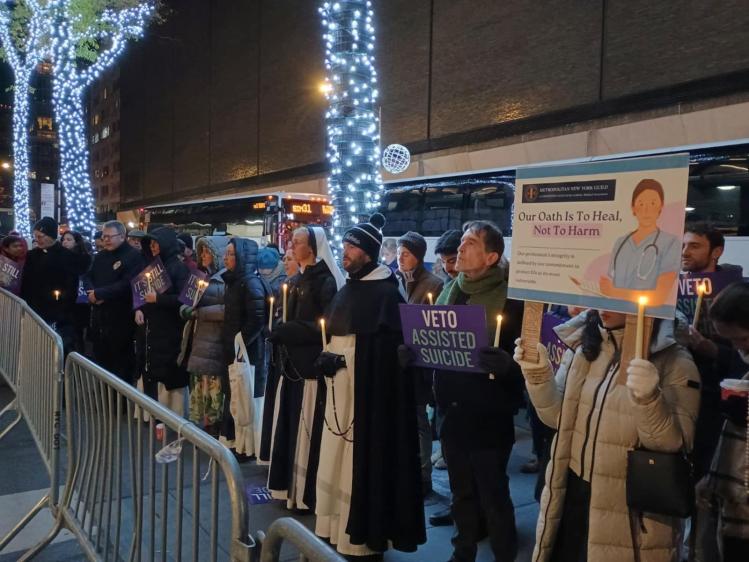
Hochul says she ultimately decided to sign the bill because “government must respect the rights and will of the people it serves.” It’s true that nearly 75 percent of New Yorkers approve of MAiD. According to one poll, even 65 percent of New York Catholics support it despite the Church’s longstanding opposition to suicide in any form. So it’s important to look at who opposes assisted suicide: most disability-rights organizations in the state rallied against the bill; Black and Hispanic populations reject assisted suicide by wide margins; the Chair of the New York State Black, Puerto Rican, Hispanic, and Asian Legislative Caucus opposed the bill on the grounds of racial disparities; Protestant, Muslim, Jewish, and Catholic leaders reject it. The American Medical Association affirmed this year that physician-assisted suicide is incompatible with the doctor’s role.
While it’s understandable that Governor Hochul would be anxious about polling as she heads toward a primary next year, it’s imperative that she weighs more heavily the voices of those on the margins and of those who care for them.
In 2012, the citizens of Massachusetts voted on whether to legalize physician-assisted suicide. The referendum failed, in large part because Victoria Reggie Kennedy, the widow of the late Senator Ted Kennedy, opposed the bill. Why did she oppose it? At the time, she wrote:
When my husband [Ted Kennedy] was first diagnosed with cancer, he was told that he had only two to four months to live, that he’d never go back to the U.S. Senate, that he should get his affairs in order, kiss his wife, love his family and get ready to die.
But that prognosis was wrong. Teddy lived 15 more productive months…. Because that first dire prediction of life expectancy was wrong, I have 15 months of cherished memories—memories of family dinners and songfests with our children and grandchildren; memories of laughter and, yes, tears; memories of life that neither I nor my husband would have traded for anything in the world.
Governor Hochul says the MAiD law is designed precisely to allow this kind of death: to
afford terminally ill New Yorkers the right to spend their final days not under sterile hospital lights but with sunlight streaming through their bedroom window. The right to spend their final days not hearing the droning hum of hospital machines but instead the laughter of their grandkids echoing in the next room. The right to tell their family they love them and be able to hear those precious words in return.
But none of this requires assisted suicide. Victoria Kennedy’s testimony shows that a peaceful and natural death at home is possible: “When the end finally did come—natural death with dignity—my husband was home, attended by his doctor, surrounded by family and our priest.”
The season of life that Victoria Kennedy just described can be difficult to contemplate. But we are all going to go through it in one way or another. We are all mortal creatures, with only a short amount of time on earth. Old age, for the people lucky enough to reach it, can be a gentle unweaving—a period of truth, grace, and reconciliation.
What the New York bill would do is create an environment where many people would feel like these last few months of truth, grace, and reconciliation are a luxury and an indulgence, or, even worse, an unbearable burden for their loved ones. Most people do not have the financial resources that someone like Ted Kennedy did. Do we want to contribute to the pressures on the poor and middle class by adding to it the notion that they should consider assisted suicide? Do we want to create a perverse cost-cutting incentive for public and private insurance programs? Or do we want a society where medicine is still oriented toward life, not death, and where the weakest and most vulnerable are cared for with compassion? Do we want to care for people at the end of life, however long that takes, or rush them to their end?
The last two popes have provided guidance on this question. Pope Francis said that “authentic palliative care is radically different from euthanasia, which is never a source of hope or genuine concern for the sick and dying.” More recently, Pope Leo declared: “Our world struggles to find value in human life, even in its last hour: may the Spirit of the Lord enlighten our minds, so that we know how to defend the intrinsic dignity of every human person.” Governor Hochul has described herself a “social-justice Catholic.” Social justice demands that she veto this bill. It’s not too late to do so.