Writer and actor Pamela Adlon’s comedy series Better Things is one of the most accurate depictions of Gen X midlife I’ve ever seen. In one episode, the fifty-something main character’s daughters keep dismissively referring to her as a Boomer, to which she replies, “For the last time, I’m Gen X! We’re the best generation because we were the last ones to use paper!”
This line stayed in my head throughout this year’s reading, which was usually done on my e-reader or through audiobooks. This is mostly an issue of convenience and adaptability, as issues with my eyes have made it harder to read for long periods of time. But the irony is not lost that this year I also read several books about the decline of print media, monoculture, and other things my generation will apparently be the last to have experienced. I did not expect being Gen X to ever feel so culturally irrelevant, but that is the fate of every generation.
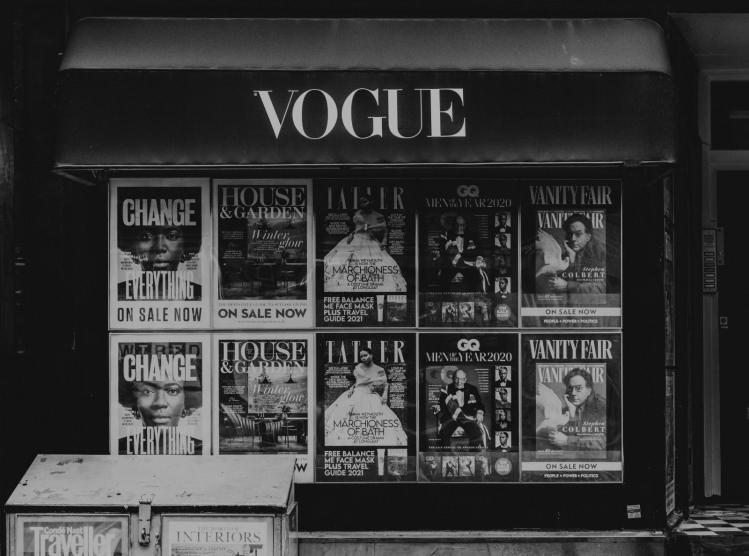
A guilty reading pleasure throughout grad school was heading to the newsstand and using my paltry teaching-assistant pay to buy a copy of Vanity Fair every month. My own journalism career began in the world of zines and alt weeklies, those relics of the 1980s and ’90s, when snarky culture critics could help us understand why the characters in Jim Jarmusch films always mumbled, or scrappy reporters could launch deep-dive investigations into local utility companies. With the slow decline of local media, this kind of reporting and culture writing is now nearly extinct, or it has mutated into endlessly forking streams of Substack newsletters, vlogs, and podcasts.
But like many people who grew up in a low-income family, I have always had a secret interest in the lives of the rich, and would often snoop through friends’ parents’ closets to feel what silk and leather were like as opposed to the sticky polyester of my school uniforms and the dank finds my mother brought home from thrift shops. There is a reason that the “poor kid gets obsessed with rich people” plot gets recycled over and over again in everything from Great Expectations to Saltburn. Gen Xers remember a television show titled Lifestyles of the Rich and Famous, an hour of real-estate and vacation porn with a voiceover of a bellicose British man named Robin Leach shouting about glamour. Glossy magazines were an affordable way to keep up with the lives of the bourgeoisie before social media exposed those lives as not much more than a shallow consumerist bacchanal.
Perhaps we are in a moment of nostalgia for this era, because 2025 saw the publication of two books about the Condé Nast empire that fueled the rise of those glossy magazines. Graydon Carter is probably one of the last celebrity editors, someone people might recognize on the street, and his memoir When the Going Was Good: An Editor’s Adventures During the Last Golden Age of Magazines (Penguin Press, $32, 432 pp.) is just as dishy as the columns he wrote for each issue of Vanity Fair.
Carter, who grew up in Canada, talked his way into a job at Time and later ascended the ranks of various now-defunct publications before landing at Condé Nast, where Vanity Fair was being relaunched as a combination of celebrity gossip and profiles alongside serious investigative journalism. Vanity Fair had celebrity journalists like Dominick Dunne and Tom Wolfe and celebrity photographers like Annie Leibovitz, and it was obsessed with the concept of celebrity itself, turning reporting on everything from crime to politics into a study of the worship of fame.
But Carter is not a shallow narrator, nor was Vanity Fair necessarily a shallow read. His memoir reveals a strategic eye for literary talent along with an ability to know when to cut ties, as he did in 2017 after twenty-five years at the helm of the magazine. In Spy magazine, which Carter also edited, he often referred to Donald Trump as a “short-fingered vulgarian,” an insult the president still has not recovered from. Carter brings the same sharp wit to his memoir. After a few hundred pages, however, the conspicuous consumption and tales of journalists with bottomless spending accounts began to wear on my nerves. There is only so much voyeurism a person can take, especially in this age of austerity.
Or so I thought, because I also read Michael M. Grynbaum’s Empire of the Elite: Inside Condé Nast, the Media Dynasty That Reshaped America (Simon & Schuster, $29.99, 368 pp.), the story of the rise and fall of the Condé Nast empire. The deep pockets of Condé Nast belonged to S. I. Newhouse Jr., the wealthy scion of Advance Publications, a media company that’s more than one hundred years old. In the 1980s and ’90s, Vanity Fair, Vogue, and The New Yorker had big budgets to match their big-egoed editors, including Carter, Anna Wintour, and Tina Brown.
There is a kind of darkly hilarious subthread in Empire of the Elite that might be called “A Tale of Two Offices.” Much like humanities departments in academia, The New Yorker was housed in a tiny, cramped office filled with tweedy and bearded ancient eccentrics who wrote one article every ten years but were somehow still in salaried positions. Like university business departments funded by wealthy donors, Vanity Fair and Vogue were located in the chrome-and-glass highrises of midtown Manhattan, with high-heeled assistants racing up and down the elevators handing nonfat lattes to the bobbed-and-sunglassed Wintour or the husky-voiced Brown.
Vogue turned into a behemoth of excess, a true gilded calf. One issue was nine hundred pages long. Mail carriers must have despaired. Photo shoots involved international travel and dozens of staff, and sometimes the entire shoot, costing hundreds of thousands of dollars, would simply be scrapped at the whim of the editor. Wintour, known for being cold and unmerciful, picked up the nickname “Nuclear Wintour,” which stuck for decades. She was a tastemaker, but her taste came at the cost of her staff’s quality of life. Brown, who absconded from The New Yorker when she was offered a job heading a new media venture by none other than disgraced film producer and accused serial rapist Harvey Weinstein, seems to have mostly been a master of her own hype and spin rather than an editor with any unique eye for talent.
Of course, the entire print media ecosystem started to crumble with the arrival of the internet. Vanity Fair today is a slim remnant of its former self. Vogue recently appointed a new editor who said that the magazine will do fewer print issues and more online content. Graydon Carter edits a Substack newsletter. These days, to survive as a journalist, even at the most elite publications, you have to have a side hustle. Even The New Yorker staff writer Jia Tolentino recently dipped into the world of sponsored content, participating in an ad campaign for Airbnb, and investigative journalist Patrick Radden Keefe appeared in a J.Crew ad wearing a rumpled trench coat like an actor playing a reporter in All the President’s Men.
The nineties-journalism nostalgia streak that ran through my reading this year also veered into an Audible Original audiobook. Hold Fast, by Trevor Aaronson, Sam Eifling, and Michael Mooney, is an accounting of scandals involved in the alt-media empire New Times. In parallel to the Condé Nast culture of money and excess, alt weeklies were meant to be real news for real people. But in the 1990s and early 2000s, the New Times corporation gobbled up storied free weekly papers like the The Village Voice, LA Weekly, and Miami New Times and funded them with pages and pages of advertising. Most of this advertising was for “adult” content, and when the internet decimated these periodicals, the New Times owners founded the website Backpage, which the Justice Department eventually investigated as a hive of sex trafficking.
Underground newspapers and alt weeklies were founded in the late 1960s as a response to the massive cultural shifts happening around the world, and to the mainstream media’s seeming inability to cover those shifts with any kind of accuracy. In many ways, they were a counterpoint to Condé Nast’s vision of the world as a playground for celebrities. The Village Voice had a staff of writers that ran from culture critics Greg Tate and Robert Christgau to film critic Andrew Sarris, who coined the idea of auteur theory, to the great comics artist Lynda Barry. Ta-Nehisi Coates was a stringer for the Voice early in his career.
Bay Area alt weeklies like The Guardian and the East Bay Express combined culture writing with service journalism, a venn diagram exactly where I hoped to land as an ambitious young writer. By the time I had the chops to write for these publications, however, they were mostly what Hold Fast depicts: a sea of porn and sex ads occasionally interrupted by club listings. I pivoted to academia with freelance journalism on the side; my friends who used to make a living in journalism now mostly work for ad agencies, nonprofits, and schools. One former newspaper editor who I hold dear delivers the mail. His back hurts, but the benefits are good.
The dream of a writing career as either a high-flying, highly paid Condé Nast staffer or an alt-weekly stalwart in corduroy trousers with worn knees was gone before I and many other Gen Xers could come close enough to touch it. Now, it’s just vapor and nostalgia, fodder for books and podcasts, the ghost of media past. Of course you can still subscribe to magazines, including this one, and you should. There are still many newspapers and magazines out there doing meaty, meaningful, quality work, necessary work in these days of bespoke newsletter oversaturation, corporate conglomeration, and AI slop. But it’s not glamorous work, and it never really was. If anything, these books just remind us that the age of gilded journalism was mostly smoke and mirrors, a magic show with no one behind the curtain.